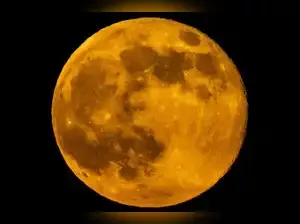
Skywatchers will have one last opportunity this year to witness a supermoon, with the final celestial event scheduled for December 4. A supermoon occurs when the Moon reaches its closest point to Earth in its elliptical orbit, appearing larger and brighter than usual. This rare alignment enhances the Moon’s luminosity and visual scale, offering an impressive sight for both casual observers and astronomy enthusiasts. With clear weather conditions forecast in several regions, the December 4 supermoon is expected to draw significant public interest. The phenomenon also offers scientists an opportunity to examine subtle atmospheric interactions influenced by lunar proximity.
A Celestial Event Marking the End of the Lunar Year
The final supermoon of the year is set to arrive on December 4, offering a visually striking display as the Moon reaches perigee—the point where it is closest to Earth. During this phase, the lunar disc can appear up to 14% larger and nearly 30% brighter than its typical full-moon appearance.
Astronomers emphasize that while the phenomenon is predictable, each supermoon carries unique observational qualities based on seasonal atmospheric conditions, local visibility, and the Moon’s position in the sky.
Why Supermoons Captivate Audiences Worldwide
Supermoons remain popular among stargazers due to their dramatic visual impact. The phenomenon enhances the natural brightness of the night sky, creating an almost luminous backdrop over oceans, landscapes, and urban skylines.
For photographers, the December 4 event presents an excellent opportunity to capture high-contrast lunar images, as the Moon’s closeness enhances surface detail, particularly across the mare regions and crater basins.
Scientific Significance Beyond Aesthetic Appeal
Beyond their visual charm, supermoons offer scientific value. When the Moon is closer to Earth, researchers observe modest fluctuations in ocean tides, often leading to slightly higher high tides known as “perigean spring tides.”
Although these variations are usually minimal and pose no risk, they remain of interest to oceanographers and climate scientists studying long-term patterns associated with Earth–Moon gravitational interactions.
Best Viewing Conditions and What to Expect
Experts recommend observing the supermoon shortly after moonrise, when it appears near the horizon. This angle often creates an optical illusion that makes the Moon appear even larger than usual, an effect known as the “moon illusion.”
Clear skies will be essential. With winter conditions settling in across many regions, visibility may vary, but areas with minimal cloud cover will be able to enjoy a vivid lunar display.
Public Enthusiasm and Cultural Resonance
Full moons often hold cultural symbolism across various traditions, representing renewal, introspection, or seasonal transition. The final supermoon of the year adds a layer of closure to 2024’s celestial calendar, providing a moment of shared global experience.
As interest in astronomy continues to rise—bolstered by social media, citizen-science projects, and accessible astrophotography—the December 4 supermoon is likely to generate widespread engagement.
A Bright Farewell to the Astronomical Year
With this event, the lunar cycle concludes its list of supermoons for the year, delivering a final spectacle of brightness and scale. For seasoned observers and first-time skywatchers alike, the December 4 supermoon stands as a reminder of the enduring fascination humans hold for the cosmos and the natural rhythms that shape our planet.
Comments