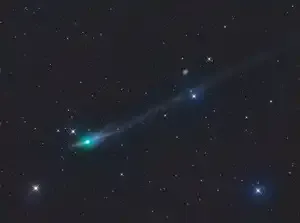
Astronomers are closely studying the interstellar comet 3I/ATLAS, a rare celestial visitor from beyond our solar system. Observations of its trajectory, composition, and behavior offer unprecedented insights into the formation of distant star systems. The comet’s high velocity and unique chemical signature distinguish it from native solar system objects, providing clues about the diversity of planetary systems across the galaxy. Researchers believe that analyzing 3I/ATLAS could enhance our understanding of cosmic evolution, the prevalence of organic compounds in space, and the processes shaping planetary formation. Its study underscores the growing intersection of astronomy, astrophysics, and advanced observational technology.
A Rare Interstellar Visitor
3I/ATLAS, first detected in late 2019, has captured the attention of the global astronomical community due to its hyperbolic orbit and interstellar origin. Unlike comets bound by the Sun’s gravity, this object entered our solar system at extraordinary speed, making its passage brief but scientifically invaluable. Observatories worldwide have mobilized to track its trajectory and collect spectroscopic data, aiming to understand its chemical composition and surface properties.
Chemical and Physical Insights
Preliminary analyses suggest that 3I/ATLAS contains volatile compounds and dust grains not commonly found in solar system comets. Its chemical signature provides clues about the conditions in the star system from which it originated, potentially informing theories of planetary formation and the distribution of organic materials in the galaxy. Scientists are particularly interested in the presence of carbon-based molecules, which may shed light on the cosmic origins of prebiotic chemistry.
Technological and Observational Advances
The study of 3I/ATLAS leverages cutting-edge telescope arrays, spectrometers, and space-based observatories. Rapid data collection and analysis have been essential due to the comet’s high velocity and short observational window. Advanced computational models are being used to simulate its trajectory and predict interactions with solar radiation and gravitational forces. This research demonstrates how technological advancements are enabling humanity to study transient cosmic phenomena with unprecedented precision.
Implications for Astrophysics and Cosmology
The investigation of interstellar objects like 3I/ATLAS has broader implications for astrophysics. Each encounter allows scientists to test models of star system formation, interstellar medium composition, and cometary dynamics. Insights gained could refine our understanding of planetary system diversity and the processes that govern matter distribution in the galaxy. As interstellar visitors are exceedingly rare, each observation is a once-in-a-lifetime opportunity to expand human knowledge beyond the confines of our solar neighborhood.
Looking Ahead
While 3I/ATLAS will soon exit our solar system, the data collected will continue to inform research for years to come. Scientists are preparing for future interstellar objects, using lessons from 3I/ATLAS to improve detection methods and analytical frameworks. The study exemplifies the synergy between observational technology, theoretical modeling, and international collaboration, reinforcing humanity’s growing ability to explore and understand the cosmos.
Comments