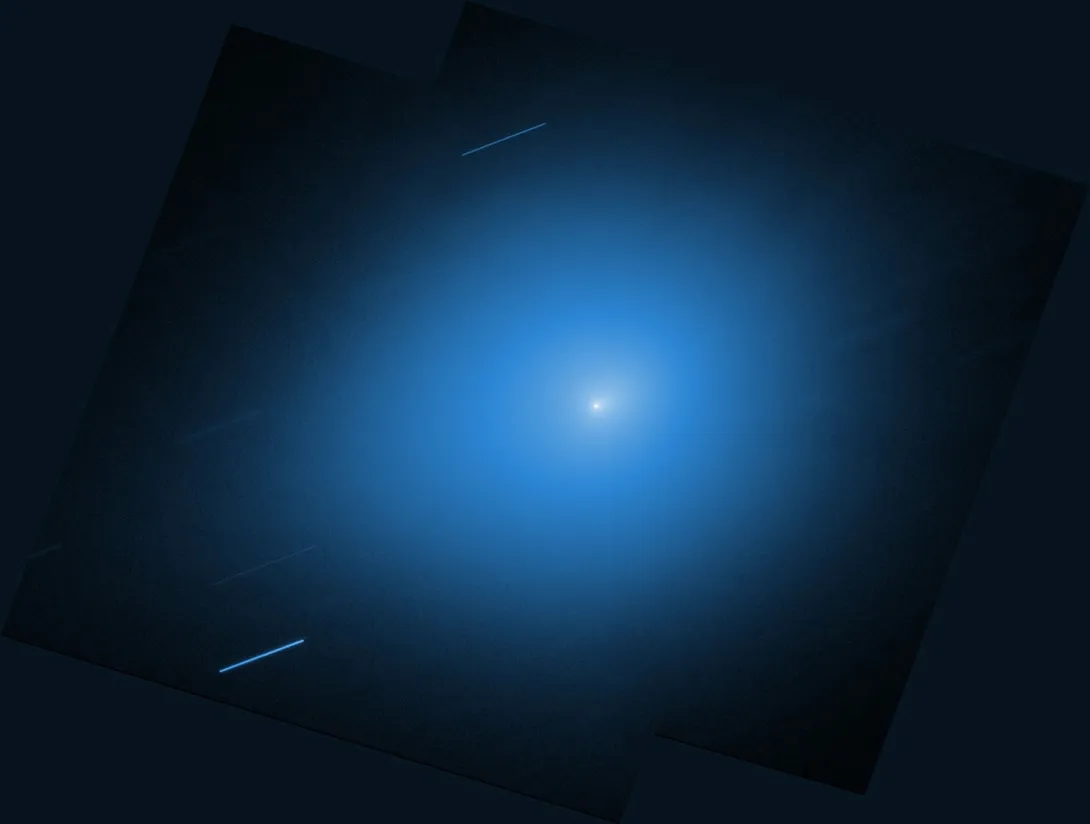
Scientists across the globe are intensifying their study of 3I/ATLAS, an interstellar comet that recently entered our solar system, offering a rare opportunity to analyze material originating from beyond the Sun’s gravitational domain. This cosmic visitor, only the third confirmed interstellar object, provides crucial clues about the composition, structure and evolution of distant planetary systems. Researchers are examining its unusual trajectory, volatile-rich chemistry and rapid fragmentation to better understand the conditions under which similar objects form. The findings could reshape current models of cosmic migration and deepen humanity’s understanding of the interstellar medium and early planetary development.
A Rare Interstellar Visitor
The arrival of comet 3I/ATLAS has sparked exceptional interest within the global scientific community. Classified as an interstellar object due to its hyperbolic orbit—one that cannot be bound by the Sun’s gravity—the comet carries material forged in an entirely different star system. Its unexpected appearance provides astronomers a rare chance to study primordial matter unaltered by billions of years within our solar environment.
Through high-resolution telescopic observations, scientists have noted that 3I/ATLAS exhibits an unusually steep approach trajectory, suggesting it spent millions of years traveling through the interstellar medium before crossing paths with our planetary system.
Key Scientific Discoveries So Far
Initial analyses indicate that 3I/ATLAS contains a higher concentration of volatile compounds than typical long-period comets. These volatile signatures imply that the comet formed in a colder, more distant zone within its original star system—possibly beyond the equivalent of a distant Kuiper Belt.
Researchers also documented early fragmentation events, which revealed its fragile structural integrity. This behavior supports theories that interstellar comets experience intense thermal and gravitational stress when transitioning from deep space into the inner solar system. The breakup has allowed scientists to examine fresh interior material, offering improved clarity on its mineral and chemical makeup.
Implications for Understanding Planetary Evolution
The study of 3I/ATLAS holds transformative potential for models of planetary formation. Since interstellar comets are believed to be remnants of early planetary systems, their compositions reflect the building blocks present during the formation of exoplanets. The data collected may help scientists refine theories related to accretion processes, atmospheric development and the role of icy bodies in transporting essential organic compounds.
Furthermore, by comparing 3I/ATLAS with previously observed interstellar objects, astronomers aim to determine whether such bodies share common origins or represent a diverse cross-section of planetary debris from across the galaxy.
Advancing Technology and Global Collaboration
The investigation into 3I/ATLAS underscores the growing importance of coordinated international research efforts. Observatories from North America, Europe, and Asia are pooling data, while space-based instruments provide continuous monitoring unaffected by atmospheric interference. These collaborations not only enhance scientific precision but also demonstrate the rapid evolution of astronomical imaging, spectrography and computational modeling.
Such advancements allow researchers to reconstruct the comet’s journey, estimate its age and evaluate the likelihood of future interstellar visitors—critical steps toward understanding the broader mechanics governing galactic dynamics.
A Gateway to Future Discoveries
Although 3I/ATLAS will eventually exit the solar system, the scientific impact of its brief visit is expected to endure. The knowledge gathered reinforces the concept that interstellar objects may be more common than previously assumed, encouraging investment in early detection systems and next-generation telescopes.
Comments