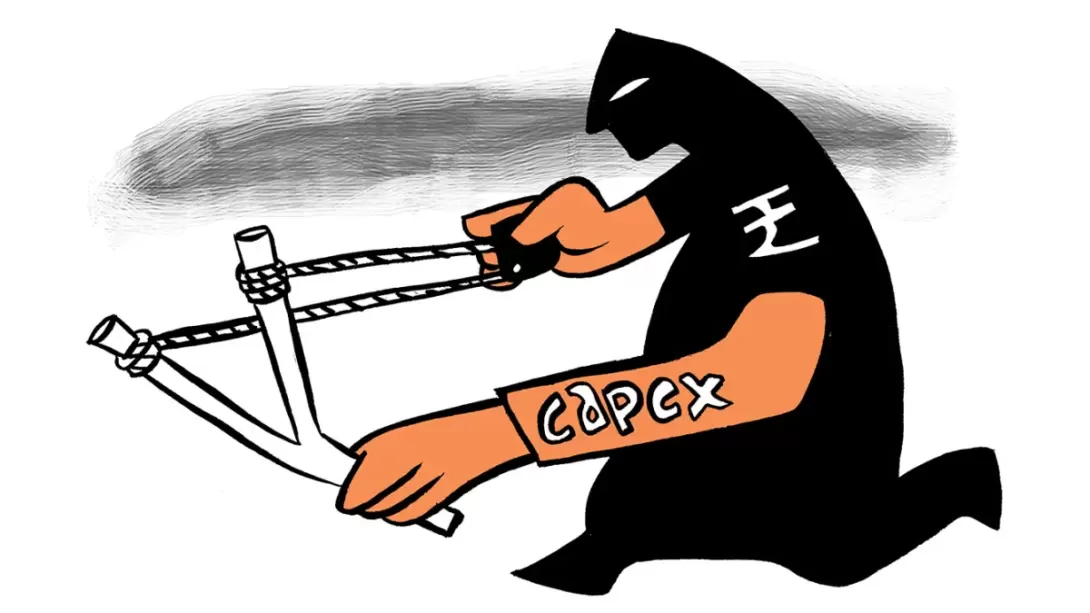
A recent government survey has forecast a significant decline in the capital expenditure (capex) plans of the private corporate sector, projecting a 25% drop to Rs 4.88 lakh crore in FY26, compared to Rs 6.56 lakh crore in FY25. Despite previous years of increasing investment, the survey reflects a more cautious stance by companies for the upcoming fiscal year. Manufacturing enterprises lead the capex distribution, but sector-specific challenges and apprehension about the economic landscape are influencing investment strategies. The findings suggest that while the overall capex remains strong, growth expectations have tempered due to global uncertainties.
Private Sector Capex Forecast for FY26 Shows Significant Decline
In a noteworthy government survey released Tuesday, the Ministry of Statistics & Programme Implementation estimated a sharp 25% drop in private sector capital expenditure (capex) plans for the fiscal year 2025-26. The survey, which forms part of the Forward-Looking Survey on Private Sector CAPEX Investment Intentions, forecasts that the corporate sector will invest approximately Rs 4.88 lakh crore, a notable decline from Rs 6.56 lakh crore projected for FY25.
The cautious outlook for FY26 reflects a broader trend of more conservative investment strategies within the corporate sector. This follows a period of heightened capex activity in the previous years, marking a shift in corporate sentiment as enterprises weigh the risks and rewards of expansion in an uncertain global environment.
Historical Context: Rising Capital Expenditure, But Caution Ahead
The Forward-Looking Survey tracked private sector capex across five years, focusing on the period between November 2024 and January 2025. The actual capex figures for the last few fiscal years indicate a general upward trajectory: from Rs 3.94 lakh crore in 2021-22 to Rs 4.22 lakh crore in 2023-24, before reaching an estimated Rs 6.56 lakh crore in FY25. Over this period, the total increase in unweighted aggregate capex amounted to 66.3%, highlighting the significant growth of private sector investments.
However, the forward-looking estimates for FY26 paint a different picture. The lower projected capex is in part due to the more cautious stance adopted by enterprises, influenced by ongoing economic and geopolitical uncertainties. This moderation in investment growth signals a potential slowdown in industrial and infrastructure expansion across key sectors of the economy.
Capex Allocation: Manufacturing Leads, but with a Shift
Manufacturing enterprises continue to account for the largest share of capital expenditures, making up more than 65% of the total gross fixed assets (GFA) in the private corporate sector from 2021-22 to 2023-24. The sector remains a major driver of growth, and its ongoing expansion reflects both the domestic demand for industrial products and the need to upgrade technological capabilities.
The report highlighted that industries such as "Electricity, Gas, Steam, and Air Conditioning Supply" saw higher average gross fixed assets, exceeding Rs 14,000 crore per enterprise, illustrating the significant investments in infrastructure and energy sectors. Despite the slowdown in capex for FY26, manufacturing and infrastructure-related investments remain vital to India's economic framework.
Investment Strategies: A Shift in Focus
The survey also sheds light on the types of investments enterprises are focusing on in the upcoming fiscal year. In 2024-25, nearly 53.1% of the total capex in the private sector was directed toward purchasing machinery and equipment, while 40.3% of enterprises planned investments in core assets. These trends reflect an emphasis on enhancing operational capabilities, especially in critical sectors such as manufacturing, technology, and transportation.
Interestingly, only a small fraction of enterprises—around 2.7%—are focusing on opportunistic assets or debt strategies. This indicates that companies are prioritizing strategic, long-term investments over more speculative or reactive capital allocations.
The breakdown also reveals a growing tendency towards income-generating investments, with 49.6% of enterprises earmarking capex for this purpose. This shift underscores a broader trend toward sustainability and long-term financial stability as companies reassess their priorities in a post-pandemic economy.
Realization Ratios: Consistent Execution Despite Uncertainty
Another critical aspect of the survey's findings is the consistency between proposed and actual capex. For instance, in 2022-23, the actual capex per enterprise exceeded the proposed capex by a realization ratio of 106.41%, indicating that companies have been effective in executing their capex plans in previous years. While the realization ratio for 2023-24 stands at a slightly lower 99.7%, it still reflects a high level of execution efficiency, despite external challenges.
This trend suggests that while the corporate sector remains cautious about future investments, companies are increasingly adept at delivering on their capex goals, which is vital for maintaining economic momentum even amid uncertainty.
Sector-Specific Trends and Implications for Economic Growth
Manufacturing continues to dominate as the largest share of capex allocation, followed by the "Information and Communication Activities" and "Transportation and Storage Activities" sectors. The expected investments in these areas are crucial for expanding India’s infrastructure, technological capacity, and global competitiveness. However, the drop in overall capex growth for FY26 could have downstream effects, particularly in sectors reliant on sustained capital inflows to drive growth.
This cautious outlook for capex in the private sector could have implications for job creation, consumer demand, and infrastructure development. The scaling back of investment, especially in manufacturing and energy, may indicate a period of consolidation in these sectors, which are crucial for India’s long-term economic growth.
The Road Ahead: Private Sector’s Cautious Outlook for FY26
In conclusion, the projected decline in capital expenditure for FY26 highlights the evolving dynamics within India’s private corporate sector. While manufacturing remains a core focus, the shifting investment strategies suggest that businesses are reassessing their capital allocation in response to both domestic and global uncertainties. The lower investment expectations may signal a temporary pause in aggressive expansion plans, though it’s important to note that the private sector remains a key driver of India’s economic growth.
Given the challenges ahead, businesses will need to adapt their strategies, focusing on core investments and value creation, while mitigating risks in an increasingly complex global economy. The coming fiscal year may offer both opportunities and challenges as India continues its path toward greater economic resilience, with a focus on innovation, infrastructure, and sustainability.
Comments