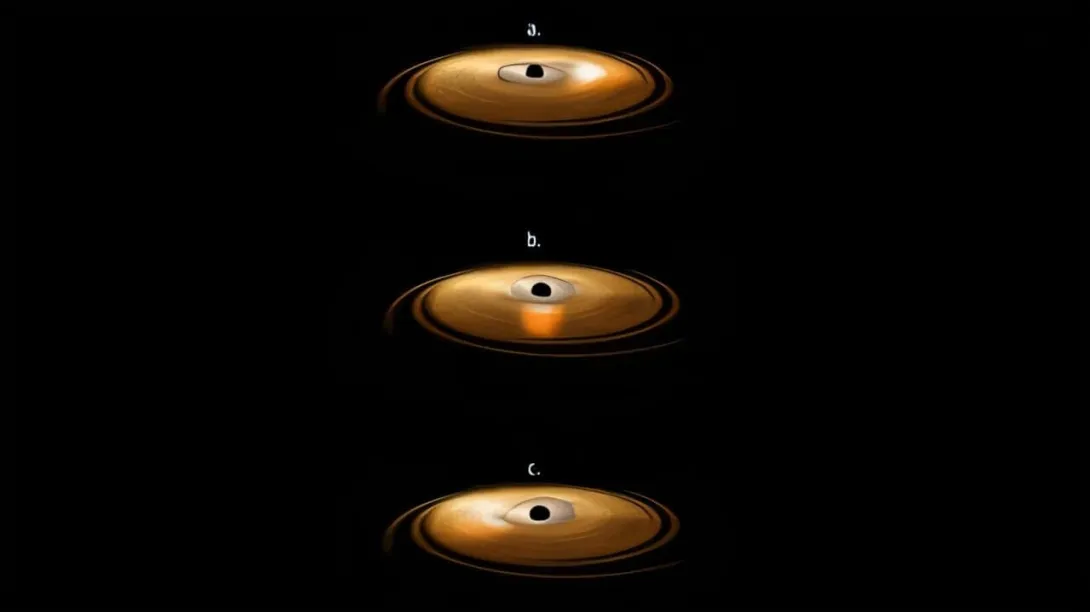
Recent scientific advances are reshaping how researchers understand the relationship between black holes and spacetime, reinforcing their role as natural laboratories for extreme physics. New observations and theoretical models suggest black holes do more than warp spacetime—they actively influence its structure, behavior and evolution. By studying gravitational waves, light distortion and matter accretion near these objects, scientists are testing the limits of Einstein’s theory of general relativity while exploring pathways toward quantum gravity. These findings are not only expanding fundamental physics but also strengthening the strategic importance of space science as a driver of innovation, advanced computing and international research collaboration.
Black Holes as Engines of Spacetime Distortion
Black holes represent regions where gravity becomes so intense that spacetime itself is severely curved. Recent studies confirm that near a black hole’s event horizon, time slows dramatically and spatial dimensions stretch in extreme ways.
These effects are no longer purely theoretical. Precise measurements of light bending and orbital motion near black holes have provided direct evidence of spacetime behaving exactly as predicted under extreme gravitational stress.
Gravitational Waves and New Evidence
One of the most significant developments has come from gravitational-wave astronomy. Collisions between black holes generate ripples in spacetime that travel vast cosmic distances before reaching Earth-based detectors.
Analysis of these signals has offered unprecedented insight into how spacetime responds to massive, high-energy events. Researchers say these observations are helping validate existing models while revealing subtle anomalies that could point to new physics.
Testing the Limits of Einstein’s Theory
General relativity has withstood every major test for more than a century, yet black holes remain its most demanding proving ground. Recent research has focused on whether spacetime behaves differently under conditions approaching infinite density.
While Einstein’s equations continue to hold, scientists are increasingly confident that black holes may reveal where classical physics gives way to quantum effects, a transition long sought by theorists.
Implications for Quantum Gravity Research
Understanding how spacetime operates inside and around black holes is central to the search for a unified theory of physics. Several models suggest spacetime may be granular or emergent rather than continuous at the smallest scales.
Although direct observation remains impossible, black holes provide indirect clues that are shaping the next generation of theoretical frameworks and computational simulations.
Technology, Investment and Strategic Value
From a business and policy perspective, black hole research is driving investment in advanced sensors, high-performance computing and artificial intelligence. These technologies have applications far beyond astronomy, including data security, climate modeling and financial analytics.
Governments and private institutions increasingly view space science as a long-term asset, with black hole research enhancing technological leadership and scientific capital.
A New Era of Spacetime Exploration
As observational tools improve, black holes are transitioning from cosmic curiosities to precision instruments for studying spacetime itself. Each discovery brings scientists closer to answering fundamental questions about the nature of reality.
In doing so, black holes continue to challenge assumptions, refine theory and remind humanity that the universe’s most extreme objects often hold the clearest insights into how everything works.
Comments