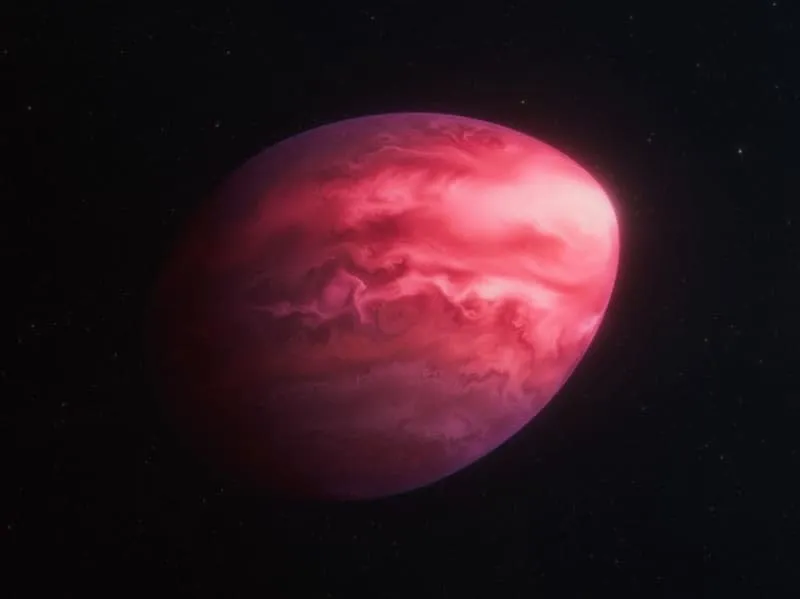
Astronomers using the James Webb Space Telescope (JWST) have identified a distant exoplanet with an unusually rare atmospheric composition, marking a significant advance in the study of worlds beyond the solar system. The discovery offers fresh insight into how planetary atmospheres form and evolve under extreme conditions. By analyzing light filtered through the planet’s atmosphere, scientists detected chemical signatures seldom observed together, challenging existing models of planetary chemistry. Researchers say the findings highlight the growing capability of next-generation space telescopes to move beyond detection toward detailed characterization, opening new pathways in the search for habitable environments and a deeper understanding of planetary diversity across the galaxy.
A Breakthrough Observation
The James Webb Space Telescope, launched to explore the universe in unprecedented detail, has delivered another landmark discovery. Using its advanced infrared instruments, JWST captured spectral data from a distant exoplanet as it transited its host star. This method allowed scientists to analyze the planet’s atmospheric makeup with exceptional precision.
The observations revealed a combination of gases rarely detected together, suggesting complex chemical processes at work. Astronomers describe the finding as a major step forward in understanding atmospheric diversity beyond the solar system.
What Makes the Atmosphere Unusual
Unlike most known exoplanets, whose atmospheres are dominated by hydrogen, helium, or simple compounds, this planet exhibits a more intricate chemical profile. Preliminary analysis indicates the presence of rare molecular signatures that may form only under specific temperature and pressure conditions.
Scientists note that such atmospheric compositions challenge long-standing assumptions about how planets develop around different types of stars. The data could prompt revisions to existing atmospheric and planetary formation models.
Implications for Exoplanet Research
The discovery underscores JWST’s role in shifting exoplanet science from detection to detailed characterization. By identifying subtle chemical fingerprints, researchers can now compare planetary environments across star systems with far greater accuracy.
Experts believe this capability will help refine criteria for planetary classification and improve assessments of which worlds may support stable climates or complex chemistry. While the newly observed planet is not considered habitable, its atmosphere provides valuable context for understanding more Earth-like candidates.
Global Scientific Collaboration
The research involved collaboration among international space agencies and academic institutions, reflecting the global nature of modern astronomy. Data from JWST were cross-verified with ground-based observatories to ensure accuracy and consistency.
Such cooperation accelerates scientific discovery and maximizes the return on large-scale investments in space infrastructure, strengthening the scientific case for continued exploration beyond Earth.
Looking Ahead
Astronomers say this observation is only an early indication of what the James Webb Space Telescope can achieve. As its mission continues, scientists expect a growing catalog of exoplanets with diverse and unexpected atmospheric properties.
These discoveries will not only deepen understanding of planetary science but also guide future missions aimed at identifying potentially habitable worlds. In the broader context, the findings reinforce the idea that the universe is far more chemically and physically diverse than previously imagined.
Comments