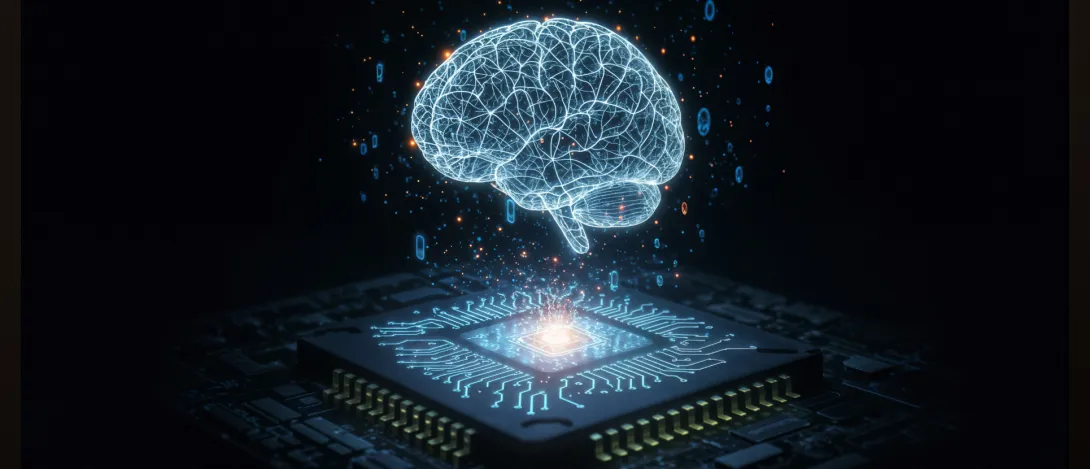
Researchers have unveiled a new class of molecular-scale devices capable of mimicking fundamental brain functions, marking a significant advance at the intersection of neuroscience and nanotechnology. These devices can process information, adapt to stimuli and exhibit learning-like behavior, characteristics traditionally associated with biological neural networks. Scientists say the breakthrough could accelerate the development of energy-efficient artificial intelligence systems and next-generation computing architectures. Beyond technology, the discovery also provides fresh insight into how complex cognitive processes may emerge from simple physical systems, opening new pathways for research in both brain science and advanced materials engineering.
A Breakthrough at the Molecular Scale
The newly developed molecular devices operate at dimensions thousands of times smaller than a human hair. Despite their size, they demonstrate behaviors analogous to synapses, the junctions through which neurons transmit signals. By responding dynamically to electrical inputs, these systems can adjust their conductance, effectively “remembering” past activity.
Researchers describe this as a foundational step toward hardware that functions more like the human brain than conventional silicon-based processors.
Mimicking Learning and Memory
One of the most notable aspects of the development is the devices’ ability to emulate learning processes. Through repeated stimulation, they alter their response patterns, resembling how biological neurons strengthen or weaken connections over time.
This property, often referred to as synaptic plasticity, is essential for memory formation and learning. Replicating it at the molecular level represents a major scientific achievement.
Implications for Artificial Intelligence
Experts believe these molecular systems could transform artificial intelligence by enabling faster and more energy-efficient data processing. Unlike traditional computing, which separates memory and computation, brain-inspired devices integrate both functions, reducing energy consumption and latency.
Such efficiency gains are critical as demand for AI-driven applications continues to rise across industries.
Beyond Computing: Insights into the Brain
The research also holds value for neuroscience. By recreating neural behavior in simplified physical systems, scientists can test theories about how cognition emerges from networks of interacting elements.
This cross-disciplinary approach may eventually help decode neurological disorders and inform new treatment strategies.
Looking Ahead
While commercial applications remain years away, researchers view the breakthrough as a foundational advance rather than a finished product. Further refinement and scalability will determine its practical impact.
Still, the emergence of molecular devices that mirror brain functions signals a profound shift in how scientists approach both computing and the study of intelligence itself.
Comments