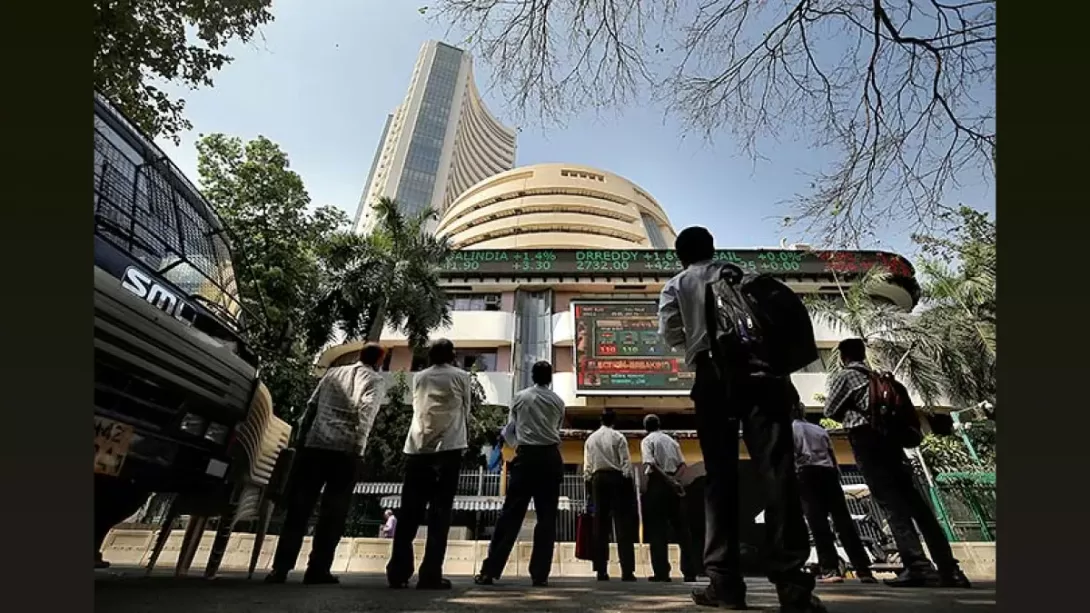
Indian equity markets closed higher on Friday, bolstered by record Goods and Services Tax (GST) collections, encouraging macroeconomic indicators, and continued foreign investment inflows. The BSE Sensex climbed 259.75 points to close at 80,501.99, following a sharp intra-day rally driven by optimism over a possible India-U.S. trade agreement. However, profit-booking and global uncertainties trimmed gains by the session’s end. The NSE Nifty posted a modest increase of 12.50 points. While select stocks in banking, finance, and infrastructure outperformed, broader markets displayed weakness, reflecting ongoing investor caution amid geopolitical tensions and volatile global cues.
Market Overview: Modest Gains Amid Intraday Swings
The Indian stock market wrapped up a turbulent trading session on a cautiously optimistic note, with benchmark indices posting modest gains after swinging nearly 1,000 points during the day. The BSE Sensex, composed of 30 blue-chip stocks, advanced by 259.75 points or 0.32% to close at 80,501.99. Earlier in the session, the index had surged as much as 935.69 points, briefly crossing the 81,000 mark, before paring gains due to intraday profit-taking.
Meanwhile, the NSE Nifty 50 edged higher by 12.50 points or 0.05%, closing at 24,346.70. The limited gain reflects investors’ selective approach, with the broader market showing signs of fatigue following a recent upward run.
Volatility dominated early trading hours, spurred by positive global cues and improved domestic macroeconomic data. However, uncertainty linked to global trade tensions and geopolitical instability kept risk appetite in check.
Sector Highlights: Ports, Banking, and Auto Lead the Charge
Within the Sensex constituents, Adani Ports stood out, rallying over 4% after reporting a 50% increase in its March quarter net profit. The company also issued a strong revenue growth forecast for the current fiscal year, supported by a rise in cargo volumes and a booming logistics segment.
Other major gainers included Bajaj Finance, IndusInd Bank, State Bank of India, Maruti Suzuki, Tata Motors, ITC, Tata Steel, and Reliance Industries. These performances were attributed to robust earnings reports, improved sectoral outlooks, and targeted institutional buying.
On the downside, Nestle India, NTPC, Kotak Mahindra Bank, Power Grid, and Titan were among the notable laggards, reflecting either muted results or profit-taking pressures after previous gains.
Macroeconomic Indicators Reinforce Market Sentiment
One of the day’s most influential data points was India’s record GST collection in April, which surged 12.6% year-on-year to reach Rs. 2.37 lakh crore. The government attributed this achievement to stronger compliance, buoyant economic activity, and the collaborative framework of cooperative federalism.
Additionally, the HSBC India Manufacturing Purchasing Managers’ Index (PMI) rose slightly to 58.2 in April from 58.1 in March, indicating the fastest rate of output growth since June 2024. The expansion was largely fueled by new order inflows and increased production capacity, underscoring continued strength in India’s manufacturing base.
These numbers reflect sustained momentum in the real economy, giving investors additional confidence in India’s medium-term growth trajectory, even as external uncertainties linger.
Foreign Investment and Global Market Trends
Foreign Institutional Investors (FIIs) remained net buyers, purchasing equities worth Rs. 50.57 crore on Wednesday. Their sustained interest signals confidence in India’s macroeconomic resilience, especially at a time when global growth remains uneven.
On the global front, equity markets were broadly positive. Asian indices such as South Korea’s Kospi, Japan’s Nikkei 225, and Hong Kong’s Hang Seng closed higher, while China’s Shanghai Composite posted marginal losses. European markets opened strong, and U.S. indices closed in the green on Thursday, buoyed by corporate earnings and declining bond yields.
In commodities, Brent crude oil fell 0.82% to USD 61.62 a barrel, offering relief to import-heavy economies like India by lowering input costs and helping keep inflation under control.
Investor Outlook: Cautious Optimism Amid Global Fragility
Despite Friday’s gains, market sentiment remains delicate. Analysts point to profit-taking as a natural outcome of the recent bull run, particularly in the absence of a clear global risk-on signal. According to Prashanth Tapse, Senior Vice President at Mehta Equities, the market is likely to remain range-bound as investors assess geopolitical developments, the trajectory of interest rates, and any definitive moves on the India-U.S. trade front.
Moreover, with broader market indices showing signs of fatigue, the emphasis is shifting toward stock-specific action, driven by earnings performance and forward guidance.
Conclusion
While the Indian equity markets have shown resilience, bolstered by strong domestic fundamentals and foreign capital inflows, the underlying volatility underscores a market still on edge. Record tax collections and improving manufacturing activity offer hope, but investors are proceeding with guarded optimism amid global uncertainties. As India negotiates economic diplomacy and navigates macroeconomic headwinds, the market is likely to remain reactive to both domestic policies and international developments in the near term.
Comments