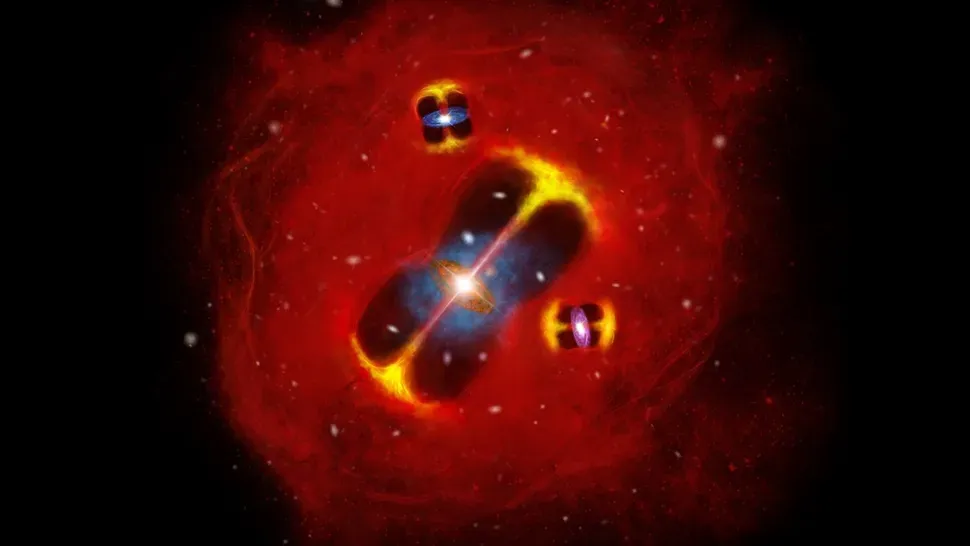
A team of international astronomers has identified a massive galaxy cluster from the early universe containing exceptionally hot intracluster gas, providing rare insights into cosmic evolution and the formation of large-scale structures. Observations using advanced space- and ground-based telescopes reveal that the gas within the cluster reaches millions of degrees, emitting X-rays and shaping the surrounding galaxies’ growth. This discovery not only challenges existing models of cluster formation but also enhances understanding of dark matter, galaxy interactions, and cosmic thermal history. Experts assert that such findings are critical for reconstructing the early universe and refining simulations of galaxy cluster evolution.
Discovery and Observational Details
The galaxy cluster, located billions of light-years away, was detected through combined X-ray, optical, and infrared observations. The intracluster medium, primarily composed of ionized gas, exhibits temperatures exceeding several million Kelvin, making it a significant X-ray emitter.
High-resolution imaging allowed researchers to map the distribution of hot gas, member galaxies, and dark matter, revealing a mature, gravitationally bound structure much earlier than previously anticipated.
Implications for Cosmic Structure Formation
The existence of a hot, massive cluster at such an early epoch provides strong evidence that galaxy clusters formed rapidly in the young universe. The high-energy intracluster gas influences star formation, galaxy mergers, and the evolution of constituent galaxies, offering a laboratory to study cosmic thermodynamics.
Analysts suggest that these observations challenge hierarchical structure formation models, which predict slower accumulation of mass in the early universe.
Role of Technology and Collaboration
The discovery leveraged cutting-edge instruments, including space-based X-ray observatories and ground-based optical telescopes equipped with spectrographs capable of measuring galaxy velocities. Collaborative efforts across multiple institutions enabled the integration of multi-wavelength data, providing a comprehensive understanding of the cluster’s properties.
Advanced computational simulations were used to compare observed properties with theoretical models, confirming that such massive, hot clusters could indeed form within the universe’s first few billion years.
Broader Scientific Significance
Galaxy clusters act as cosmic laboratories, offering insights into dark matter distribution, galaxy evolution, and the thermal history of the universe. This early-universe cluster illustrates the complex interplay between gravity, gas dynamics, and galactic interactions.
Experts highlight that studying such systems improves predictive cosmological models, informs our understanding of high-energy astrophysics, and guides future observational campaigns targeting the universe’s formative epochs.
Outlook: Future Research
Ongoing observations aim to refine measurements of intracluster gas temperatures, metallicity, and density profiles while tracking the motion and interaction of member galaxies. Researchers also plan to investigate the role of feedback from supermassive black holes in heating the intracluster medium.
Such studies will deepen understanding of cosmic evolution, provide constraints on dark matter and energy models, and enhance knowledge of how the universe’s largest structures emerged from primordial density fluctuations.
Comments