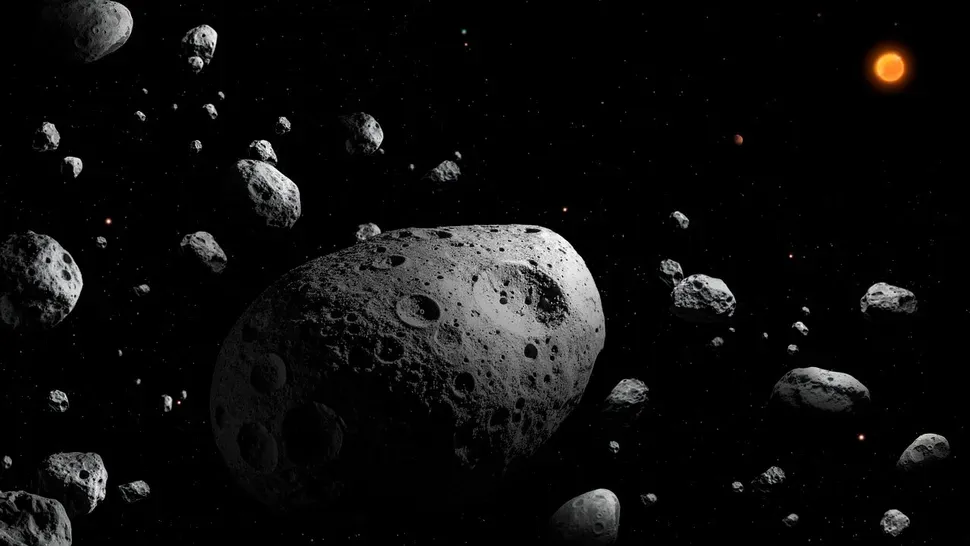
Astronomers have identified asteroid 2025 MN45 as setting a new record for rotational velocity among known near-Earth objects (NEOs). Spinning faster than any previously observed asteroid of comparable size, 2025 MN45 presents unique opportunities to study the structural integrity and composition of small celestial bodies. Researchers note that its rapid rotation challenges existing models of asteroid cohesion and surface dynamics. Understanding such extreme rotators has practical implications for planetary defense strategies, mission planning, and potential resource utilization. The discovery underscores the importance of continuous NEO monitoring, as these objects not only inform science but also influence global preparedness for impact threats.
Discovery and Characteristics of 2025 MN45
Asteroid 2025 MN45 was first detected by survey telescopes in late 2025 and has since been closely monitored using radar and optical observations. Key characteristics include:
- Rotation Rate: Completing a full rotation in just under 15 minutes, surpassing prior speed records for asteroids in its size range.
- Size and Composition: Estimated at 180–200 meters in diameter, composed primarily of silicate materials with possible metallic inclusions.
- Orbit: Classified as a near-Earth asteroid, its trajectory intersects the Earth’s orbital path, though current projections show no immediate impact threat.
Scientists are particularly interested in how such rapid rotation affects surface cohesion, mass shedding, and potential for future fragmentation.
Implications for Asteroid Science
The extraordinary rotation speed of 2025 MN45 challenges conventional understanding of asteroid physics. Historically, smaller bodies with rapid spin were thought to disintegrate due to centrifugal forces. The stability of MN45 suggests either:
- Unusually strong material cohesion or internal structure, or
- A previously underappreciated effect of shape and density distribution stabilizing the rotation.
These findings refine models used to predict asteroid evolution, surface regolith behavior, and potential hazards from rotational breakup events.
Planetary Defense and Mission Planning
Understanding the structural dynamics of rapidly rotating NEOs is critical for planetary defense. 2025 MN45 offers a test case for:
- Deflection Strategies: Knowing how spin affects impact response is vital for kinetic or explosive mitigation attempts.
- Robotic Missions: Landing or sampling spacecraft on fast-spinning asteroids presents unique engineering challenges.
- Resource Extraction: Rapidly rotating asteroids may exhibit exposed materials due to centrifugal forces, informing mining strategies for rare metals.
NASA, ESA, and other space agencies are closely reviewing data from 2025 MN45 to enhance mission planning and risk assessments.
Future Observations
Ongoing radar mapping, spectroscopy, and lightcurve analysis will further elucidate 2025 MN45’s surface features, density distribution, and internal structure. These observations are expected to refine predictive models of NEO behavior, benefiting both scientific research and planetary defense initiatives.
Comments