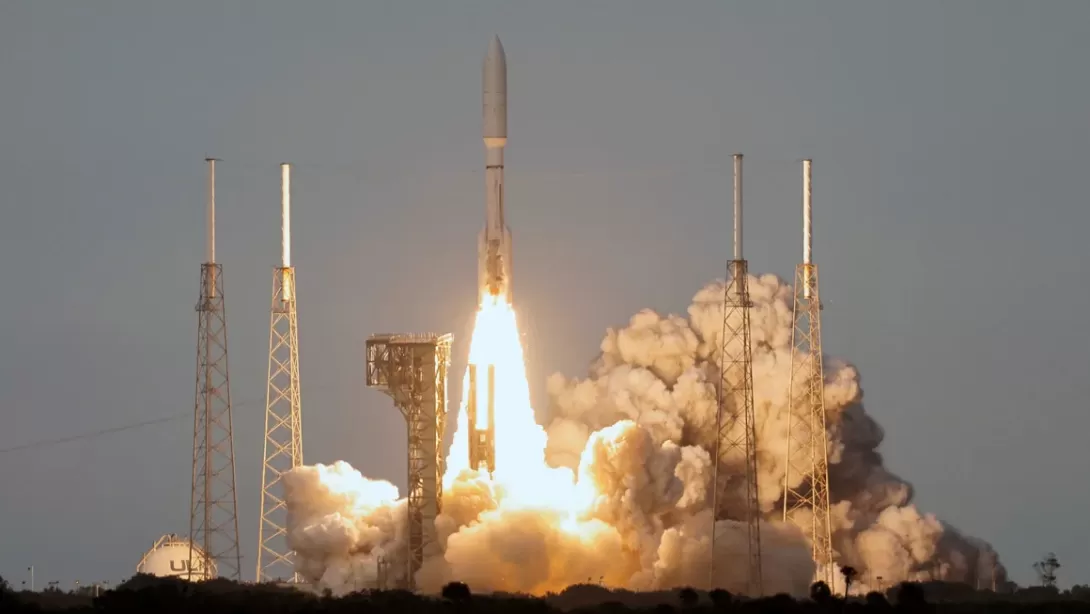
Amazon has launched 27 satellites into low-Earth orbit, marking a significant milestone in its ambitious Project Kuiper, aimed at providing global internet connectivity. This venture positions Amazon to compete directly with Elon Musk’s SpaceX, which has already established a massive satellite network, Starlink, with millions of users worldwide. Despite the high stakes, analysts are skeptical about Amazon’s ability to catch up to SpaceX, as the satellite internet market presents complex challenges. This article examines the competition between these two tech giants and the challenges Amazon faces in a race to transform global connectivity.
Amazon’s Ambitious Satellite Internet Plan
On a quiet Monday evening, the skies over Cape Canaveral, Florida, were lit up by the launch of 27 satellites that marked the first substantial step in Amazon’s quest to revolutionize global internet connectivity. Aboard an Atlas V rocket from United Launch Alliance, these satellites are part of Amazon’s Project Kuiper — an endeavor designed to establish a constellation of low-Earth orbit satellites that will beam internet access to remote and underserved regions.
Amazon’s entry into the satellite internet market sets the stage for a battle against SpaceX’s Starlink, which already boasts millions of customers globally. This race to create a high-speed, low-cost, satellite-based internet network will fundamentally change how the world connects to the internet, particularly in rural or hard-to-reach areas.
The Satellite Internet Race: Kuiper vs. Starlink
Amazon’s Project Kuiper and SpaceX’s Starlink share a common goal: to deliver internet services where traditional broadband infrastructure is either cost-prohibitive or entirely absent. These satellite constellations aim to provide global coverage by placing thousands of satellites in low-Earth orbit, ensuring faster internet speeds due to their proximity to the Earth’s surface.
Starlink has been operational for some time now and has already established itself as the leader in the satellite internet market, connecting over 4.6 million customers worldwide. It provides services not only to individual homes in remote areas but also to businesses, RVs, and even spacecraft. In comparison, Amazon's Kuiper project has just begun to take flight, with a plan to launch around 3,200 satellites — significantly fewer than Starlink’s growing network.
The Competitive Advantage of Low-Earth Orbit
Both Kuiper and Starlink satellites will operate in low-Earth orbit, at altitudes of about 280 miles and 340 miles, respectively. This proximity to the planet offers a clear advantage: the closer a satellite is to Earth, the faster the data transmission. Traditional communications satellites, such as those operated by Inmarsat and Viasat, orbit much higher at approximately 22,236 miles. At these higher altitudes, the delay in data transmission is more pronounced, making services slower and less reliable.
This strategic positioning of both companies' satellites in low-Earth orbit ensures faster, more efficient communication, a critical factor in delivering seamless internet service, especially in areas where reliable connectivity is a challenge.
Will Amazon’s Kuiper Catch Up to SpaceX?
Despite the promising technology and high stakes, industry experts are questioning Amazon’s ability to successfully rival SpaceX in the satellite internet market. While Amazon has the financial resources and technological infrastructure to support this ambitious project, analysts are wary of how long it will take for Kuiper to catch up to SpaceX, which already has a significant market lead.
Craig Moffett, senior managing director at the research firm MoffettNathanson, is particularly skeptical. In a conversation with CNN, Moffett noted, “Kuiper is going to have a long way to go to catch up to be able to serve a significant part of the market.” He further remarked that the project’s success is uncertain, and there’s a strong possibility that it may turn out to be “too late” for Amazon to carve out a substantial share of the satellite internet business.
The High Costs of Expansion
Another hurdle Amazon faces is the immense cost and time required to expand the Kuiper network. While SpaceX has made significant strides with its Starlink network, Amazon must still deploy thousands of satellites and build the necessary ground infrastructure to support the service. These efforts will demand substantial investments and likely take years before Kuiper can match the coverage and reliability of Starlink. While Amazon has a track record of successfully entering competitive markets and innovating at scale, the satellite internet business presents unique challenges.
Comments