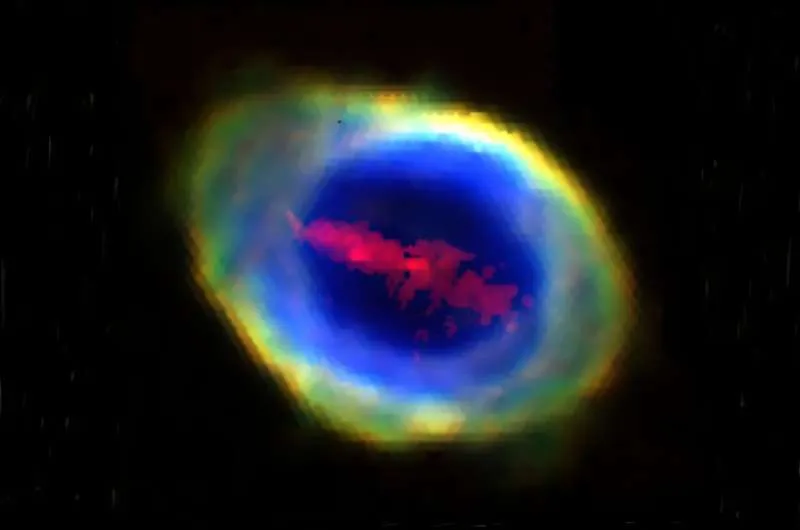
Astronomers have identified intricate iron-based structures within the Ring Nebula, a planetary nebula located roughly 2,000 light-years from Earth, providing insights into the fate of our Sun and solar system billions of years from now. These findings reveal how dying stars eject heavy elements into space, shaping surrounding nebulae and contributing to cosmic recycling processes. The detection of iron-rich filaments suggests that the Sun, in its red-giant phase, may similarly disperse elements essential for planetary formation. Researchers emphasize that understanding these processes not only informs stellar evolution models but also offers a window into the ultimate trajectory of Earth and its environment.
Mapping the Ring Nebula’s Hidden Structures
Using high-resolution spectroscopy and advanced imaging from space telescopes, scientists observed complex filamentary structures dominated by iron within the Ring Nebula. These formations, previously undetected, indicate a highly organized ejection pattern of stellar material. The discovery challenges conventional models that assumed a more chaotic dispersal of elements during the final stages of a star’s life.
Implications for Stellar Evolution
The presence of iron-rich filaments suggests that certain elements condense and organize in predictable ways during a star’s death throes. These observations refine understanding of nucleosynthesis—the creation of heavy elements—and the mechanisms by which planetary nebulae form. For astrophysicists, this data provides a tangible blueprint to model the Sun’s eventual transition into a white dwarf.
Insights Into Earth’s Long-Term Fate
While the process will occur billions of years from now, the Ring Nebula offers a preview of the solar system’s distant evolution. As the Sun expands into a red giant, Earth’s surface may become uninhabitable, eventually experiencing atmospheric and structural changes similar to the ejections seen in planetary nebulae. The study underscores the cyclical nature of cosmic material, linking stellar death to the potential formation of future planetary systems.
Broader Scientific Significance
Beyond tracing Earth’s future, the iron structures reveal how stars contribute to galactic chemical enrichment. Iron and other heavy elements are critical for the formation of terrestrial planets, magnetic fields, and even life-supporting chemistry. By understanding the dispersal patterns of these elements, astronomers gain a clearer picture of how galaxies evolve over time.
Future Research Directions
Scientists plan to conduct multi-wavelength studies of other planetary nebulae to determine whether iron filamentation is a universal phenomenon or unique to certain stellar types. Integrating these findings into stellar evolution simulations will refine predictions for solar-type stars and their planetary systems.
Comments