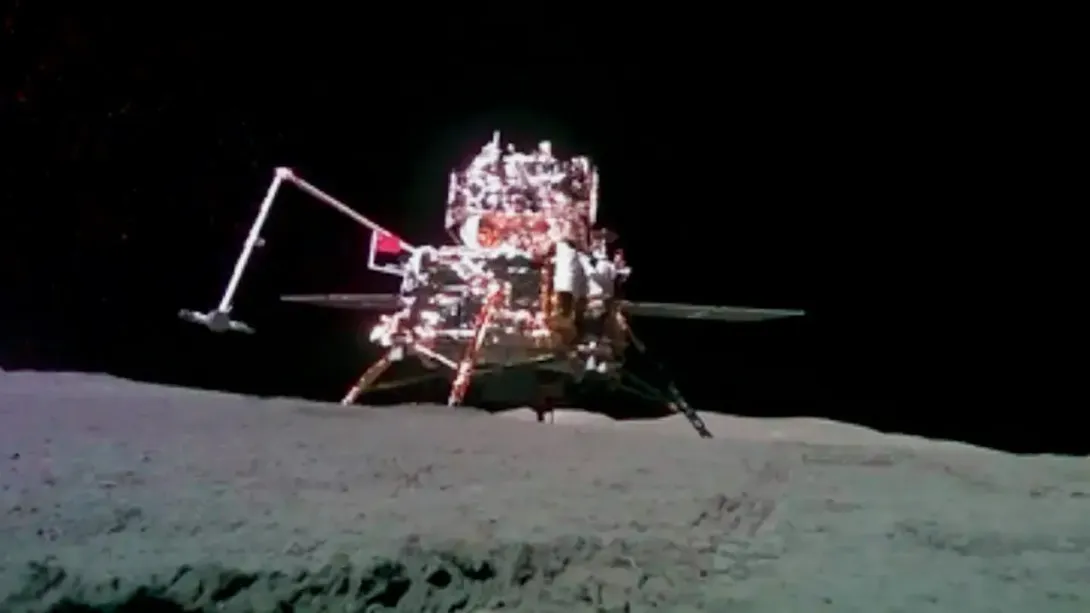
China has achieved a landmark milestone in space exploration with the successful return of lunar samples from the Moon’s far side through its Chang’e-6 mission. This rare scientific accomplishment places China at the forefront of deep-space research, opening a new chapter in lunar science. The samples are expected to provide critical insights into the Moon’s geological history, internal structure, and early solar system evolution. Beyond scientific value, the mission underscores China’s growing technological maturity and strategic ambition in space exploration, reinforcing its position as a leading global space power with long-term lunar and planetary goals.
A First-of-Its-Kind Lunar Achievement
The Chang’e-6 mission marks the first time samples have been collected and returned from the Moon’s far side, a region that has remained largely unexplored due to communication and navigation challenges. Unlike the near side, which constantly faces Earth, the far side offers a distinct geological record shaped by different volcanic and impact histories.
Scientists believe these samples could fundamentally alter current understanding of lunar formation.
Mission Execution and Technical Precision
Launched as part of China’s long-running Chang’e lunar program, Chang’e-6 successfully completed a complex sequence involving landing, sample collection, ascent, lunar orbit docking, and Earth reentry. The mission relied on relay satellites to maintain communication, demonstrating China’s advanced capabilities in autonomous space operations.
Such precision highlights the robustness of China’s space engineering and mission planning frameworks.
Scientific Value of Far-Side Samples
Researchers expect the returned material to shed light on why the Moon’s two hemispheres differ so dramatically in composition and appearance. Early analysis may help explain asymmetries in crust thickness, volcanic activity, and impact frequency.
The samples are also likely to refine timelines related to lunar evolution and offer comparative data relevant to planetary science more broadly.
Strategic Implications for Global Space Exploration
Chang’e-6 strengthens China’s long-term vision for sustained lunar exploration, including future crewed missions and the development of a lunar research station. The mission also carries geopolitical significance, signaling China’s intent to shape the next phase of space exploration alongside, and in some areas independent of, traditional space powers.
Analysts note that lunar capabilities increasingly intersect with technology leadership and national prestige.
What Comes Next for China’s Lunar Program
With Chang’e-6 completed, attention is turning to upcoming missions aimed at deeper exploration and potential human presence on the Moon. The success of far-side sample return provides valuable operational data that will inform future landings and infrastructure planning.
As the samples undergo detailed study, Chang’e-6 is expected to deliver scientific returns for years to come—cementing its place as one of the most consequential lunar missions of the modern era.
Comments