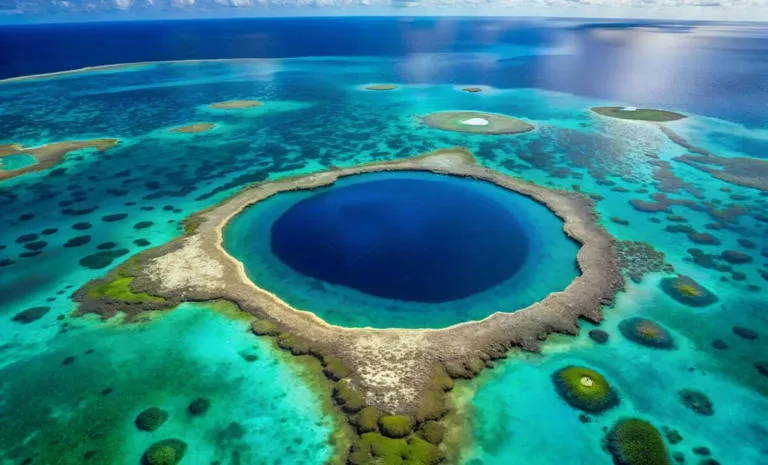
The Dragon Hole in the South China Sea, the deepest known blue hole on Earth, has emerged as a focal point for marine scientists and geopolitical observers alike. Plunging more than 300 meters below sea level, the underwater sinkhole offers rare insights into oceanic geology, climate history, and extreme marine ecosystems. Recent scientific expeditions have revealed sharply stratified water layers, low oxygen zones, and unique biological conditions that set the Dragon Hole apart from other marine formations. Beyond its scientific value, the site also underscores the strategic and environmental importance of the South China Sea in a rapidly changing global context.
Understanding the Dragon Hole Phenomenon
Located in the Paracel Islands region, the Dragon Hole—also known as Yongle Blue Hole—was formally measured and confirmed as the world’s deepest blue hole during Chinese-led marine surveys. Blue holes are underwater vertical caves formed over thousands of years through geological erosion and sea-level changes.
What distinguishes the Dragon Hole is its exceptional depth and isolation, creating a natural laboratory for studying ocean chemistry and deep-sea processes.
A Rare Window Into Marine Stratification
Scientific studies have found that the Dragon Hole contains sharply defined layers of water, with oxygen levels dropping dramatically below a certain depth. Below roughly 100 meters, the environment becomes almost entirely anoxic, meaning it cannot support most forms of marine life.
This stratification allows researchers to observe how marine ecosystems respond to extreme conditions, offering parallels to ancient oceans and future climate scenarios where oxygen depletion may become more widespread.
Implications for Climate and Ocean Research
Sediment samples collected from the Dragon Hole provide valuable records of past climate patterns, including monsoon activity and sea-level fluctuations. These records help scientists reconstruct environmental conditions stretching back tens of thousands of years.
Such data is increasingly important as policymakers and researchers seek to understand long-term climate cycles and their potential economic and environmental consequences.
Strategic and Environmental Considerations
Beyond science, the Dragon Hole’s location in the South China Sea places it within a region of significant geopolitical sensitivity. While research efforts have focused on conservation and exploration, the site also highlights the need for cooperative marine governance to protect fragile underwater ecosystems.
As exploration technology advances, the Dragon Hole is likely to remain both a scientific priority and a symbol of the broader challenges facing global ocean stewardship.
Comments