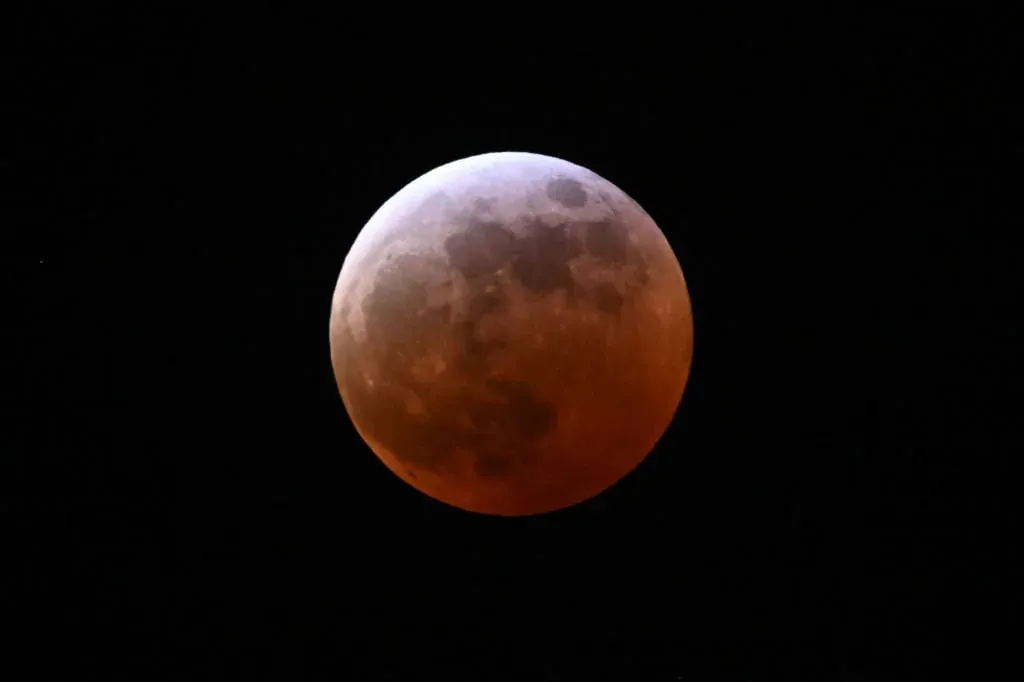
A total lunar eclipse scheduled for March 3 is expected to transform the Moon into a striking “blood moon,” captivating observers across large parts of the world. The phenomenon occurs when the Earth moves directly between the Sun and the Moon, casting a shadow that gives the lunar surface a deep reddish hue. Scientists note that the event is not only visually compelling but also scientifically valuable, offering insights into Earth’s atmosphere and light behavior. With clear skies, the eclipse will be visible to the naked eye, reinforcing public fascination with predictable yet awe-inspiring celestial events.
What Causes a Blood Moon
During a total lunar eclipse, the Moon passes fully into Earth’s umbral shadow. Instead of disappearing from view, it takes on a red or copper tone due to sunlight filtering through Earth’s atmosphere. Shorter blue wavelengths are scattered, while longer red wavelengths bend toward the Moon, creating the signature blood moon effect.
Visibility and Timing
The March 3 eclipse will be visible across multiple regions, depending on local timing and weather conditions. Unlike solar eclipses, lunar eclipses can be safely viewed without protective equipment, making them accessible to a wide audience. Astronomical organizations are also expected to provide live broadcasts for regions with limited visibility.
Scientific Significance
Beyond its visual appeal, a total lunar eclipse allows scientists to study Earth’s atmosphere. Variations in color and brightness can reveal changes in atmospheric composition, including the presence of dust or pollution. These observations contribute to climate and atmospheric research.
Public Interest and Cultural Resonance
Historically, blood moons have carried cultural and symbolic significance across civilizations. In modern times, they continue to draw public attention, amplified by social media and real-time digital coverage. Such events often serve as entry points for broader engagement with science and astronomy.
A Reminder of Cosmic Rhythm
As anticipation builds for March 3, the eclipse stands as a reminder of the precise mechanics governing celestial motion. In an increasingly complex world, moments like these offer a shared experience—uniting science, curiosity, and wonder under a changing night sky.
Comments