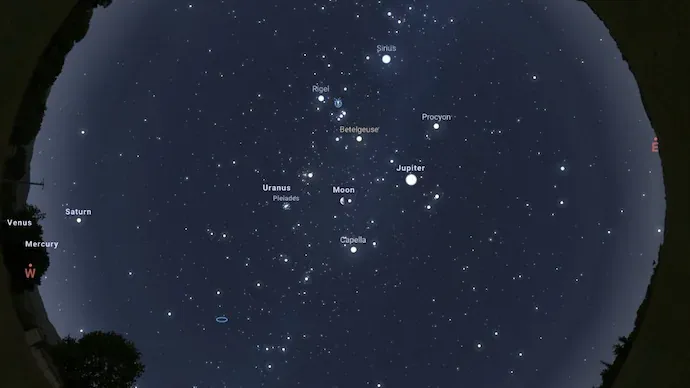
Skywatchers around the world are set to witness an unusual celestial event on February 28, when six planets will appear aligned in what astronomers commonly describe as a “planet parade.” Although not a perfect straight-line formation, the visual clustering of multiple planets across the night sky is a relatively rare phenomenon that captures both scientific and public imagination. The alignment offers an opportunity for amateur astronomers and enthusiasts to observe planetary motion with the naked eye or basic equipment. Experts note that such events underscore the predictability of orbital mechanics while reminding observers of the dynamic architecture of our solar system.
What Is a Planet Parade?
A planet parade occurs when several planets become visible along the same broad arc of the sky, following the plane of the solar system. This alignment is an optical effect driven by planetary orbits rather than a physical convergence, yet it remains visually striking and educational.
Why the February 28 Alignment Matters
Alignments involving five or more planets are infrequent, making this six-planet configuration notable. Astronomers emphasize that while the event has no direct impact on Earth, it offers a valuable moment to engage the public with astronomy and observational science.
Viewing Conditions and Timing
Visibility will depend on geographic location, weather conditions and light pollution. Clear horizons and minimal urban lighting will enhance the experience. Experts recommend checking local sky guides for precise viewing windows, as planets rise and set at different times.
Scientific Perspective
From a research standpoint, planetary alignments reinforce fundamental principles of orbital dynamics and celestial mechanics. They also serve as practical demonstrations of how planetary positions are calculated with remarkable precision decades in advance.
A Moment of Cosmic Perspective
Beyond science, the February 28 planet parade provides a reminder of humanity’s place within a vast, orderly cosmos—an event that blends rigorous astronomy with simple wonder, accessible to anyone willing to look up.
Comments