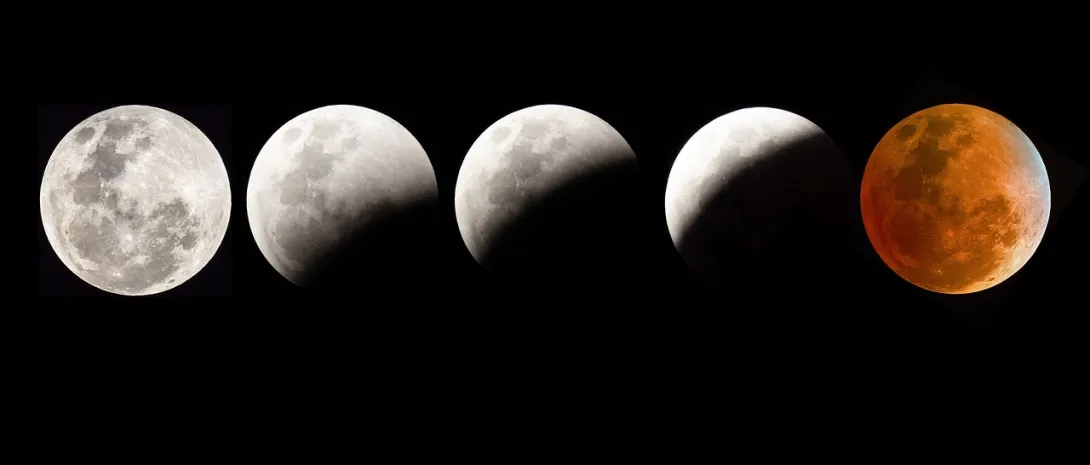
On March 3, skywatchers worldwide will witness a total lunar eclipse, famously producing the striking “blood moon” effect as Earth’s shadow envelops the moon. Astronomers explain that the reddish hue results from sunlight refracting through Earth’s atmosphere, filtering shorter wavelengths and casting a deep crimson glow. The phenomenon offers both scientific and cultural significance, attracting enthusiasts, researchers, and media coverage alike. Analysts note that astronomical events of this magnitude also stimulate local tourism, telescope equipment sales, and science-related merchandising, generating economic activity estimated in several Rs. crores, while fostering global interest in space science and observational astronomy.
Understanding the ‘Blood Moon’ Effect
A total lunar eclipse occurs when the Earth positions itself directly between the Sun and the Moon, casting a shadow that fully covers the lunar surface. The reddish coloration arises from Rayleigh scattering, the same atmospheric effect that makes sunsets appear red, bending sunlight into the Earth’s shadow. This natural optical display has fascinated humans for millennia, inspiring cultural interpretations, myths, and astronomical study.
Viewing Opportunities and Best Practices
The eclipse will be visible across Asia, Africa, Australia, and parts of Europe, with peak totality expected to last approximately 75 minutes. Astronomy organizations recommend observing the event with the naked eye, binoculars, or telescopes for enhanced detail. Educational institutions and observatories are hosting public viewing events, providing safe guidance and increasing engagement with STEM fields. Analysts suggest such events can lead to measurable boosts in educational tourism and equipment sales, as enthusiasts invest in telescopes, cameras, and astronomy accessories.
Scientific and Cultural Significance
Beyond its visual spectacle, the blood moon provides opportunities for scientific research, including lunar surface studies, atmospheric analysis, and photometric measurements. Cultural historians note that eclipses often hold symbolic significance, appearing in folklore, literature, and artistic expression. The combined scientific and cultural attention amplifies public engagement, highlighting astronomy as a multidisciplinary field with educational, cultural, and economic impact.
Economic Implications
While a celestial event is primarily experiential, it indirectly generates economic activity. Telescope retailers, astronomy clubs, observatories, and local tourism agencies benefit from increased interest, translating into sales and ticketed events worth several Rs. crores in aggregate. Digital platforms also experience spikes in content consumption, including live streaming, educational webinars, and astronomical photography, further expanding revenue streams associated with the phenomenon.
Conclusion
The total lunar eclipse on March 3 promises a rare and visually stunning “blood moon,” merging scientific intrigue, cultural resonance, and economic opportunity. By blending observational astronomy with public engagement, the event underscores how natural phenomena can drive both intellectual curiosity and commercial activity. For enthusiasts, researchers, and casual observers alike, the upcoming eclipse represents a moment to witness the intersection of celestial mechanics, human culture, and measurable economic influence.
Comments