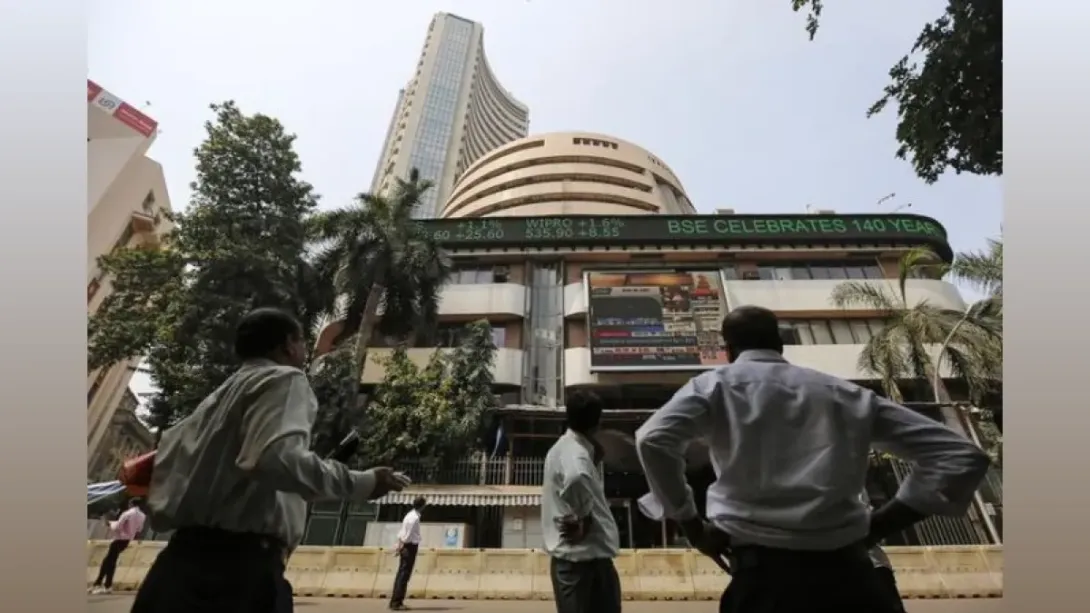
India’s equity markets witnessed a sharp correction during the latest trading week, resulting in a combined erosion of approximately Rs 2.81 lakh crore in the market capitalization of several leading companies. The decline reflects heightened volatility in global financial markets, cautious investor sentiment, and sector-specific pressures across banking, information technology, and energy stocks. Major corporate giants including Reliance Industries, Tata Consultancy Services, Infosys, and HDFC Bank experienced valuation declines. Analysts say the correction reflects routine market cycles, although it underscores the sensitivity of equity markets to global economic signals and institutional investment flows.
Stock Market Correction Impacts Corporate Valuations
India’s stock market recently experienced a notable period of volatility, resulting in a substantial decline in the combined market value of some of the country’s largest listed companies. During the week, the total market capitalization of these corporate heavyweights fell by around Rs 2.81 lakh crore.
Market capitalization, calculated by multiplying a company’s share price by its outstanding shares, is widely used as a measure of a company’s market value. When share prices fall amid investor sell-offs or profit-booking, the overall valuation of companies declines accordingly.
The recent drop illustrates how even well-established companies can experience temporary valuation fluctuations during uncertain market conditions.
Major Blue-Chip Companies See Value Erosion
Among the companies most affected by the correction were several prominent blue-chip firms that dominate India’s benchmark stock indices.
Shares of Reliance Industries, one of the country’s largest conglomerates with interests spanning energy, retail, and telecommunications, experienced a decline that reduced its overall market value.
Similarly, leading technology firms such as Tata Consultancy Services and Infosys saw their valuations slip amid cautious investor sentiment toward global technology spending.
In the financial sector, HDFC Bank also recorded a reduction in market capitalization, reflecting broader pressures on banking stocks amid evolving interest rate expectations.
Global Economic Factors Influence Investor Behavior
Market experts attribute the recent correction to a combination of international and domestic factors. Global financial markets have been navigating uncertainty surrounding interest rate policies, geopolitical tensions, and economic growth prospects.
Such developments often lead investors to rebalance their portfolios, particularly in emerging markets where foreign institutional investment plays a significant role.
When international funds adjust their exposure, large-cap companies—such as Reliance Industries and Tata Consultancy Services—frequently experience the most pronounced price movements due to their substantial weight in benchmark indices.
Sector-Specific Pressures Add to Market Volatility
Beyond global economic developments, sector-specific concerns have also contributed to the market correction. Technology companies have faced questions about slowing demand in certain international markets, which has weighed on investor sentiment toward IT stocks.
Meanwhile, banking and financial services companies have been closely watched for signals regarding credit growth, asset quality, and regulatory developments. Changes in interest rate expectations can directly influence banking sector valuations, affecting companies such as HDFC Bank.
Energy and conglomerate businesses like Reliance Industries are also influenced by fluctuations in global commodity prices, which can shape investor expectations about future earnings.
Long-Term Fundamentals Remain Strong
Despite the recent decline of Rs 2.81 lakh crore in combined market capitalization, many analysts remain optimistic about the long-term prospects of India’s corporate sector.
India continues to benefit from strong economic growth, expanding digital infrastructure, and a growing consumer base. These structural factors provide a solid foundation for corporate earnings over the long term.
Market corrections, experts say, are an inherent feature of equity markets and often serve to stabilize valuations after periods of rapid growth.
Investor Outlook and Market Perspective
For investors, periods of volatility can serve as a reminder of the importance of maintaining a long-term investment perspective. While short-term fluctuations may generate concern, they can also present opportunities for investors seeking to accumulate high-quality stocks at more attractive valuations.
Companies with strong balance sheets, diversified revenue streams, and robust corporate governance—such as Infosys and Tata Consultancy Services—are widely viewed as resilient players capable of navigating economic cycles.
As market conditions stabilize, analysts expect investor confidence to gradually return, reinforcing the central role of India’s leading corporations in the country’s financial and economic landscape.
Comments