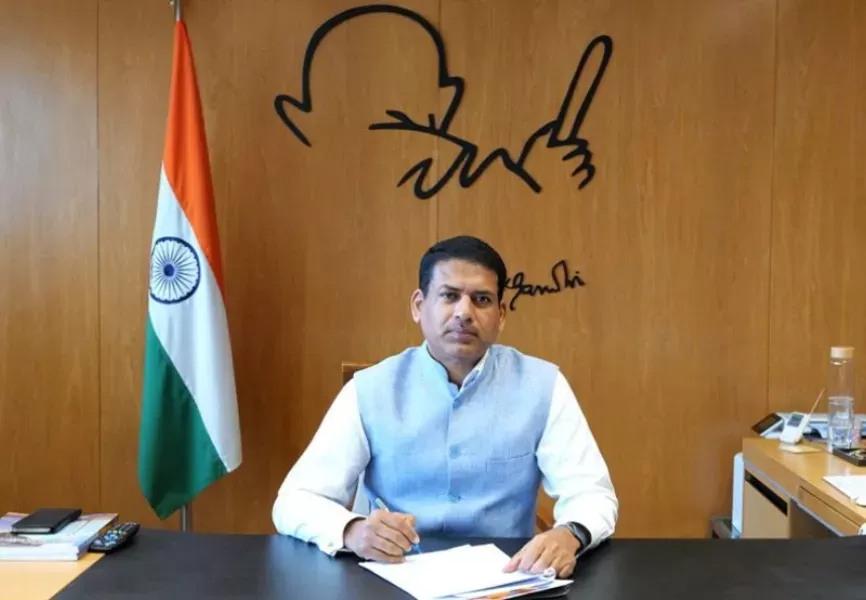
In a significant development within India’s renewable energy sector, Santosh Kumar Sarangi, Secretary of the Ministry of New and Renewable Energy, has been appointed interim Chairman and Managing Director (CMD) of the Solar Energy Corporation of India (SECI). This leadership change follows the abrupt termination of Rameshwar Prasad Gupta’s tenure, just one year into his two-year term. The move has stirred political controversy, with opposition parties linking Gupta’s exit to ongoing international scrutiny of billionaire Gautam Adani and his business dealings. At the center of it all stands SECI, India’s flagship agency for advancing its ambitious clean energy goals.
Interim Appointment Signals High-Level Shift at SECI
The Ministry of Personnel has issued an official directive assigning Santosh Kumar Sarangi, a seasoned bureaucrat and current Secretary of the Ministry of New and Renewable Energy (MNRE), additional charge as CMD of SECI. The decision takes immediate effect and will remain in force until a permanent appointment is made or further notice is issued.
Sarangi's appointment follows the sudden and unelaborated termination of Rameshwar Prasad Gupta, who assumed the role in June 2023. Gupta, a 1987 batch IAS officer from the Gujarat cadre, had previously served as Secretary of the Ministry of Environment, Forest and Climate Change. The absence of an official explanation for his early removal—more than a month before the conclusion of his two-year term—has prompted speculation in policy and political circles.
Political Undercurrents: Gupta’s Exit and the Adani Allegations
Shortly after Gupta’s termination, political controversy erupted. Senior Congress leader Jairam Ramesh alleged that Gupta’s removal is potentially linked to a broader scandal involving Gautam Adani. Referring to a U.S. indictment reportedly implicating SECI on November 20, 2024, in a case concerning Adani and his associates, Ramesh asserted that the government is attempting to obscure what he called the "Adani scam."
While these allegations remain unsubstantiated in the Indian legal context, their timing raises questions. The silence surrounding Gupta’s dismissal may feed a perception of opacity, particularly in a public sector landscape where transparency and accountability are cornerstones of public trust.
SECI’s Strategic Role in India’s Green Energy Push
As the designated nodal agency for renewable energy implementation in India, SECI holds a pivotal position in the nation’s clean energy mission. Established under the Ministry of New and Renewable Energy, it is responsible for executing large-scale solar and wind power projects, facilitating auctions, and supporting public-private partnerships in green infrastructure.
Classified as a Navratna public sector enterprise, SECI commands strategic importance both domestically and in global climate policy circles. Its ability to function efficiently hinges not only on regulatory autonomy but also on stable leadership that can foster investor confidence and steer the agency through complex policy and geopolitical landscapes.
Broader Implications for Governance and Sectoral Stability
The timing of this leadership transition comes at a sensitive juncture. India is targeting 500 GW of non-fossil fuel energy capacity by 2030, and SECI’s role in achieving this is irreplaceable. Any disruption in its leadership, especially amid allegations of political interference, could introduce uncertainty into an ecosystem that relies heavily on clear, consistent policy direction.
Moreover, the potential linkages to international investigations—however circumstantial—highlight the vulnerabilities of state institutions in the face of global financial scrutiny. With foreign investments flowing into India’s renewable sector, governance practices at leading agencies like SECI are under more international observation than ever before.
The Road Ahead
For now, Sarangi’s dual charge offers continuity in the short term, but the need for a dedicated full-time CMD remains urgent. As India accelerates its energy transition, SECI’s operational and reputational resilience will be tested. Stakeholders—domestic and international—will be watching closely for signs of stability, transparency, and effective leadership.
The government would be well advised to clarify the circumstances of Gupta’s exit and expedite the appointment of a permanent successor with the credentials to inspire confidence in the sector. Only then can SECI fully recommit to its mission of powering India’s renewable future without distraction.
Comments