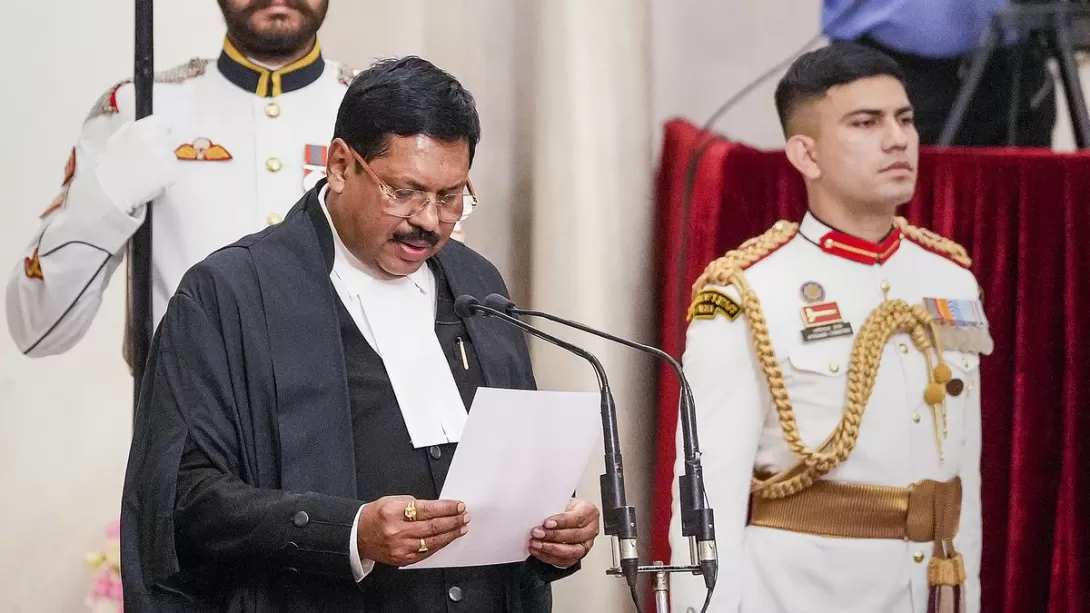
In a significant milestone for India's judiciary, Justice Bhushan Ramkrishna Gavai was sworn in as the 52nd Chief Justice of India (CJI) in a ceremony held at Rashtrapati Bhavan. Administered the oath by President Droupadi Murmu, Justice Gavai's appointment is historic—not only is he the first Buddhist to hold the post, but also only the second individual from the Dalit community to ascend to the nation’s top judicial office. A jurist with deep roots in Ambedkarite philosophy, Justice Gavai succeeds CJI Sanjiv Khanna and is expected to serve until his mandatory retirement on November 23, 2025.
A Historic Appointment in India’s Judiciary
Justice B.R. Gavai's elevation to the apex of the Indian judiciary marks a turning point for diversity and inclusion within the nation’s legal landscape. Taking the oath at the prestigious Rashtrapati Bhavan, his appointment not only affirms the growing representation of marginalized communities but also signals a broader shift toward a more inclusive judiciary.
He is the first Buddhist and the second Dalit to assume the role of Chief Justice, following in the footsteps of Justice K.G. Balakrishnan, who served as the 37th CJI from 2007 to 2010.
Background and Early Life
Born on November 24, 1960, in Amravati, Maharashtra, Justice Gavai grew up in a family deeply influenced by the teachings of Dr. B.R. Ambedkar. His father, the late R.S. Gavai, was a distinguished politician, scholar, and governor who held constitutional posts in Bihar, Sikkim, and Kerala. An active figure in the Republican Party of India, R.S. Gavai was known for his commitment to Dalit empowerment and Ambedkarite ideals—a legacy that Justice Gavai now brings to the country's highest bench.
Justice Gavai earned his law degree from the University of Mumbai and began practicing at the Bombay High Court, eventually rising through the ranks due to his diligence, clarity of thought, and judicial temperament.
Judicial Career and Notable Contributions
Justice Gavai’s career on the bench spans decades, starting with his appointment as a judge of the Bombay High Court in 2003. Over the years, he built a reputation for balanced jurisprudence and a deep understanding of constitutional law. His tenure at the Supreme Court, which began in May 2019, saw him preside over several high-profile cases involving civil liberties, administrative law, and constitutional interpretation.
Legal scholars and practitioners alike have commended his ability to blend legal precision with empathy—an approach that resonates with his social background and the philosophical legacy of his upbringing.
Tenure and Expectations
Justice Gavai will serve as Chief Justice until November 23, 2025, succeeding Justice Sanjiv Khanna, who demitted office on May 13. Though his term will span approximately 18 months, it is expected to be eventful, with crucial cases on electoral reforms, civil rights, and institutional accountability likely to reach the court’s docket.
There is also a growing expectation that under his leadership, the Supreme Court may take more definitive stances on judicial transparency and efficiency—issues that have long challenged the Indian legal system.
Symbolism and Significance
Beyond jurisprudence, Justice Gavai’s appointment is a powerful symbol of social mobility and democratic resilience. It underscores the principle that India’s constitutional offices are open to all, regardless of caste, creed, or religion—a core value of the republic envisioned by Dr. Ambedkar.
His rise to the highest judicial office reflects not only personal achievement but also the aspirations of millions from historically disadvantaged communities, particularly those aligned with the Ambedkarite movement and Buddhist philosophy.
Conclusion
Justice Bhushan Ramkrishna Gavai's assumption of the office of Chief Justice of India is more than a ceremonial transition—it is a moment of national significance. Rooted in a legacy of social justice and legal acumen, his leadership arrives at a time when the judiciary is under close public and institutional scrutiny. The coming months will determine how Justice Gavai navigates the complex intersection of law, politics, and public trust. For now, his appointment stands as a testament to the evolving inclusivity of India's democratic institutions.
Comments