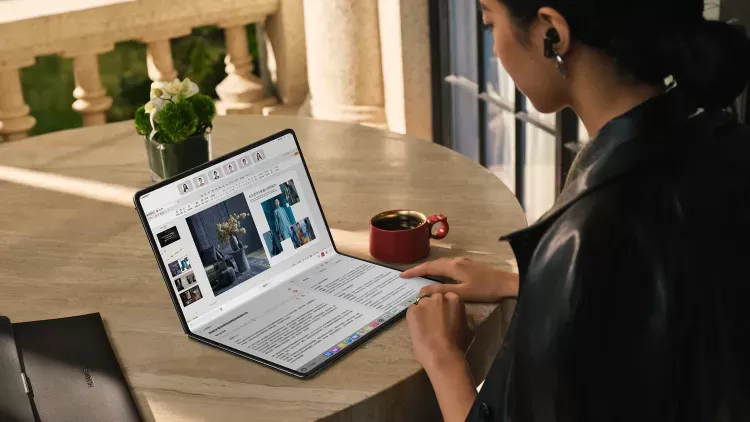
Huawei has launched a groundbreaking entry into the foldable computing market with the MateBook Fold Ultimate, a premium device that blends cutting-edge hardware, proprietary software, and a bold divergence from the Windows ecosystem. This 18-inch foldable laptop, running on Huawei’s HarmonyOS 5, is now available for pre-order in China and is poised to redefine how consumers perceive ultra-portable, productivity-driven devices. Priced between Rs. 2,85,000 and Rs. 3,20,000, the MateBook Fold Ultimate positions itself in the high-end market segment, signaling Huawei’s commitment to innovation in a geopolitically charged tech environment.
A Bold Step Away from Windows: Embracing HarmonyOS 5
In a strategic move away from reliance on U.S.-based software, Huawei has loaded its latest foldable laptop with HarmonyOS 5—its proprietary operating system developed in the aftermath of U.S. trade restrictions. The company’s decision to forego Windows in favor of a homegrown OS reflects not only growing technological self-reliance but also a potential shift in how global OEMs view the future of operating systems.
HarmonyOS 5 is tailored for seamless cross-device integration within Huawei's ecosystem, offering potential advantages in workflow continuity between laptops, smartphones, tablets, and IoT devices. While its app ecosystem is still maturing compared to Windows or macOS, Huawei appears to be betting on synergy and user experience over platform conformity.
Form Meets Function: Hardware That Redefines Portability
The MateBook Fold Ultimate features an 18-inch OLED LTPO display that folds seamlessly into a compact form factor weighing just 1.16kg and measuring 14.9mm when closed. When unfolded, the screen boasts a resolution of 3296 x 2472 with a 4:3 aspect ratio. In folded "laptop mode," the resolution adjusts to 2472 x 1648 with a 3:2 ratio, enhancing productivity. The panel peaks at 1600 nits brightness and offers eye-friendly features like 1440Hz PWM dimming.
Durability hasn't been compromised in pursuit of elegance. The screen incorporates a non-Newtonian fluid protective layer and carbon fiber reinforcements, while the body is constructed using a three-layer aluminum design. The result is a product that not only looks and feels premium but also promises enhanced longevity, with Huawei claiming 30% lower power consumption and triple the lifespan of standard OLED panels.
Design Elegance with Professional Utility
Huawei’s attention to detail is evident in the peripheral design. Users who prefer tactile input can opt for the included 5mm-thin wireless keyboard made from aluminum alloy. With a 1.5mm key travel and a lightweight build at 290g, the keyboard ensures that the combined weight of the laptop setup remains under 1.5kg.
Inside, the MateBook Fold Ultimate is packed with 32GB of RAM and is offered in 1TB and 2TB SSD configurations. The exact chipset remains undisclosed, but thermal efficiency is maintained through a vapor chamber and dual slim fans—a setup typically reserved for performance-oriented ultrabooks. Rounding out the specifications are a 74.69Wh battery, dual USB-C ports, six speakers, and four microphones, along with dual-band Wi-Fi 6 and Bluetooth 5.2 for seamless connectivity.
Each device also includes a 140W USB-C charger, cable, a matching carrying case, and is available in three sleek colorways.
Stock Market Implications and Investor Outlook
Huawei remains a privately held company and is not publicly traded. However, the ripple effects of its aggressive expansion into foldable laptops may have implications for publicly listed competitors like Lenovo, HP, Dell, and Apple.
For instance, Lenovo Group Ltd. (HKEX: 0992), which was among the early adopters of foldable laptop technology, may face renewed competitive pressure, especially in the Chinese and broader Asian markets. Huawei’s ecosystem-first strategy combined with its in-house OS may also influence investor expectations around vertically integrated tech models, potentially raising the bar for R&D spending across the industry.
Meanwhile, Microsoft Corp. (NASDAQ: MSFT)—a key supplier of Windows OS—might see marginal downstream impact from large-scale device manufacturers like Huawei opting out of the Windows ecosystem. While the global Windows user base is unlikely to erode overnight, the trend underscores a long-term strategic risk: the slow but steady rise of OS alternatives rooted in national sovereignty and regulatory insulation.
Strategic Context: Tech Innovation in a Fragmented Geopolitical Climate
Huawei’s launch of the MateBook Fold Ultimate must also be viewed through a geopolitical lens. Amid ongoing U.S.-China tech decoupling and growing regulatory scrutiny over foreign software dependencies, Huawei’s product strategy sends a clear message: technological self-reliance is both feasible and market-ready.
While the product is currently exclusive to China, its release sets a precedent. The question for global markets is not merely whether the MateBook Fold Ultimate will be exported, but whether other hardware manufacturers will follow Huawei’s lead in developing vertically integrated, software-agnostic ecosystems.
Conclusion: A High-Stakes Bet on the Future of Computing
The Huawei MateBook Fold Ultimate is not just a laptop—it’s a bold statement about the future of computing, sovereignty in software ecosystems, and the next frontier of portable productivity. Whether it can challenge the global dominance of Windows-based devices remains to be seen, but for now, Huawei has reignited the conversation about what premium computing can—and perhaps should—look like in the post-Windows era.
Comments