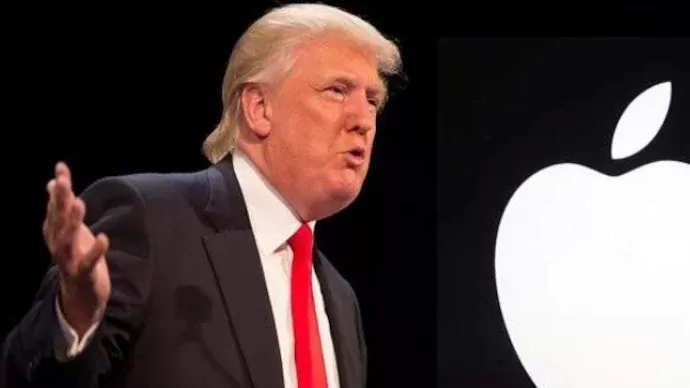
As Apple intensifies its manufacturing operations in India, producing iPhones worth Rs. 1.83 lakh crore in a single fiscal year, former U.S. President Donald Trump has publicly criticized the move, urging the tech giant to prioritize domestic production instead. His remarks, driven by the “Make America Great Again” philosophy, highlight a growing geopolitical tension between economic nationalism and global supply chain efficiency. Despite Trump’s stance, Apple continues to deepen its investments in India, citing cost benefits, skilled labor, and strategic diversification away from China amid escalating trade disputes.
Trump’s Objection: Economic Nationalism Meets Global Strategy
In a blunt rebuke delivered during a business summit in Doha, former U.S. President Donald Trump voiced discontent with Apple’s expanding footprint in India. Addressing Apple CEO Tim Cook directly, Trump reportedly warned against diverting manufacturing investments abroad, arguing that the company should prioritize job creation and production within the United States.
His critique is rooted in the core tenets of his “Make America Great Again” campaign, which champions the repatriation of industrial jobs and domestic economic self-reliance. Trump also took issue with India’s high tariff regime and perceived market opacity, asserting that “India can take care of themselves.”
While his comments reflect an enduring protectionist worldview, they also stand at odds with the modern realities of tech manufacturing—where cost efficiency, geopolitical risk mitigation, and global talent pools are essential to long-term scalability.
India’s Manufacturing Emergence: Apple’s Pivot East
Apple’s decision to expand production in India is not merely a cost-cutting measure; it is part of a long-term strategic realignment. From April 2024 to March 2025, the Cupertino-based tech firm manufactured iPhones worth Rs. 1.83 lakh crore—approximately $22 billion—in India, marking a 60% year-on-year surge. Nearly 15% of Apple’s global iPhone production now originates from Indian facilities.
This shift includes the manufacture of flagship models such as the iPhone 16 Pro and 16 Pro Max, assembled in partnership with suppliers like Foxconn, Pegatron, and Tata Electronics. Even Apple’s AirPods are now being assembled in India, signaling a broader supply chain migration beyond smartphones.
India’s appeal lies in its vast pool of technically skilled labor, competitive production costs, and a policy environment that increasingly favors foreign direct investment in high-tech manufacturing. The country is emerging not just as a production base but as an integral link in Apple’s global value chain.
Strategic Diversification: Navigating Beyond China
Apple’s increasing reliance on India is, in part, a response to the risks posed by a highly concentrated manufacturing base in China. Trade tensions between Washington and Beijing, coupled with unpredictable tariffs and rising operational costs, have incentivized companies to diversify production.
India offers a politically stable alternative with lower labor costs and a burgeoning ecosystem of local and international suppliers. Foxconn’s commitment of $1.5 billion to its Indian subsidiary underscores this transition, serving both Apple’s manufacturing needs and India’s ambition to become a global electronics hub.
The Cost of Coming Home: Economic Implications of Reshoring
Analysts caution that relocating Apple’s manufacturing operations back to the U.S., as Trump demands, could prove economically unfeasible. According to a Bank of America report, such a move could inflate iPhone production costs by as much as 25%, primarily due to higher American labor costs and the need for extensive capital investment in new facilities.
This would likely translate into higher retail prices for consumers worldwide and a potential contraction in Apple’s profit margins. For Indian consumers, the ripple effects could mean reduced affordability and a slowdown in product availability. For U.S. consumers, it could undermine Apple’s pricing competitiveness against global rivals.
A Case for Collaboration: Globalization Over Isolation
Experts such as CA (Dr.) Suresh Surana argue for a more nuanced approach—advocating for a collaborative Indo-U.S. model that leverages India’s cost advantages and America’s strengths in innovation and branding. He notes that U.S. tech giants like Microsoft and Google have long benefited from Indian talent and offshore efficiencies. The same logic, he suggests, should apply to manufacturing.
Rather than forcing a binary choice between onshoring and offshoring, a distributed, hybrid model could better serve both economies—bolstering global competitiveness while preserving national interests.
Apple's Commitment to India Remains Unshaken
Despite Trump’s remarks, Apple appears steadfast in its commitment to India. Reports indicate that senior executives have reassured Indian authorities of their long-term investment intentions. This not only fortifies India’s position in global supply chains but also signals to other multinational corporations that India is a reliable, scalable, and economically viable production base.
Apple’s Indian manufacturing expansion also dovetails with New Delhi’s “Make in India” initiative, creating a rare alignment between corporate strategy and national policy. The symbiosis offers economic upliftment through job creation, technology transfer, and export revenue—while allowing Apple to mitigate global risks and preserve profitability.
Conclusion: Realigning the Global Tech Economy
Trump’s critique of Apple’s India strategy underscores a broader ideological clash between globalization and protectionism. In a world where supply chains are complex and interdependent, forcing companies to retreat into national boundaries risks undermining their competitiveness and stifling innovation.
Apple’s bet on India is not a betrayal of American economic interests—it’s a calculated move to future-proof its business against geopolitical shocks and market volatility. As the tech world adapts to new economic realities, policies must evolve beyond slogans. Strategic collaboration, not isolationism, is the key to sustainable growth in a truly interconnected world.
Comments