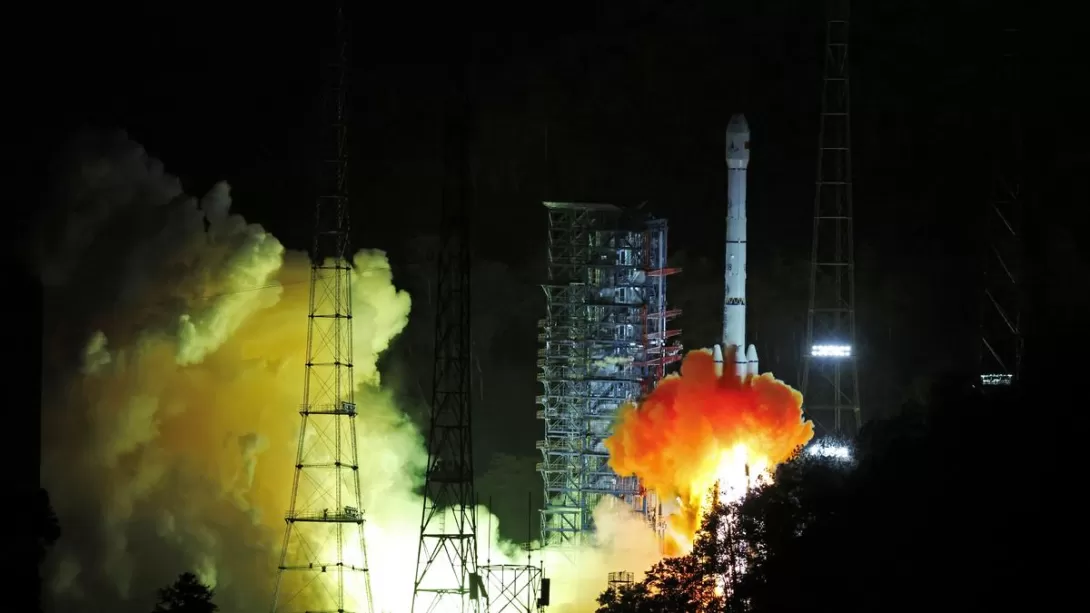
China has launched its Tianwen-2 spacecraft, marking a significant advancement in its interplanetary exploration efforts. Launched on May 29, 2025, aboard the Long March 3-B rocket, Tianwen-2 is tasked with collecting samples from asteroid 2016 HO3 and conducting an in-depth study of the distant main-belt comet 311P. The China National Space Administration (CNSA) highlights that this mission aims to deliver pioneering insights into the early solar system and expand humanity’s cosmic understanding. This ambitious endeavor positions China as a key player in the global space exploration race, showcasing its growing technological capabilities.
Launch and Mission Objectives
The Tianwen-2 probe successfully lifted off from southern China early Thursday morning, propelled by the reliable Long March 3-B rocket. This mission targets two distinct celestial bodies: asteroid 2016 HO3, which is in near-Earth orbit but near Mars in proximity, and the main-belt comet 311P, located in the asteroid belt further from Earth than Mars.
CNSA officials have emphasized the mission’s dual objectives — not only to retrieve physical samples from 2016 HO3, which could hold clues about the primordial matter that shaped our solar system, but also to investigate the composition and behavior of comet 311P, which may provide critical information about volatile compounds in space.
Scientific Significance and Expected Outcomes
The return of asteroid samples to Earth is a pivotal step in understanding the building blocks of planetary formation and the origins of water and organic compounds on Earth. Analyzing these materials in terrestrial laboratories allows scientists to perform detailed isotopic and mineralogical studies impossible through remote sensing alone.
By integrating sample collection with comet exploration, the Tianwen-2 mission aims to achieve a comprehensive survey of primitive celestial bodies, potentially unlocking new data on the early solar nebula and the processes governing small-body dynamics. Such findings could have far-reaching implications for planetary science, astrobiology, and future space resource utilization.
Strategic Implications for China’s Space Program
The Tianwen-2 mission underscores China’s strategic commitment to establishing itself as a leading spacefaring nation. Following the successes of its lunar exploration program and Mars rover missions, this probe adds a critical interplanetary sample-return capability to China’s portfolio.
The mission’s complexity and scope highlight China’s expanding technological proficiency, from precision spacecraft navigation to autonomous sample retrieval in deep space. This capability strengthens China’s position in international collaborations and competition, potentially influencing future commercial and scientific partnerships in space exploration.
Conclusion
As the Tianwen-2 probe embarks on its pioneering voyage, the global scientific community awaits with anticipation. The successful retrieval and analysis of extraterrestrial samples will deepen humanity’s understanding of our cosmic neighborhood and the origins of life-essential compounds. China’s bold stride into asteroid and comet exploration signifies a new chapter in space research, reflecting both the nation’s technological ambition and its contribution to collective knowledge about the solar system’s formative years.
Comments