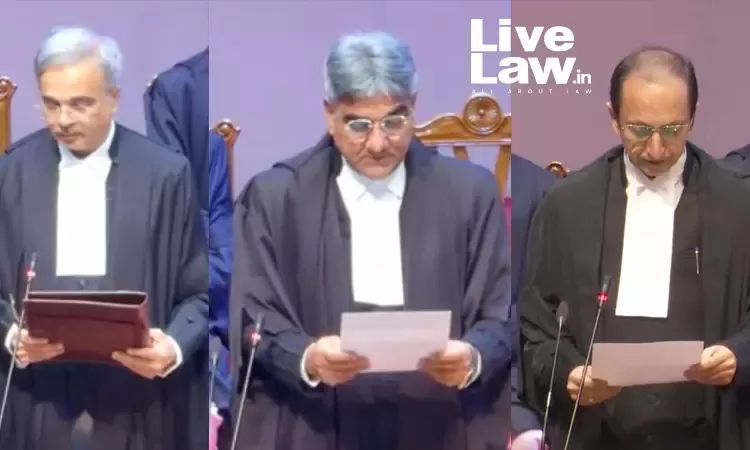
The Supreme Court of India welcomed three new judges today—Justices N.V. Anjaria, Vijay Bishnoi, and Atul S. Chandurkar—solidifying the Court's full complement of 34 judges. Their appointments, which were approved by the President on May 29 following recommendations from the Supreme Court Collegium, reflect a broadening of judicial perspectives across different High Courts. Justice Anjaria previously served as Chief Justice of the Karnataka High Court, Justice Bishnoi as Chief Justice of the Gauhati High Court, and Justice Chandurkar as a judge of the Bombay High Court. Chief Justice D.Y. Chandrachud administered the oaths in a ceremony underscoring the Supreme Court’s commitment to justice and diversity.
New Judicial Appointments Cement Court’s Full Strength
The appointments of Justices N.V. Anjaria, Vijay Bishnoi, and Atul S. Chandurkar have restored the Supreme Court of India to its sanctioned strength of 34 judges. This development follows a May 26 recommendation by the Supreme Court Collegium, subsequently approved by the President and formally notified by the Centre on May 29.
Justice Anjaria, whose parent High Court is Gujarat, most recently served as Chief Justice of the Karnataka High Court. His tenure on the Supreme Court bench is slated to continue until March 23, 2030. Similarly, Justice Bishnoi, originating from the Rajasthan High Court and formerly Chief Justice of the Gauhati High Court, will serve until March 25, 2029. Justice Chandurkar, who served as a judge in the Bombay High Court, will hold his Supreme Court seat until April 7, 2030.
Oath Ceremony and Language Choice
Chief Justice of India D.Y. Chandrachud administered the oath of office in a ceremony that underscored the solemnity and gravity of the judicial function. Notably, Justice Vijay Bishnoi chose to take his oath in Hindi, marking a significant moment of linguistic inclusivity within the highest echelons of the judiciary.
The addition of these judges not only brings fresh perspectives but also helps ensure the Supreme Court’s ability to address an increasingly complex docket of constitutional, civil, and criminal cases.
Looking Ahead: Judicial Strength and Upcoming Changes
While the appointments ensure a full bench for the moment, another vacancy looms on the horizon. Justice Bela M. Trivedi is set to retire on June 9, once again opening up a seat on the country’s highest court.
Nevertheless, the Supreme Court’s steady replenishment of its judicial roster underscores the institution’s resilience and its ongoing effort to deliver timely and equitable justice. With a full complement of judges, the Court is well-positioned to continue its crucial role as the guardian of the Constitution and the final arbiter of legal disputes in India.
Conclusion: Renewed Energy for the Apex Court
As the Supreme Court moves forward with its expanded bench, observers anticipate a renewed vigor in tackling the mounting case load and addressing pressing legal questions. The presence of three new judges, each bringing a unique judicial philosophy and a wealth of experience from India’s diverse high courts, bodes well for the judiciary’s enduring commitment to upholding the rule of law and ensuring justice for all.
Comments