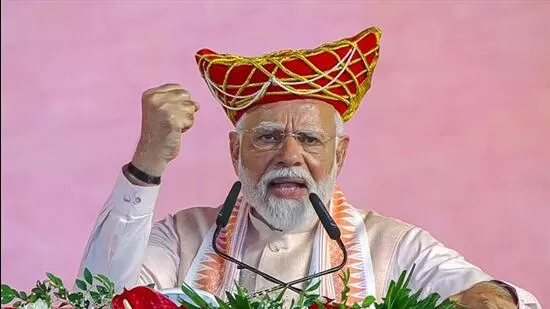
Prime Minister Narendra Modi paid tribute to the legacy of Devi Ahilyabai Holkar, the 18th-century Maratha queen, at a recent event, praising her exemplary governance and reforms aimed at uplifting women, tribals, and marginalized communities. Modi emphasized the importance of her pioneering efforts in women’s rights, including advocating for the raising of the minimum marriage age and securing property rights for women. Reflecting on his government's alignment with these values, Modi highlighted key initiatives such as the Swachh Bharat Mission and Ayushman Bharat, which aim to enhance the lives of women and citizens across India.
PM Modi Honors Devi Ahilyabai Holkar's Role in Women's Empowerment
In a recent speech, Prime Minister Narendra Modi paid heartfelt tribute to Devi Ahilyabai Holkar, recognizing her contributions to India’s culture, governance, and particularly her role in advancing the rights of women. Speaking at a public event, Modi remarked on how Ahilyabai, the ruler of the Holkar dynasty in the 18th century, had pioneered reforms that addressed crucial societal issues—especially those pertaining to women’s welfare. From raising the minimum age of marriage for girls to advocating for the rights of widows, Ahilyabai’s progressive vision transcended the norms of her time.
Ahilyabai Holkar’s Vision of Governance: A Model for Today
Modi further elaborated on the progressive governance model implemented by Ahilyabai during her reign, emphasizing her commitment to the welfare of the underprivileged. She focused on uplifting the marginalized sections of society, notably through her initiatives that promoted employment, entrepreneurship, and self-sufficiency. These efforts were centered around agriculture, cottage industries based on forest produce, and the handicraft sector. Ahilyabai’s rule, according to Modi, was a beacon of governance that not only ensured the wellbeing of her people but also laid the foundation for the empowerment of future generations, particularly women.
A Legacy of Women’s Rights: Devi Ahilyabai’s Progressive Reforms
PM Modi also lauded Ahilyabai’s pioneering efforts to secure women's rights. He drew attention to how she raised the issue of the minimum age for girls’ marriage—a topic considered taboo during her time. Furthermore, Ahilyabai pushed for women’s right to own property and supported the remarriage of widows, advancing progressive ideas that were ahead of her time. Modi contrasted this with current discussions on “secularism,” pointing out that such issues of women’s rights were addressed by Ahilyabai when it was challenging even to talk about them publicly.
Government Schemes Echoing Ahilyabai's Vision of Welfare
Reflecting on the modern-day government’s efforts, Modi highlighted various schemes launched by his administration that echo the values promoted by Ahilyabai Holkar. He pointed to initiatives like the "Drone Didi" program, which empowers rural women, and the "Nal Jal Yojana" that ensures access to clean water for households across India. Modi also highlighted the Swachh Bharat Mission, the Housing for All initiative, and Ayushman Bharat, all of which aim to improve the quality of life for women and their families. These government schemes, Modi emphasized, are not just facilities but are dedicated efforts to honor the role of women—mothers and sisters—in the nation’s progress.
PM Modi and President Murmu’s Shared Vision for Tribal Welfare
In his address, Modi also acknowledged the contributions of President Draupadi Murmu, India’s first tribal woman president, and stated that it was a privilege to work under her leadership. Drawing a parallel between President Murmu and Devi Ahilyabai Holkar, Modi noted how both women have been instrumental in championing the cause of tribal communities and the marginalized. Ahilyabai, Modi said, was an early advocate for the welfare of tribal and nomadic tribes, an effort he sees reflected in President Murmu’s presidency and the government’s ongoing efforts to improve the lives of India’s indigenous populations.
Inauguration of Key Infrastructure Projects in Madhya Pradesh
During the event, PM Modi also inaugurated several key infrastructure projects in Madhya Pradesh. This included the Indore Metro project—the first of its kind in the state—which Modi described as a testament to the progress of the region. Additionally, Modi inaugurated airports in Satna and Datia, further emphasizing the government's commitment to improving connectivity and boosting regional development. These infrastructure projects are expected to create new employment opportunities, especially for women, and contribute to the economic empowerment of the state.
Conclusion: Upholding the Legacy of Women’s Empowerment
PM Modi’s speech underscored how the government’s policies and initiatives are aligned with the progressive ideals set forth by Devi Ahilyabai Holkar. His remarks highlighted the continuity of women’s empowerment from the time of Ahilyabai to the present, drawing clear links between her governance model and the present-day initiatives aimed at improving the lives of the Indian populace. By focusing on the welfare of women, tribal communities, and the marginalized, Modi positioned his government as one that honors the legacy of women leaders like Ahilyabai, while also working toward a more inclusive future for all citizens.
Comments