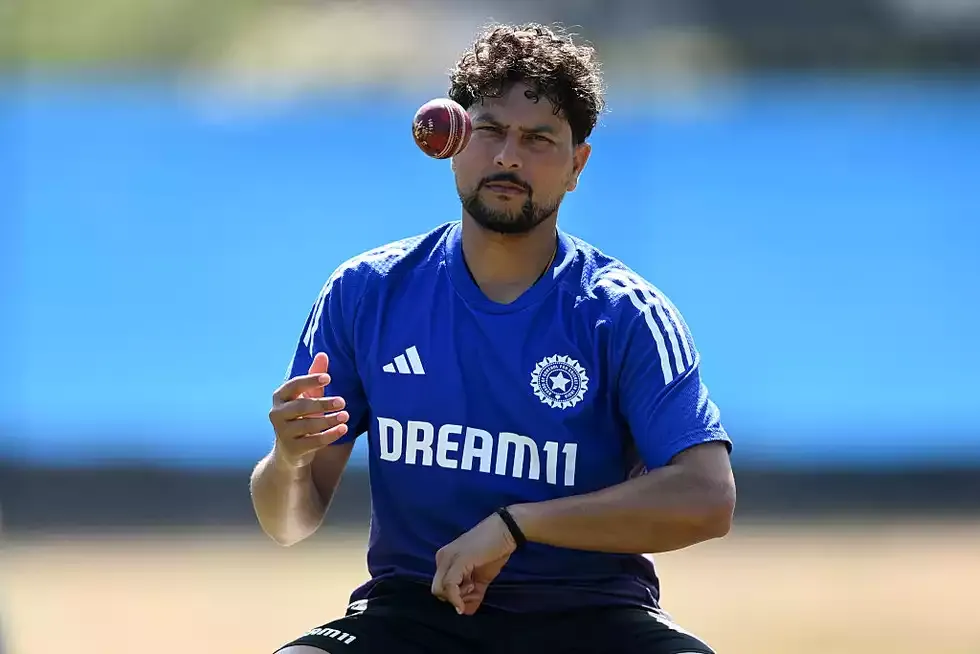
Despite delivering consistently impressive performances over an eight-year Test career with an enviable bowling average of 22.16, Kuldeep Yadav remains an underutilized asset in Indian cricket’s spin department. Overshadowed by generational talents like R. Ashwin and Ravindra Jadeja, and later by the emergence of Axar Patel and Washington Sundar, Kuldeep’s role has been largely peripheral. As India confronts challenging overseas conditions, particularly in England, the question resurfaces: will Kuldeep finally receive the sustained opportunity his skills merit, or continue to be sidelined in favor of perceived safer, all-rounder options?
The Promise and Paradox of Kuldeep Yadav’s Career
When Ravi Shastri, India’s then head coach, declared Kuldeep Yadav the future of Indian spin following a five-wicket haul in Sydney six and a half years ago, expectations soared. However, reality has fallen short of that promise. Kuldeep has played only 13 Tests over eight years, a startlingly low number for a bowler of his caliber. While his bowling average of 22.16 rivals the best, he has been consistently overlooked, often in favor of spinners who bring additional batting prowess.
Kuldeep’s left-arm wrist spin offers an angle and variety seldom found in India’s spin repertoire. Yet, the presence of stalwarts like Ashwin and Jadeja, whose all-round capabilities significantly bolster the team balance, has constrained Kuldeep’s opportunities. When these veterans’ careers began winding down, the rise of Axar Patel — another spin-bowling all-rounder — further diminished Kuldeep’s prospects.
The Selection Conundrum: Balance Versus Impact
The crux of the dilemma lies in team composition strategy. Indian selectors often prioritize players who can contribute with both ball and bat, a prudent approach that safeguards lower-order resilience. Kuldeep, a specialist bowler with limited batting skills, is seen as a potential luxury, especially when the team faces precarious situations such as collapses in the middle order.
Assistant coach Ryan ten Doeschate recently highlighted this tension, underscoring the difficulty in balancing wicket-taking ability with batting depth. “When you're 430 for 3, it's absolutely fine. But when you're 200 for 5, it's a very different ball game,” he remarked, capturing the dilemma faced by India’s selectors.
This approach partly explains why players like Washington Sundar, who offer control and can bat lower down the order, are often preferred over Kuldeep, especially in conditions where all-rounders provide tactical flexibility.
Kuldeep’s Value in Varied Conditions
Kuldeep’s skills have proven especially potent in subcontinental conditions and on pitches traditionally favorable to spin. His ability to spin the ball both ways, combined with deception and sharp variations, poses significant challenges even to accomplished batsmen. In the recent India-England series, his inclusion in Vizag — due to injury substitutions — was pivotal. He took 19 wickets at an average of 20.15, outperforming Ashwin and Jadeja, affirming his match-winning potential.
Even against aggressive batting styles, such as those employing reverse sweeps, Kuldeep’s wrist spin created difficulties. His ability to adapt bowling strategies, switching to defensive lines when required, illustrates his growing maturity and tactical acumen.
Moreover, Kuldeep has shown resilience with the bat, contributing valuable lower-order runs and stabilizing innings when necessary, as seen in his partnership with Dhruv Jurel in Ranchi.
The England Test Series: A Crucial Juncture
As India prepares for Tests in England, conditions that historically challenge spinners, Kuldeep’s role hangs in the balance once again. The prospect of pitches conducive to spin and India’s recent batting dominance, with a mammoth 835-run innings, present an ideal scenario to deploy a wicket-taking specialist.
The team’s current top order has demonstrated robustness against England’s bowling attack, potentially allowing selectors to take calculated risks with their bowling lineup. In this “Bazball” era of aggressive cricket, the conventional preference for safety may paradoxically represent a risk itself.
Assistant coach ten Doeschate indicated a strong likelihood of India fielding two spinners, with Washington Sundar seemingly favored. Yet, the fundamental question remains: should India embrace Kuldeep’s unique skill set to maximize their bowling potency, or continue with the safer, multi-dimensional options?
Conclusion: Will Kuldeep Finally Get His Day?
Kuldeep Yadav’s career narrative is one marked by exceptional talent constrained by strategic conservatism. His limited Test appearances belie his proven effectiveness, creating a compelling case for more consistent inclusion.
In an era demanding bold decisions and dynamic cricketing strategies, Kuldeep’s left-arm wrist spin could be the game-changer India needs. As the Edgbaston Test approaches, selectors face a defining moment — to capitalize on Kuldeep’s wicket-taking prowess or perpetuate a cautious status quo. The answer will significantly impact India’s quest for dominance in the global Test arena.
Comments