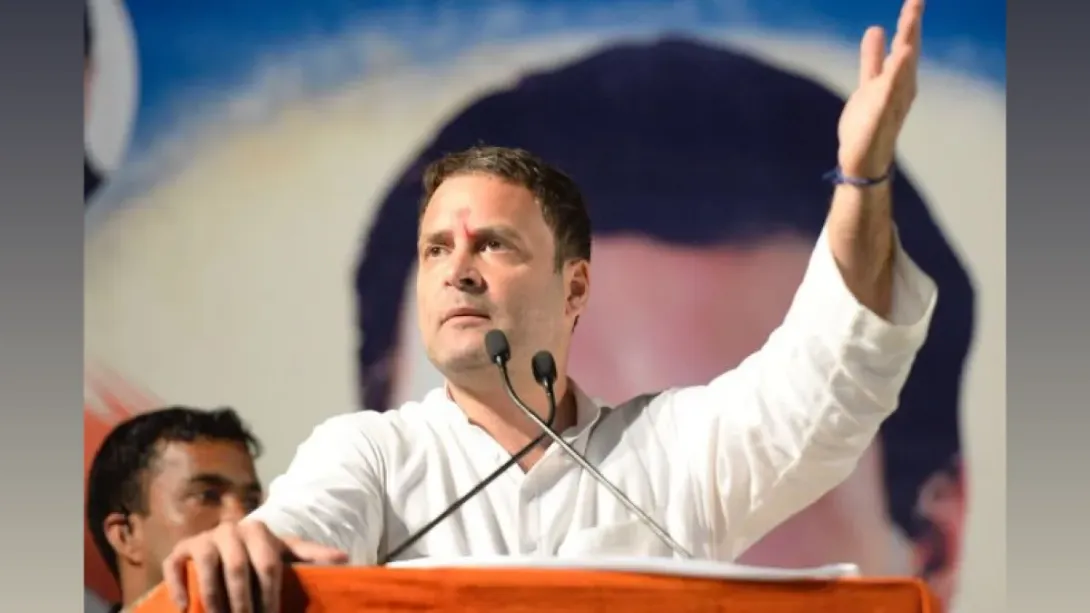
A political sparring match has erupted between the Bharatiya Janata Party (BJP) and Congress leader Rahul Gandhi over recent regulatory action by the Securities and Exchange Board of India (SEBI) against hedge fund Jane Street. Gandhi has accused SEBI of long-standing inaction and alleged market manipulation that harms retail investors. In response, BJP’s IT cell head Amit Malviya refuted the claims, citing the Modi government's reforms that have strengthened SEBI’s independence and fueled retail investor participation in equities and mutual funds. The war of words highlights broader political divisions over market governance, investor protection, and economic literacy.
SEBI’s Action Sparks Political Fallout
The recent clampdown by SEBI on Jane Street Capital, accused of distorting indices through complex derivative trades, has drawn sharp reactions from across the political aisle. Congress leader Rahul Gandhi alleged regulatory inertia and complicity, questioning why SEBI acted only after significant financial damage may have occurred. He argued that India’s Futures & Options (F&O) markets have morphed into arenas favoring institutional players at the expense of small investors.
Gandhi’s remarks, delivered via social media platform X, accused the regulator of staying silent while foreign hedge funds manipulated crores of rupees in market value—an assertion that resonated with his earlier warnings about increasing systemic risk in derivatives trading.
BJP Fires Back: “Action, Not Apathy”
The BJP swiftly rebutted Gandhi’s allegations. Amit Malviya, head of the party’s IT department, characterized Gandhi’s criticism as “fear-mongering” and “uninformed.” He underscored that SEBI’s move to sanction Jane Street is in itself proof that India’s regulatory framework is robust and responsive. “If SEBI was truly silent, there would be no ban, no investigation, no headlines,” Malviya stated.
He further asserted that under Prime Minister Narendra Modi’s leadership, SEBI has gained greater autonomy, transparency, and enforcement powers—attributes he claimed were lacking during the Congress-led governments, citing historical financial scandals such as the Harshad Mehta scam and the collapse of UTI.
A Decade of Market Democratization
Malviya used the occasion to outline the Modi administration’s achievements in capital markets. He noted that India has added USD 1 trillion in market capitalization since March 2025—marking the highest absolute gain among the world’s top 10 equity markets. He attributed this growth to structural reforms, digitization, and policy initiatives aimed at retail investor empowerment.
The mutual fund industry, Malviya said, has seen its assets under management balloon from Rs 8 lakh crore in 2014 to Rs 54 lakh crore in 2025—a 576% increase. Furthermore, the number of unique mutual fund investors has jumped fourfold, from under 1 crore to over 4 crore.
Systematic Investment Plan (SIP) contributions, another barometer of retail participation, have risen 4.5 times in seven years, with retail investors contributing significantly to India’s growing equity base. Since 2020, over 580 companies have gone public through Initial Public Offerings (IPOs), collectively raising over Rs 3 lakh crore and expanding wealth creation opportunities beyond institutional circles.
F&O Markets and the “Big Shark” Debate
Central to Gandhi’s criticism was the concern that India’s F&O markets have tilted in favor of “big sharks” while retail investors absorb mounting losses. The statement comes amid growing regulatory scrutiny of F&O trading volumes and concerns raised in a recent SEBI study showing that nearly 91% of individual traders incurred losses in FY2025.
However, Malviya argued that reforms under the Modi government have ensured greater transparency and risk disclosure, which he says are essential for safeguarding individual investors. He emphasized that SEBI’s interventions are precisely designed to prevent undue market concentration and abusive practices.
Ideological Clashes on Economic Literacy
In a more pointed critique, Malviya dismissed Gandhi’s analysis as lacking economic literacy and accused him of politicizing regulatory actions for partisan gains. He highlighted what he described as hypocrisy in Gandhi’s approach—publicly criticizing the markets while “quietly growing his own portfolio in the background.”
“Strong regulation, democratized access, and increased retail participation are precisely what protect small investors,” Malviya asserted. He framed Gandhi’s comments as emblematic of an outdated political mindset rooted in fear and slogans rather than constructive economic engagement.
Conclusion
The exchange between Rahul Gandhi and the BJP over market regulation reflects a deeper ideological battle over India’s economic direction. At stake is not merely a debate about hedge funds or market dynamics, but the credibility of institutions, the role of retail investors, and the evolving narrative of economic inclusion. While SEBI’s recent enforcement action signals regulatory assertiveness, the political response reveals the extent to which financial governance has become a high-stakes electoral issue. Whether investor trust is better served by confrontation or constructive policy discourse remains an open question—but one with significant consequences for India’s capital markets.
Comments