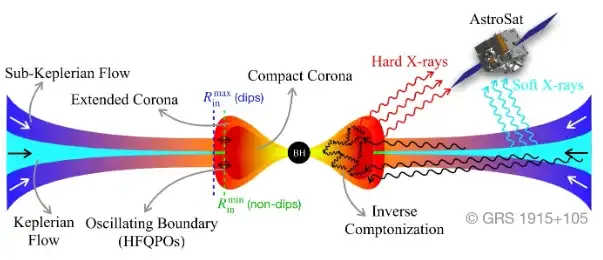
In a groundbreaking scientific development, India’s multi-wavelength space observatory AstroSat has identified periodic X-ray signals from a black hole system, offering unprecedented insight into the behavior of matter spiraling into these gravitational abysses. This rhythmic pulsation, known as quasi-periodic oscillation (QPO), is akin to the heartbeat of the black hole, providing valuable clues about its spin, mass, and the physical properties of its surrounding accretion disk. This discovery not only affirms India’s growing stature in space-based astrophysics but also enhances the global understanding of the timing signatures that mark the final moments of matter before it vanishes beyond the event horizon.
AstroSat’s Milestone in High-Energy Astrophysics
AstroSat, launched by the Indian Space Research Organisation (ISRO), has been instrumental in capturing high-resolution data across ultraviolet and X-ray wavelengths. This latest finding focuses on the observation of quasi-periodic oscillations—minute but measurable flickers of X-ray intensity—emerging from the vicinity of a black hole.
The QPOs detected show a regular, almost clockwork-like fluctuation in X-ray emissions, caused by the turbulent dynamics of the black hole’s accretion disk. These signals are not mere anomalies; they are fundamental to understanding the underlying mechanics of black hole systems, particularly in binary arrangements where a companion star feeds material into the black hole.
The Science Behind Quasi-Periodic Oscillations
QPOs are essentially the result of matter orbiting extremely close to a black hole at relativistic speeds before crossing the event horizon. These oscillations reflect the complex interplay of gravitational, electromagnetic, and centrifugal forces in regions where classical physics no longer holds sway and general relativity dominates.
The rhythmic pattern identified by AstroSat offers a unique diagnostic tool for scientists. By analyzing the frequency and intensity of the pulses, researchers can infer the mass and spin rate of the black hole—parameters that are otherwise notoriously difficult to measure. Moreover, the discovery enables better calibration of theoretical models predicting the behavior of spacetime in extreme environments.
Global Implications for Astrophysics
India’s successful detection of QPOs using its homegrown space technology underscores the nation's increasing contribution to the global astrophysical community. Previously, such observations had been dominated by missions like NASA’s Rossi X-ray Timing Explorer and ESA’s XMM-Newton. AstroSat’s detection affirms its capability to perform at par with international observatories in capturing transient, high-energy cosmic phenomena.
This finding also contributes to the broader effort in multi-messenger astronomy, where data from electromagnetic signals, gravitational waves, and neutrinos are combined to build a holistic view of cataclysmic celestial events. Understanding the temporal rhythms of black holes could help synchronize observations across platforms—ushering in a new era of precision cosmology.
Looking Ahead: New Frontiers in Space Research
With AstroSat’s capabilities validated by this discovery, future missions could focus on real-time monitoring of other black hole systems, neutron stars, or magnetars. The success also paves the way for proposed follow-up missions, such as India’s XPoSat, aimed at polarimetric studies of X-ray sources.
Furthermore, these observations help refine gravitational wave models, especially in the context of mergers involving black holes or neutron stars. As space agencies around the world prepare for deeper space explorations, such time-sensitive data will be instrumental in decoding the life cycles of the universe’s most enigmatic entities.
Conclusion
AstroSat’s identification of a black hole’s rhythmic oscillations marks a watershed moment in Indian and global astrophysics. It captures not just a cosmic phenomenon, but the scientific maturity of a nation that is now contributing critical discoveries to humanity’s understanding of the universe. The steady pulses detected from this celestial void remind us that even in the darkest corners of space, there exists a rhythm—a beat—that tells a story waiting to be understood.
Comments