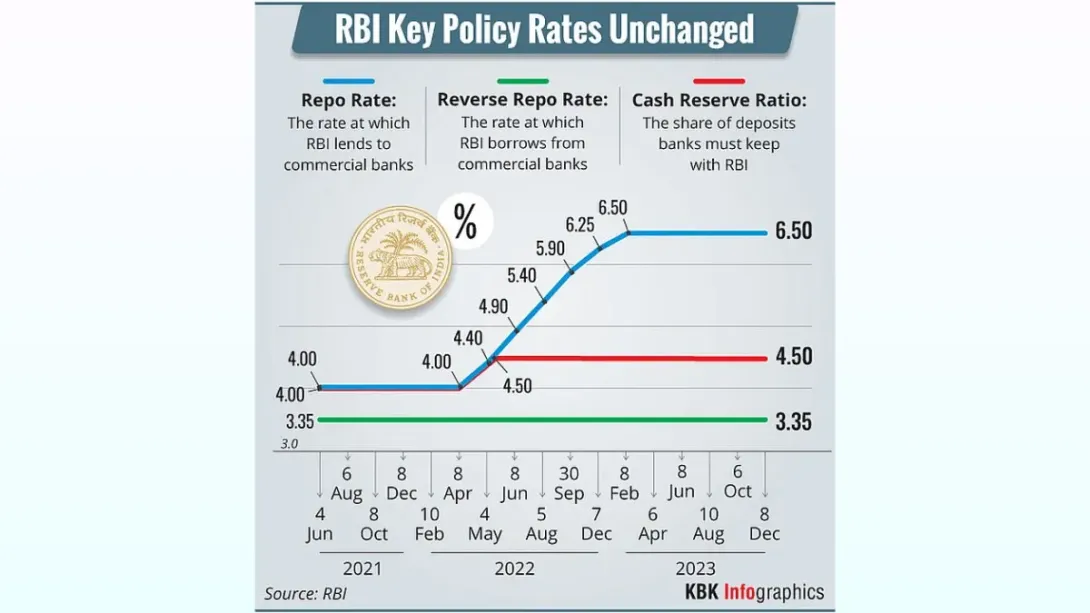
The Reserve Bank of India (RBI) has opted to maintain the benchmark repo rate at 5.50%, citing inflationary risks stemming from global tariff uncertainties and volatile commodity prices. This decision marks a cautious stance by the central bank as it weighs the implications of geopolitical tensions, elevated food costs, and potential external shocks. While growth remains stable, the RBI emphasized its commitment to price stability and calibrated policy responses. Analysts interpret this pause as a signal of watchful patience, with the central bank keeping its options open in a shifting macroeconomic landscape.
---
Policy Steady, Caution Elevated
The Monetary Policy Committee (MPC), in its August policy review, unanimously voted to keep the repo rate steady at 5.50%, maintaining a neutral stance. The central bank’s approach reflects a balancing act—protecting fragile economic recovery while guarding against persistent inflation risks, especially those linked to global trade disruptions and import cost escalations.
Governor Shaktikanta Das reiterated that while India’s growth outlook remains intact, external headwinds, such as rising protectionism and supply chain bottlenecks, necessitate a vigilant approach to monetary policy.
---
Inflation in Focus
Although headline inflation has moderated from last year’s highs, recent data indicates renewed pressure in food and energy categories. The RBI acknowledged that rising global tariffs, particularly in essential imports like crude oil and key agricultural commodities, could contribute to price instability in the near term.
To address this, the central bank revised its inflation forecast slightly upward for the upcoming quarters, projecting an average retail inflation rate closer to 4.7%, while still aiming to remain within the 2–6% tolerance band. Core inflation, however, continues to trend downward, offering some cushion to policymakers.
---
Growth Outlook Unchanged
Despite the inflationary concerns, the RBI maintained its GDP growth projection at 7.2% for the current fiscal year. Key drivers include robust private consumption, an uptick in rural demand, and strong services sector performance. Public capital expenditure has also played a role in maintaining momentum.
The central bank, however, warned that if global tariff wars escalate or if monsoon patterns turn erratic, growth dynamics could face mild disruptions. For now, domestic macroeconomic indicators point to resilience, giving the RBI room to hold rates steady without stifling recovery.
---
Market Reaction and Forward Guidance
Financial markets responded positively to the RBI’s cautious tone, with bond yields holding firm and equity indices inching higher. The unchanged rate was broadly in line with investor expectations, though forward guidance indicated that any future tightening would be data-dependent.
In his address, the governor reaffirmed the RBI’s readiness to act if inflation expectations become unanchored, but also hinted at patience and flexibility in policy adjustments. Liquidity conditions are likely to remain stable, with the central bank continuing its nuanced liquidity management to avoid market disruptions.
---
A Delicate Balancing Act
The central bank’s decision to pause rate action underlines its careful navigation through a complex economic terrain. With inflation risks still simmering and external trade dynamics in flux, the RBI appears to be playing the long game—prioritizing macroeconomic stability without overcorrecting too soon.
Analysts expect the central bank to stay in wait-and-watch mode for at least another quarter, while remaining prepared to respond swiftly should risks escalate. In an era of economic uncertainty, this measured approach may offer the steady hand India’s economy needs.
Comments