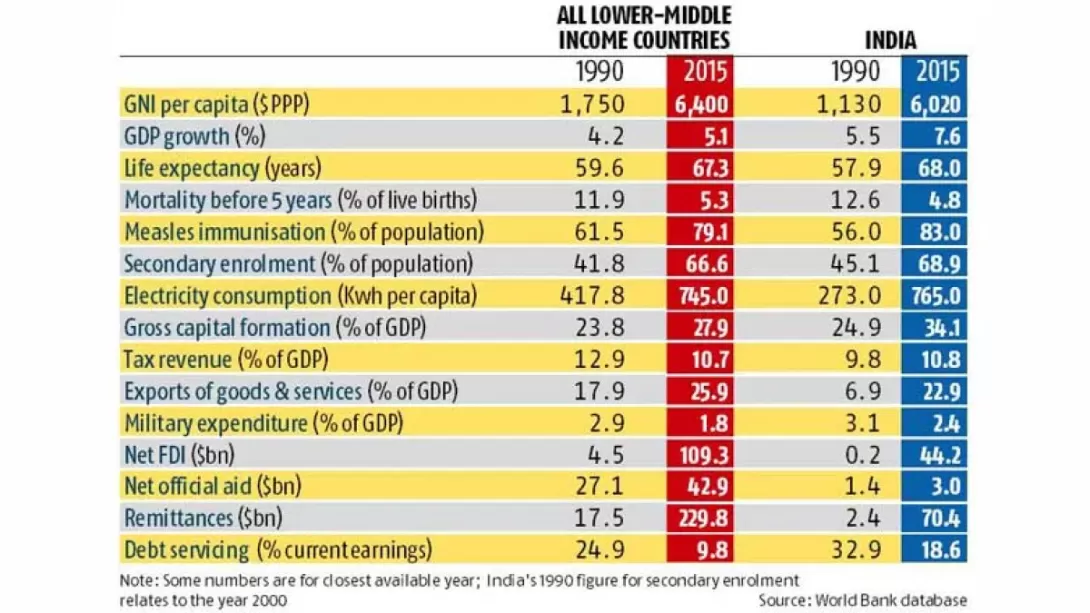
India's ambition to become a developed nation by 2047, as outlined by Chief Economic Advisor V. Anantha Nageswaran, hinges on achieving sustained high growth while navigating complex global headwinds. Speaking at the Columbia India Summit 2025, Nageswaran stressed the urgency of generating at least 8 million jobs annually and boosting manufacturing’s share in GDP to drive inclusive development. He warned that external trade, once a powerful growth engine, may no longer deliver the same dividends in the decades ahead. Instead, India's focus must shift to internal reforms, MSME growth, technology adaptation, and improving productivity through strategic investment.
A Tall Order: The Vision for a Developed India by 2047
As India sets its sights on becoming a fully developed economy by its centenary year of independence in 2047, the government’s economic leadership acknowledges the magnitude of the task ahead. Chief Economic Advisor V. Anantha Nageswaran laid out the roadmap during a keynote address at Columbia University’s India Summit 2025.
He emphasized that the nation's development trajectory must accommodate not only its vast population but also a challenging global landscape marked by deglobalization, geopolitical strife, and technological disruption. Unlike previous decades, the coming era is unlikely to offer the same benign external conditions that powered India’s rapid growth between 2003 and 2008.
The Employment Imperative: 8 Million Jobs a Year
A key pillar of India’s transformation lies in employment generation. According to Nageswaran, the economy must consistently create at least 8 million jobs annually over the next 10–12 years to absorb the youth bulge and ensure social stability. This is particularly pressing in light of the demographic transition and the risks posed by automation and artificial intelligence (AI).
"AI may erode entry-level and routine jobs, especially in the IT-enabled services sector," Nageswaran noted, cautioning that public policy must walk a tightrope between fostering innovation and preserving employment. It’s not just about preparing the workforce for a tech-dominated future, he explained, but also ensuring that labour-centric policies aren’t rendered obsolete by unchecked automation.
Reviving Manufacturing: A Strategic Necessity
To underpin job creation and reduce dependence on volatile global demand, India must significantly boost its manufacturing sector. While manufacturing currently contributes around 17% to GDP, the government aims to raise this share substantially. This move is crucial for absorbing semi-skilled labour and fostering export competitiveness.
Nageswaran underscored that a thriving small and medium enterprise (SME) sector is essential for manufacturing expansion. "Countries that became manufacturing powerhouses built strong MSME ecosystems," he said. India must follow suit by improving access to finance, easing regulatory burdens, and integrating SMEs into global value chains.
Global Capital, Domestic Investment, and Strategic Efficiency
Given that global capital flows are increasingly vulnerable to geopolitical tensions and economic fragmentation, Nageswaran urged India to either raise its domestic investment rate or extract greater productivity from existing capital stock.
This will require a dual strategy: one, maintaining investor confidence through regulatory stability and ease of doing business; and two, improving capital efficiency through better infrastructure, logistics, and last-mile connectivity. He noted that while external trade will continue to matter, its contribution to GDP growth is expected to shrink, making internal productivity gains all the more critical.
Export Realities and the Case for Quality Over Quantity
India’s export-driven growth peaked in the early 2000s when exports accounted for nearly 40% of annual GDP growth. However, this has since halved and may decline further. Global demand uncertainty, protectionist tendencies, and technological parity among nations mean India can no longer rely solely on exports to drive expansion.
Instead, Nageswaran called for a pivot towards quality, innovation, and research and development (R&D). “We must raise our game in terms of quality, R&D, and internal logistics,” he emphasized. Enhancing export competitiveness through internal reform will not only open new markets but also stimulate domestic innovation.
Balancing Growth and Policy: The Deregulation Agenda
Despite formidable external constraints, Nageswaran expressed cautious optimism. India’s post-pandemic growth has averaged over 8% in the last three years. While replicating this pace consistently is improbable, sustaining a 6.5% growth rate over the next two decades—with periodic spikes to 7%—remains achievable, especially if India continues to pursue domestic deregulation and structural reforms.
Deregulation, alongside investments in digital infrastructure, human capital, and sustainable energy, can fuel long-term productivity and reduce friction in doing business.
Looking Ahead: Strength Through Policy Clarity
At a time when global economies are bracing for a slowdown, India’s internal dynamism could be its biggest advantage. The United Nations Conference on Trade and Development (UNCTAD) forecasts a 6.5% GDP growth for India in 2025, citing robust public spending and policy continuity.
“The global backdrop is undeniably challenging,” Nageswaran concluded, “but with clarity in policy direction and focus on key development levers, India can preserve its growth advantage and work steadily toward the vision of ‘Viksit Bharat’.”
Conclusion: The Road to 2047 Is Paved With Strategy, Not Serendipity
India’s developmental aspirations are bold, but not unreachable. The strategy hinges not on external goodwill or favorable cycles, but on pragmatic policy execution, sectoral diversification, and the balancing act between human capital and technological advancement. In an age where uncertainty is the only constant, India’s best hope lies in preparing for the future with foresight, flexibility, and fierce commitment to reform.
Comments