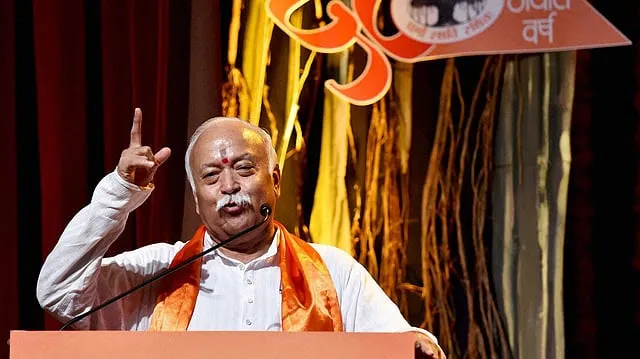
Rashtriya Swayamsevak Sangh (RSS) chief Mohan Bhagwat has underscored the importance of economic self-reliance, urging India to reduce dependence on imports while simultaneously strengthening its global trade footprint. Speaking at a public forum, Bhagwat emphasized that sustainable growth must come from within, highlighting domestic innovation, entrepreneurship, and manufacturing as key drivers of national resilience. His remarks come at a time when global supply chains are under strain and countries are reassessing their reliance on foreign markets, placing self-sufficiency at the heart of both economic strategy and national security.
Self-Reliance as a National Imperative
Bhagwat argued that India’s long-term stability rests on cultivating its own economic capabilities rather than relying heavily on imports. He noted that the pursuit of self-reliance should not translate into isolationism but should instead encourage domestic industries to become globally competitive.
Citing India’s historical strength in craftsmanship, agriculture, and knowledge systems, Bhagwat stressed that revitalizing traditional industries alongside modern manufacturing will help the nation achieve economic independence while preserving cultural identity.
Trade as a Strategic Lever
While advocating for reduced import dependence, Bhagwat maintained that international trade must remain a vital part of India’s growth agenda. He noted that India’s expanding export potential—ranging from information technology to pharmaceuticals and renewable energy—could serve as a crucial tool for strengthening diplomatic and economic influence worldwide.
His remarks reflect the growing consensus among policymakers that trade and self-reliance are not mutually exclusive but complementary strategies. A balanced approach, he suggested, will ensure that India is neither vulnerable to global shocks nor isolated from international opportunities.
Innovation, Industry, and Entrepreneurship
A central theme of Bhagwat’s address was the need to invest in research, technology, and indigenous entrepreneurship. He called on Indian enterprises to innovate rather than merely replicate, pointing out that a strong industrial base rooted in homegrown solutions can shield the economy from global uncertainties.
By encouraging startups and micro, small, and medium enterprises (MSMEs), Bhagwat argued that India can generate employment, strengthen local supply chains, and foster resilience against external economic pressures.
Global Shifts and India’s Response
Bhagwat’s comments come against the backdrop of rising protectionism, supply chain disruptions, and geopolitical tensions that have led many nations to rethink their trade policies. For India, which imports heavily in sectors such as electronics, energy, and defense equipment, the push toward self-reliance aligns with government initiatives like “Atmanirbhar Bharat.”
Analysts believe that Bhagwat’s emphasis mirrors a broader sentiment within India’s policymaking ecosystem: the need to balance global engagement with domestic empowerment. If executed strategically, this approach could reduce vulnerabilities while enhancing India’s leverage in global markets.
Outlook: Charting a Path Forward
Bhagwat’s remarks highlight a growing recognition that India’s economic future depends on striking the right equilibrium between self-sufficiency and global integration. For industry leaders and policymakers, the challenge lies in translating this vision into actionable reforms that encourage competitiveness, boost productivity, and open new markets.
As India navigates a complex international environment, the message is clear—sustainable growth will not come from dependence, but from self-confidence, innovation, and a proactive role in shaping global trade.
Comments