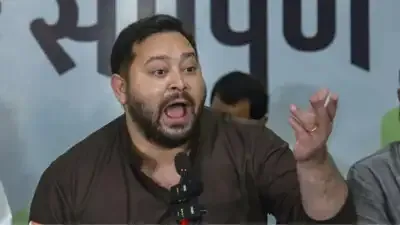
A fresh political row has erupted after Bihar’s opposition leader Tejashwi Yadav accused Prime Minister Narendra Modi and the Bharatiya Janata Party (BJP) of adopting “double standards” in their public discourse. The controversy stems from remarks allegedly made about Yadav’s mother, former chief minister Rabri Devi, which triggered heated exchanges across party lines. In a pointed rebuttal, Yadav highlighted past comments by the prime minister, arguing that selective outrage reveals a lack of consistency in political ethics. The episode underscores the intensifying verbal battles ahead of the upcoming electoral contests in Bihar and beyond.
Political Context and Escalation
The controversy began when opposition leaders claimed that derogatory remarks were directed at Rabri Devi, a veteran political figure and the matriarch of the Rashtriya Janata Dal (RJD). Tejashwi Yadav, widely seen as the party’s future face, condemned the alleged remarks and questioned why the ruling party chooses silence when its own leaders engage in disparaging rhetoric.
By invoking instances where Prime Minister Modi himself has made sharp comments about rivals, Yadav sought to spotlight what he called “hypocrisy in political morality.” His response was not only a defense of his mother but also a strategic attempt to frame the debate around the perceived erosion of civility in national politics.
Accusations of Double Standards
Yadav’s attack centered on what he described as a selective application of outrage. He argued that while the BJP frequently criticizes opposition leaders for their rhetoric, it rarely acknowledges or distances itself from controversial statements made by its own members. According to him, this inconsistency weakens the credibility of political discourse and reduces public trust.
The RJD leader also drew attention to past speeches where the prime minister had used biting language against opponents, suggesting that such precedents weaken the moral ground from which the ruling party now criticizes others.
Strategic Implications for Bihar Politics
This confrontation is not just about personal grievance but also a calculated political maneuver. With Bihar poised to be a key battleground, the RJD is seeking to consolidate its voter base by portraying itself as the victim of political targeting. By defending Rabri Devi, Yadav taps into the party’s traditional support base that views the family as champions of social justice against entrenched elites.
For the BJP, however, the controversy provides an opportunity to project itself as a party that upholds standards of political decency while framing the opposition as combative and disrespectful. The clash, therefore, deepens the polarization between the two camps.
Broader Significance
The episode reflects a broader trend in Indian politics where personal attacks increasingly overshadow substantive debate on governance and policy. As parties trade barbs over language, critical issues such as development, employment, and welfare risk being sidelined. Analysts note that while political theatre may energize party cadres, it often leaves voters disillusioned with the quality of discourse.
For Tejashwi Yadav, the controversy serves both as a shield against attacks on his family and as a weapon to challenge the ruling party’s credibility. For the BJP, it raises questions about consistency in responding to inappropriate rhetoric.
Comments