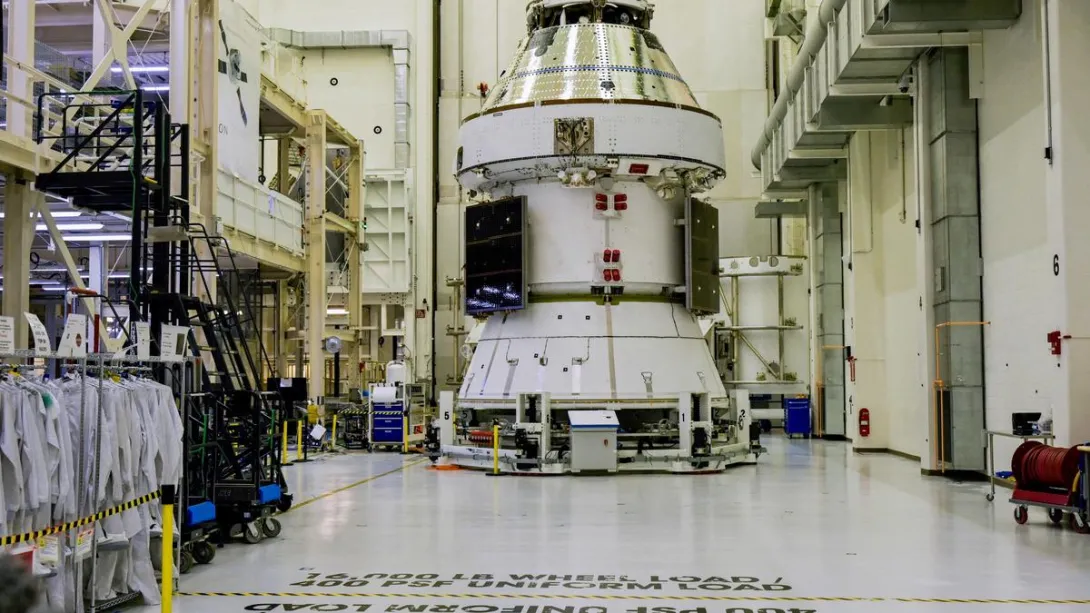
NASA’s Artemis II mission marks a historic milestone as the United States prepares for its first crewed flight around the Moon in nearly half a century. Building on the success of Artemis I, the mission aims to validate life-support systems, orbital navigation, and crew operations in deep space, laying the foundation for future lunar landings and Mars exploration. Equipped with cutting-edge technologies, the Orion spacecraft will carry a multi-astronaut crew on a precise trajectory around the Moon before returning safely to Earth. Artemis II is not just a technological achievement but a strategic step in reasserting U.S. leadership in space exploration.
Mission Objectives and Scope
Artemis II is the first crewed mission in NASA’s Artemis program, designed to:
- Test Human Systems in Deep Space: Validate life-support, propulsion, and communication systems for extended lunar missions.
- Crewed Lunar Flyby: Conduct a precise trajectory around the Moon, including translunar injection and return maneuvers.
- Operational Readiness: Prepare for Artemis III, which aims to land astronauts, including the first woman and next man, on the lunar surface.
The mission underscores NASA’s commitment to sustainable lunar exploration while advancing scientific, engineering, and operational capabilities.
Spacecraft and Technological Advancements
The Artemis II mission leverages the Orion spacecraft and Space Launch System (SLS) rocket:
- Orion Spacecraft: Equipped with advanced life-support systems, radiation shielding, and navigation instruments.
- SLS Rocket: The most powerful launch vehicle developed by NASA, capable of delivering the crew and Orion modules into lunar orbit.
- Onboard Systems Testing: Integrated systems for propulsion, thermal control, and communications are rigorously evaluated to ensure mission safety.
Experts note that Artemis II demonstrates a new era of human spaceflight technology, integrating decades of research with modern innovations in spacecraft engineering.
Strategic and Scientific Importance
Artemis II carries both geopolitical and scientific significance:
- Reasserting U.S. Leadership in Space: Positions NASA at the forefront of global space exploration amidst growing international competition.
- Lunar Science Advancement: Enables future missions to conduct in-situ studies, sample collection, and deployment of research instruments.
- Pathway to Mars: Develops critical expertise in crewed deep-space operations, necessary for eventual interplanetary exploration.
By combining strategic leadership with scientific inquiry, Artemis II strengthens the foundation for long-term lunar presence and research.
Challenges and Preparations
Preparing for a crewed lunar flight involves addressing multiple challenges:
- Human Health in Space: Protecting astronauts from radiation exposure and microgravity effects during multi-day missions.
- Navigation Precision: Accurate trajectory calculations are essential for lunar orbit insertion and safe Earth return.
- Systems Reliability: Ensuring redundancies and fail-safe operations across propulsion, life-support, and communication systems.
NASA’s extensive simulations, rehearsals, and testing protocols aim to mitigate these risks and ensure a successful mission outcome.
Conclusion
Artemis II represents a pivotal leap in human space exploration, blending advanced technology, rigorous testing, and strategic foresight. Beyond being a lunar flyby, the mission is a testament to human ingenuity, international collaboration, and the United States’ renewed commitment to sustainable deep-space exploration. As the world watches, Artemis II promises not only to expand scientific horizons but also to inspire generations to come, reaffirming humanity’s enduring ambition to explore the cosmos.
Comments