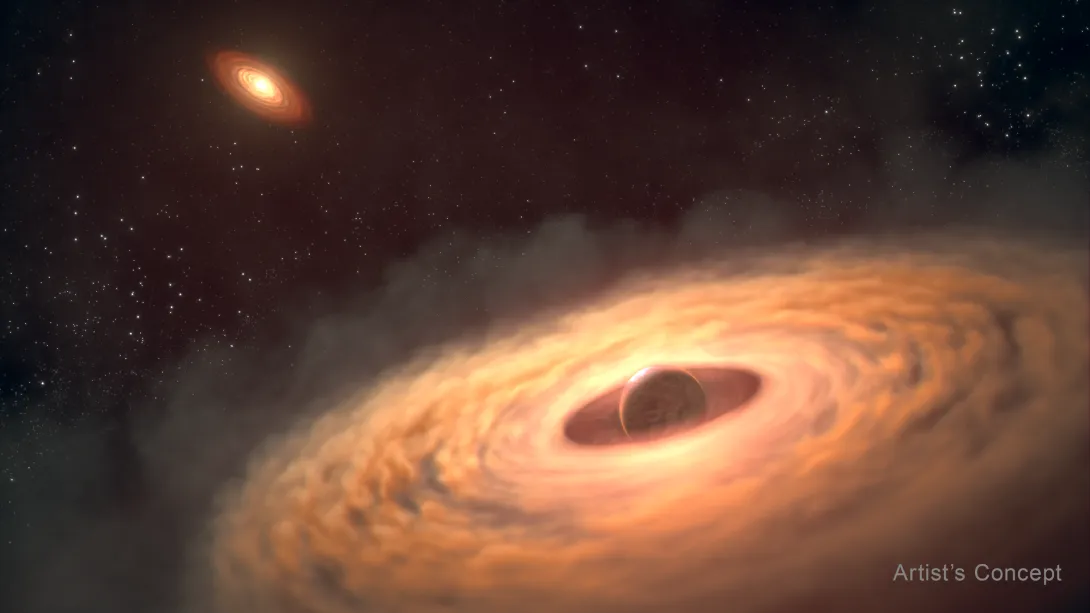
In a groundbreaking astronomical observation, NASA’s James Webb Space Telescope (JWST) has detected a circumplanetary disk, a region of gas and dust where moons are forming, around a young exoplanet. This discovery provides unprecedented insights into planetary and satellite formation, shedding light on processes similar to those that shaped our own solar system. By analyzing the disk’s structure, composition, and dynamics, scientists hope to refine models of moon formation and planetary evolution. The observation highlights JWST’s unparalleled infrared capabilities, offering a front-row view into the earliest stages of planetary system development.
The Discovery
Astronomers using JWST identified a dense, rotating disk surrounding a gas giant exoplanet located hundreds of light-years away. Key highlights include:
- The disk is composed of gas and dust, material critical for the accretion of natural satellites.
- Infrared imaging allowed researchers to detect thermal emissions that are invisible to traditional optical telescopes.
- The exoplanet’s mass and the disk’s density suggest conditions favorable for the formation of multiple moons over millions of years.
This observation marks one of the first times that a moon-forming disk has been directly imaged beyond our solar system, offering a rare glimpse into satellite genesis.
Scientific Significance
The detection has profound implications for astronomy and planetary science:
- Planetary Formation Models: Confirms predictions that gas giants can host circumplanetary disks during their formative years.
- Exomoon Research: Provides a direct observational framework to study exomoon formation, a field previously limited to theoretical models.
- Comparative Studies: Allows researchers to compare these distant systems with the Jupiter-Ganymede and Saturn-Titan systems in our solar system.
The findings pave the way for future studies of planetary architecture, satellite formation rates, and the chemical environments surrounding young exoplanets.
Role of James Webb Space Telescope
JWST’s cutting-edge instruments played a pivotal role in this discovery:
- Its mid-infrared camera detected thermal emissions from the disk, revealing its density and spatial structure.
- The telescope’s high sensitivity and resolution make it uniquely capable of studying faint circumplanetary material around distant exoplanets.
- JWST’s observations are expected to revolutionize the understanding of planetary and satellite formation across the galaxy.
The telescope’s ability to peer into the earliest stages of planet formation offers astronomers a critical tool for exploring the evolution of planetary systems.
Conclusion
The observation of a moon-forming disk by JWST marks a major milestone in astronomy, providing direct evidence of satellite formation beyond the solar system. By bridging theory and observation, this discovery enhances our understanding of how planets and moons coalesce, evolve, and shape their systems. As JWST continues to survey young planetary systems, further discoveries are expected, offering unprecedented insights into the origins of worlds and the universality of moon formation.
Comments