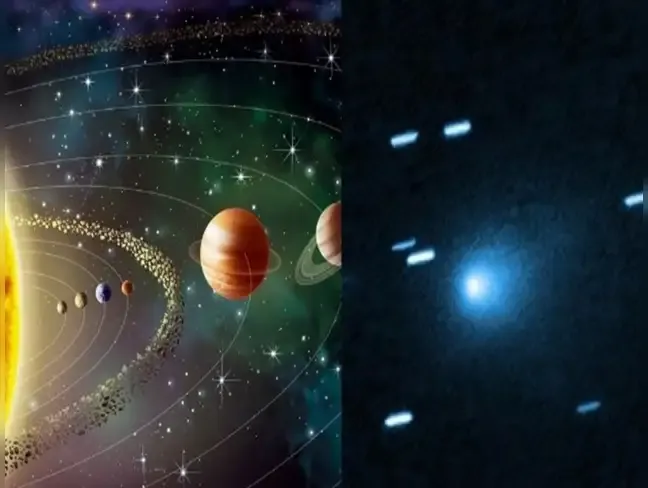
Scientists worldwide are intensifying research on the interstellar comet 3I/ATLAS, the first of its kind observed entering our solar system from beyond. Discovered in 2020, the comet has provided a rare opportunity to study material originating from another star system. Its trajectory, composition, and behaviour offer invaluable insights into the formation of planetary systems, stellar evolution, and the chemistry of distant star environments. Researchers are leveraging advanced telescopes and spectroscopy to analyse the comet’s dust and gas emissions, aiming to better understand interstellar matter and the broader processes that govern the cosmos.
Discovery and Trajectory
3I/ATLAS was first detected by the Asteroid Terrestrial-impact Last Alert System (ATLAS) in late 2020.
- Interstellar Origin: Unlike typical comets from the Kuiper Belt or Oort Cloud, 3I/ATLAS entered the solar system at a hyperbolic speed, indicating it originated from a different star system.
- Unique Trajectory: Its path is not gravitationally bound to the Sun, highlighting its interstellar provenance and offering scientists a fleeting observation window.
- Observation Window: Researchers are closely monitoring its trajectory to maximise data collection before it exits the solar system permanently.
Scientific Insights
The study of 3I/ATLAS could transform our understanding of cosmic processes:
- Chemical Composition: Spectroscopic analyses reveal the presence of volatile compounds and organic molecules, providing a comparative basis with solar system comets.
- Dust and Ice Properties: Investigating the particle size and reflectivity aids in reconstructing the environment of its home system.
- Planetary System Formation: Observations may shed light on how comets form in distant star systems, offering clues to planetary evolution across the galaxy.
Astronomers emphasise that each measurement adds to the sparse data available on interstellar objects, making this comet a unique laboratory for cosmic chemistry.
Technological Collaboration
To study 3I/ATLAS, scientists are employing global observatories and space telescopes:
- Ground-Based Telescopes: Instruments in Chile, Hawaii, and Spain track the comet’s motion and spectral properties.
- Space Telescopes: Observatories like the Hubble Space Telescope provide high-resolution imaging and ultraviolet spectral data.
- International Collaboration: Agencies and research institutions are sharing real-time data to maximise observation during the comet’s brief solar system passage.
This collaborative approach accelerates understanding and ensures comprehensive coverage of this rare interstellar visitor.
Implications for Astronomy
3I/ATLAS offers significant implications for both theoretical and observational astronomy:
- Cosmic Material Diversity: Comparing its composition with local comets may reveal variations in chemical environments across star systems.
- Origins of Organic Matter: The detection of complex molecules supports hypotheses about the ubiquity of life's building blocks in the galaxy.
- Future Interstellar Studies: Lessons learned from 3I/ATLAS pave the way for detecting and studying similar interstellar objects in coming decades.
Scientists underscore that interstellar comets serve as tangible links between distant star systems and our own, offering a new dimension to our understanding of the universe.
Conclusion
Interstellar comet 3I/ATLAS continues to captivate astronomers, providing an unprecedented glimpse into the material composition of other star systems. Its study not only enhances our knowledge of cometary science but also informs broader questions about planetary formation, chemical diversity, and the potential distribution of life’s precursors across the galaxy. As the comet speeds away from the Sun, the data gathered will fuel research for years, reinforcing the importance of interstellar visitors as cosmic messengers.
Comments