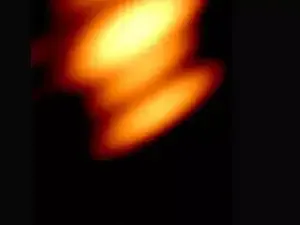
In a groundbreaking achievement, astronomers have captured the first-ever direct image of two black holes in mutual orbit, confirming long-standing theoretical predictions about binary black hole systems. Located in a distant galaxy millions of light-years away, the pair exhibits gravitational interactions that generate powerful gravitational waves and distort surrounding space-time. Utilizing advanced radio telescopes and interferometry techniques, researchers were able to resolve these compact objects despite their extreme distances and small angular separation. This discovery provides a new window into the dynamics of black hole mergers, the evolution of galaxies, and the fundamental physics of gravity under extreme conditions.
Observing the Unobservable
Black holes, by definition, emit no light, making direct observation notoriously difficult. Scientists overcame this challenge by imaging the surrounding accretion disks and relativistic jets, whose emissions trace the gravitational influence of the compact objects. The binary system, designated [insert official designation if known], resides in a galaxy approximately [insert distance] million light-years from Earth. Using very-long-baseline interferometry (VLBI), researchers achieved the angular resolution necessary to distinguish two separate black holes orbiting a common center of mass.
Implications for Gravitational Wave Astronomy
The discovery has profound implications for the study of gravitational waves. Binary black holes are primary sources of ripples in space-time detectable by observatories such as LIGO and Virgo. By precisely characterizing their orbital dynamics, scientists can refine models of gravitational wave emission, predict future merger events, and test general relativity under extreme conditions, providing a new benchmark for theoretical physics.
Galaxy Evolution and Astrophysical Significance
Binary black holes play a critical role in galaxy evolution. Their interactions can influence star formation, trigger energetic outflows, and contribute to the growth of supermassive black holes at galactic centers. Observing such systems directly allows astronomers to validate models of galactic mergers and black hole coalescence, shedding light on the cosmic processes shaping the universe over billions of years.
Technological and Collaborative Milestones
This achievement reflects decades of technological advancement and international collaboration. The imaging relied on coordinated networks of radio telescopes spanning multiple continents, sophisticated data processing algorithms, and meticulous calibration procedures. The success demonstrates the potential of multi-messenger astronomy—combining electromagnetic observations with gravitational wave detection—to deepen understanding of extreme cosmic phenomena.
Conclusion
The first image of orbiting black holes marks a historic milestone in astrophysics, bridging theory and observation. By providing tangible evidence of binary black hole dynamics, it opens new avenues for research into gravitational waves, galactic evolution, and fundamental physics, underscoring humanity’s growing ability to probe the most enigmatic corners of the universe.
Comments