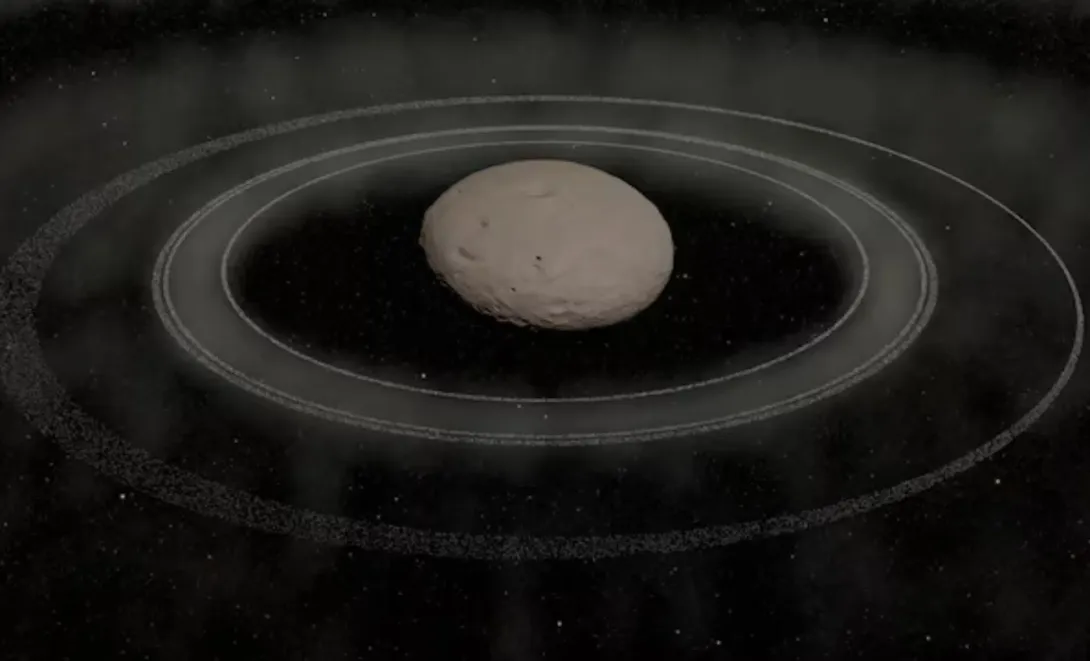
In a remarkable astronomical breakthrough, scientists have observed the formation of rings around Chiron, a small celestial body orbiting between Saturn and Uranus. Long regarded as a hybrid between an asteroid and a comet, Chiron’s newly discovered rings challenge conventional notions about the composition and behavior of minor planets. This finding, achieved through precise stellar occultation observations, suggests that ring systems—once believed exclusive to giant planets—may be more common across the solar system. The discovery not only deepens scientific understanding of planetary evolution but also opens intriguing questions about the origins and stability of such structures in space.
A Rare Discovery in the Outer Solar System
Chiron, officially designated as 2060 Chiron, has intrigued astronomers since its discovery in 1977. Positioned between the orbits of Saturn and Uranus, it belongs to a class of objects known as centaurs—bodies that exhibit both asteroid-like and comet-like characteristics.
Recent observations using telescopes in Europe and South America have revealed subtle dimming patterns of distant starlight as Chiron passed in front of background stars. This phenomenon, known as stellar occultation, allowed researchers to detect faint, ring-like structures encircling the object. The data indicate that Chiron possesses two narrow rings, each measuring a few kilometers in width and separated by a small gap—remarkably similar to those surrounding another centaur, Chariklo, discovered a decade earlier.
How Scientists Identified Chiron’s Rings
The confirmation of Chiron’s rings required years of observation and data synthesis. Astronomers employed high-precision instruments capable of measuring millisecond variations in starlight intensity.
The ring detection was not based on direct imaging—still beyond the reach of current telescope resolution—but rather on interpreting how light fluctuated during the occultation event. These patterns matched theoretical models of ring systems, showing symmetrical dips in brightness before and after the main occultation by Chiron’s solid body.
Further analysis indicated that the material composing the rings may consist of dust, ice, and rocky debris, possibly remnants from a past collision or from outgassing activity—similar to the processes that form cometary tails.
Scientific Significance and Theoretical Implications
The discovery of rings around Chiron is significant for several reasons. For decades, ring systems were believed to exist only around the gas giants—Jupiter, Saturn, Uranus, and Neptune. However, the identification of rings around smaller bodies like Chariklo and now Chiron suggests that ring formation may be a universal process, not limited by planetary mass.
This revelation compels astronomers to revisit existing models of planetary accretion and fragmentation. One theory posits that Chiron’s rings may have originated from a collision that ejected surface material into orbit, later stabilized by gravitational resonance. Another hypothesis suggests that volatile outgassing, common in comet-like objects, could have expelled material that coalesced into a temporary ring system.
Either explanation challenges traditional views, highlighting that even relatively small celestial bodies can develop complex and dynamic environments.
A Broader Perspective: What This Means for Planetary Science
From a broader scientific and economic standpoint, such discoveries are reshaping how we perceive resource potential and structural formation in the outer solar system. Understanding the composition and mechanics of small-body rings could provide clues for future asteroid-mining initiatives and space resource management, particularly in identifying regions rich in water ice and minerals.
Moreover, these findings are instrumental in refining orbital stability models for spacecraft navigation. The presence of fine debris or ring particles around small bodies must be carefully mapped to avoid collision risks for future interplanetary missions.
For planetary scientists, Chiron now represents a natural laboratory for studying the transitional behavior between comets and asteroids, offering insights into the processes that shaped our solar system’s early architecture.
The Economic and Strategic Value of Deep-Space Observation
While the discovery’s scientific impact is profound, it also underscores the increasing relevance of space research to global economies. Governments and private entities have collectively invested billions of rupees into observational astronomy and space-based infrastructure.
India’s growing participation in deep-space exploration—through missions like Chandrayaan and Aditya-L1—positions it well to collaborate in future studies of centaurs and other trans-Neptunian objects. Such collaborations enhance data exchange, foster advanced instrumentation development, and create high-value opportunities in aerospace engineering and data analytics.
Additionally, the expanding space economy—estimated to exceed Rs. 45 lakh crore (USD 550 billion) globally by 2030—relies heavily on discoveries like these, which push the boundaries of both science and innovation.
A Glimpse Into the Solar System’s Dynamic Future
The rings around Chiron not only symbolize a new chapter in the study of small celestial bodies but also reflect the solar system’s dynamic and ever-changing nature. As technology advances, future telescopes—such as the James Webb Space Telescope and ground-based Extremely Large Telescopes (ELTs)—are expected to capture direct imagery of such structures, enabling scientists to monitor their evolution in real time.
Understanding Chiron’s rings could also shed light on the temporary nature of ring systems—whether they endure for millions of years or eventually dissipate into diffuse dust clouds. In either case, their study bridges the gap between the known and the unknown, enriching humanity’s quest to comprehend the intricate mechanics of the cosmos.
Conclusion
The discovery of ring formation around Chiron marks a milestone in planetary science, blurring the line between asteroids, comets, and planets. It challenges established theories of celestial formation and underscores the universe’s complexity, where even the smallest objects can harbor grandeur akin to Saturn’s iconic rings.
For astronomers and investors alike, it is a reminder that the cosmos remains an untapped frontier—scientifically profound, economically promising, and infinitely mysterious. Chiron’s rings are more than a cosmic curiosity; they are a symbol of discovery, collaboration, and the unending pursuit of knowledge that defines human progress.
Comments