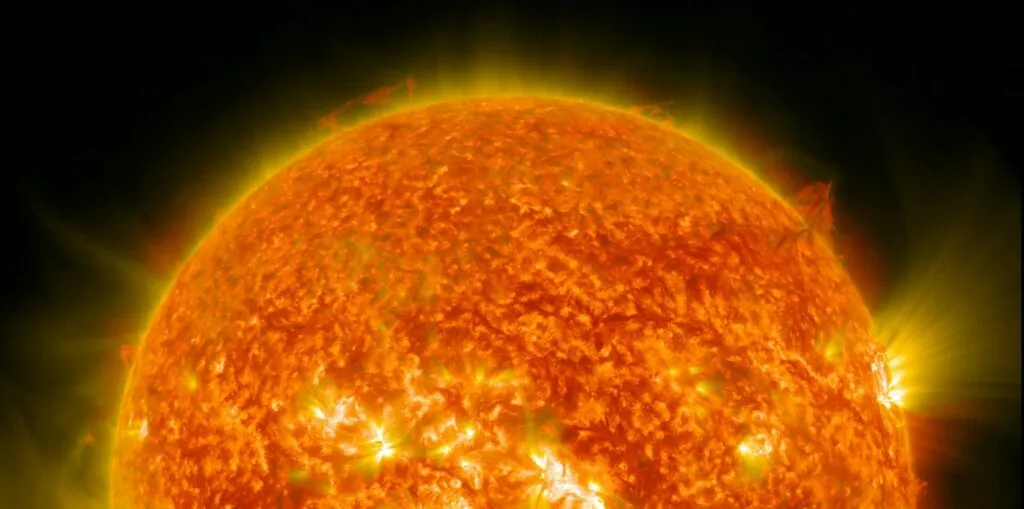
A groundbreaking study has provided new insights into the long-standing mystery of why the Sun's outer atmosphere, the corona, reaches temperatures exceeding one million degrees Celsius, while its surface remains around 5,500°C. Researchers have observed small-scale, twisting magnetic waves known as torsional Alfvén waves within the corona. These waves, first predicted in the 1940s, appear to transport energy from the Sun's interior to its outer layers, potentially explaining the intense heating of the corona. This discovery marks a significant advancement in solar physics and enhances our understanding of solar phenomena.
The Coronal Heating Enigma
For over a century, scientists have grappled with the "coronal heating problem": understanding why the Sun's corona is significantly hotter than its surface. Traditional theories, including magnetic reconnection and nanoflares, have offered partial explanations. However, these models could not fully account for the observed temperatures. The recent detection of torsional Alfvén waves provides a compelling addition to the existing theories, suggesting a continuous and dynamic process contributing to the corona's heat.
Discovery of Torsional Alfvén Waves
Utilizing the Daniel K. Inouye Solar Telescope in Hawaii, scientists have directly observed these elusive magnetic waves for the first time. The waves twist the Sun's magnetic field lines, transferring energy through the plasma of the corona. Despite their small amplitude, these waves may collectively deliver sufficient energy to account for the corona's extreme temperatures. The study, published in Nature Astronomy, represents a significant breakthrough in solar research.
Implications for Solar Physics
Understanding the mechanisms behind coronal heating is crucial for predicting space weather events, such as solar flares and coronal mass ejections, which can impact satellite operations and communication systems on Earth. The discovery of torsional Alfvén waves offers a new avenue for modeling solar activity and enhances our ability to forecast these phenomena. Additionally, this finding underscores the importance of advanced observational tools in unraveling complex astrophysical processes.
Comments