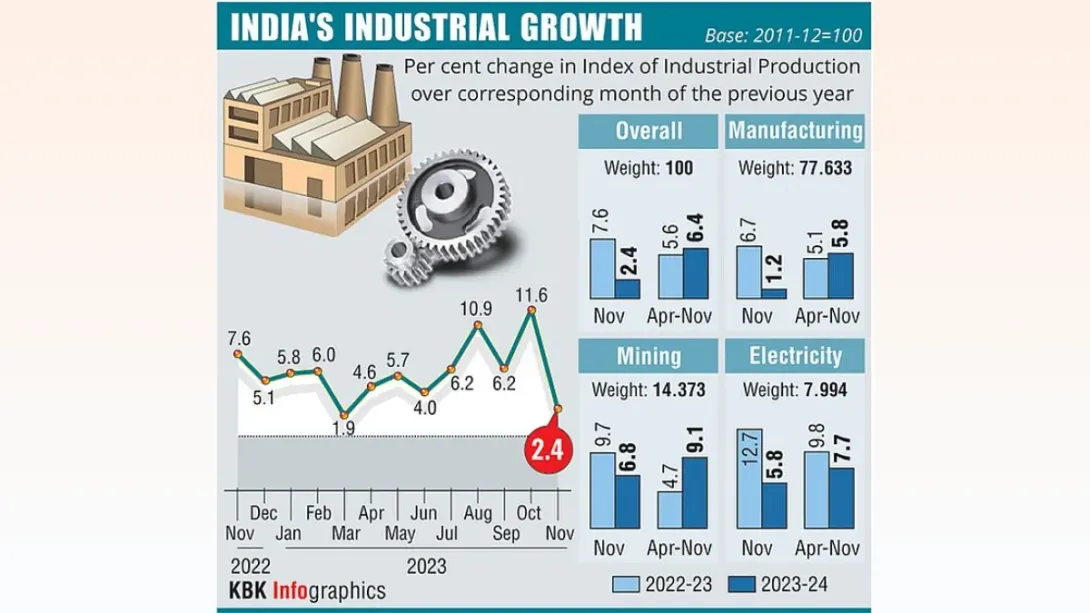
India’s industrial output sustained a steady 4% year-on-year growth in September 2025, reflecting resilience in the manufacturing and energy sectors amid moderating global demand. The latest Index of Industrial Production (IIP) data highlights consistent expansion in capital and consumer goods, indicating sustained domestic momentum despite external headwinds. Economists view the performance as a sign of stable industrial recovery supported by policy incentives, infrastructure spending, and urban consumption. However, concerns remain over export softness and rural demand, which could influence future momentum in India’s industrial trajectory.
Manufacturing and Energy Lead Growth Momentum
The manufacturing sector, which accounts for nearly 77% of the IIP, registered a 4.3% expansion, marking one of its most stable performances in recent months. Key sub-segments such as automobiles, capital goods, and pharmaceuticals recorded notable increases, buoyed by festive season demand and inventory buildup.
Electricity generation saw a 5.1% rise, underscoring robust energy consumption linked to industrial activity and urban power demand. Meanwhile, mining output grew at a slower pace of 2.6%, constrained by monsoon-related disruptions and uneven commodity demand.
Economists suggest that industrial activity is benefiting from government-led infrastructure investments, supply chain efficiency improvements, and fiscal incentives targeting domestic manufacturing under the Production-Linked Incentive (PLI) schemes.
Consumer and Capital Goods Show Positive Signals
The IIP data also indicated encouraging trends in both consumer durables and capital goods, reflecting sustained business confidence and urban spending strength. Consumer durables production expanded by 6.8%, supported by rising demand for electronics, home appliances, and automobiles during the festive period.
Capital goods output — a key indicator of investment activity — grew by 5.7%, suggesting private sector confidence in long-term capacity expansion. Industry experts attribute this to favorable credit availability, lower borrowing costs for high-quality borrowers, and a gradual recovery in capital expenditure across core sectors such as steel, cement, and machinery.
However, consumer non-durables, which mirror rural spending trends, saw muted growth, signaling that rural consumption recovery remains uneven amid inflationary pressures and uneven monsoon patterns.
Policy Support and Investment Boost Underpin Stability
The government’s continued push for domestic industrial resilience has played a crucial role in sustaining the current momentum. Initiatives such as ‘Make in India,’ ‘Atmanirbhar Bharat,’ and sector-specific incentives under PLI programs have helped bolster investment and export competitiveness.
Additionally, large-scale infrastructure programs — including roadways, ports, and renewable energy projects — have generated strong demand for steel, cement, and heavy machinery. The public capital expenditure cycle has also encouraged private participation, leading to multiplier effects across related industries.
Economists note that while the industrial sector remains steady, achieving higher growth may depend on improving rural demand and addressing global trade slowdowns.
Export Headwinds and Global Demand Challenges
Despite solid domestic indicators, India’s industrial outlook faces challenges from global trade headwinds and declining export orders. The slowdown in key markets such as the United States and Europe has affected manufacturing exports, particularly in textiles, engineering goods, and electronics.
Additionally, volatility in crude oil and commodity prices has contributed to cost pressures for manufacturers. While inflation has moderated from last year’s peaks, input costs for energy-intensive industries continue to fluctuate, impacting margins and pricing strategies.
Trade experts highlight that diversifying export destinations, strengthening trade ties with emerging markets, and investing in advanced manufacturing technologies could mitigate the impact of global demand fluctuations.
Outlook: Cautious Optimism Ahead
Industry analysts maintain a cautiously optimistic outlook for the coming quarters. With festive spending likely to boost consumption through the December quarter and continued policy support for manufacturing, India’s industrial growth could remain within the 4–5% range in the near term.
However, sustaining higher growth levels will depend on accelerating private investment, improving logistics efficiency, and enhancing rural purchasing power. Analysts also point to the need for continued reforms in labour laws, logistics, and ease of doing business to strengthen India’s competitiveness in the global value chain.
Conclusion
India’s steady 4% industrial output growth in September reflects a balanced combination of policy-driven investment, resilient manufacturing performance, and moderate consumption recovery. While global uncertainties pose short-term risks, the broader trajectory remains stable, supported by a strong policy framework and growing domestic demand.
Comments