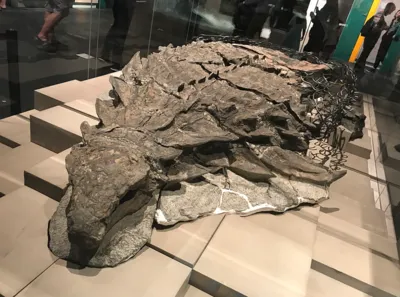
In a groundbreaking paleontological discovery, scientists have uncovered a 110-million-year-old dinosaur fossil so well-preserved that even its stomach contents remain intact. The specimen, belonging to a nodosaur species, offers an unprecedented glimpse into prehistoric life and diet. Unlike typical fossils that reveal only skeletal remains, this extraordinary find preserves skin impressions, armor plating, and digestive matter — a phenomenon rarely encountered in dinosaur research. Experts attribute its remarkable preservation to unique environmental conditions that shielded the carcass from decomposition, turning it into a natural time capsule that could rewrite scientific understanding of Cretaceous ecosystems.
A Fossil Frozen in Time
The 110-million-year-old nodosaur fossil represents one of the most astonishing examples of natural preservation ever recorded. Unlike most dinosaur fossils, which are flattened remnants of bone and rock, this specimen retains a three-dimensional form, with visible scales and armor that resemble those of modern reptiles. The creature, estimated to weigh more than 1,300 kilograms in life, met its end during the Early Cretaceous period and was likely swept into a body of water, where mineral-rich sediments enveloped it before decay could occur.
The combination of rapid burial, low oxygen levels, and mineralization effectively “mummified” the dinosaur, preserving even the soft tissues that usually vanish over millions of years.
The Secret of Its Preservation
Researchers suggest that this exceptional state of preservation resulted from an extremely rare convergence of geological and biological factors. After the dinosaur’s death, it sank into a seabed rich in fine silt, which quickly encased the carcass and protected it from scavengers and bacteria. Over time, minerals infiltrated its tissues, replacing organic matter without disrupting structural details.
This process — known as permineralization — created a near-perfect stone replica of the dinosaur’s exterior, locking in its natural contours and colors. Scientists describe the fossil as a “three-dimensional snapshot of life in the Cretaceous,” offering an unparalleled opportunity to study the anatomy and armor pattern of herbivorous dinosaurs.
A Glimpse into Prehistoric Diet
Perhaps the most remarkable aspect of the find is the intact stomach content — an extremely rare feature in the fossil record. Analysis of the preserved material revealed traces of ferns and cycads, confirming that the nodosaur was primarily herbivorous. The discovery provides concrete evidence of plant diversity in the dinosaur’s environment and how vegetation shaped early ecosystems.
Microscopic examination of the stomach remains also revealed fragments of charcoal, suggesting that the dinosaur may have lived in an area prone to wildfires, which could have influenced its feeding patterns. Such insights deepen scientists’ understanding of how ancient species adapted to changing ecological conditions.
Redefining Paleontology
The discovery is more than just an isolated marvel; it redefines the potential of paleontological research. Traditional fossil studies rely heavily on bone structure to infer behavior and diet, but this specimen bridges that gap between biology and geology. It allows researchers to analyze how external features — like armor design and pigmentation — evolved for protection and camouflage.
Moreover, this discovery demonstrates how advances in imaging technology and geochemical analysis can unlock secrets long buried in stone. Scientists are now using high-resolution scanning techniques to examine the fossil’s microstructure, hoping to extract data on muscle fibers, pigmentation, and even microscopic cellular traces.
A Legacy Carved in Stone
This extraordinary find is not just a scientific triumph but also a humbling reminder of the planet’s deep history. It bridges a 110-million-year gap, offering a vivid window into a world long erased by time. The nodosaur’s impeccable preservation allows humanity to witness a creature that once roamed lush prehistoric landscapes, now immortalized in stone.
As paleontologists continue to uncover its secrets, the fossil stands as a testament to nature’s ability to preserve life — not merely through evolution, but through the silent artistry of geology itself.
Comments