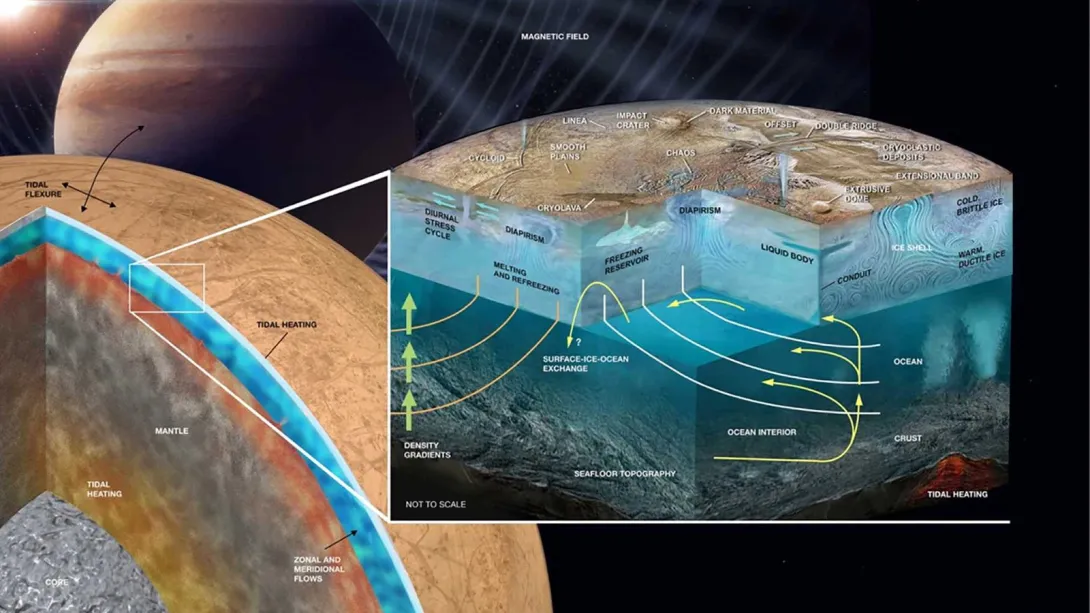
Scientists are advancing efforts to understand how essential nutrients could reach the vast subsurface ocean believed to exist beneath the icy crust of Europa, one of Jupiter’s most intriguing moons. New research focuses on geological and chemical processes that may transport surface materials, including salts and oxidants, into the concealed ocean below. These findings strengthen Europa’s standing as a prime candidate in the search for extraterrestrial life. By examining ice dynamics, radiation chemistry, and potential energy exchanges, researchers are piecing together how Europa’s ocean could sustain complex chemical systems over geological time.
Europa’s Ocean and the Search for Habitability
Europa has long captured scientific attention due to strong evidence suggesting a global ocean of liquid water beneath its frozen exterior. This hidden ocean, estimated to be tens of kilometers deep, is kept liquid by tidal heating generated by Jupiter’s immense gravitational pull. While liquid water is a key ingredient for life, scientists emphasize that habitability also depends on the availability of nutrients and energy sources.
Recent studies aim to determine whether Europa’s ocean is chemically isolated or actively exchanging materials with its surface—an essential distinction in evaluating its biological potential.
Surface Chemistry as a Nutrient Source
Europa’s surface is constantly bombarded by intense radiation from Jupiter’s magnetosphere. This radiation alters surface ice, producing oxidants and other chemically reactive compounds. According to researchers, these materials could serve as metabolic fuel if transported downward into the ocean.
Laboratory simulations and spacecraft data suggest that Europa’s fractured ice shell may allow surface compounds to migrate through cracks, faults, or slowly convecting ice layers. Over time, this process could enrich the subsurface ocean with life-supporting chemistry.
Geological Pathways Beneath the Ice
Scientists are also studying Europa’s dynamic ice shell, which shows evidence of resurfacing and tectonic activity. Features such as ridges, chaotic terrain, and subsurface lakes indicate that the ice is neither static nor uniform.
These structures may act as conduits, allowing nutrients to move from the surface into the ocean below. Models suggest that warm ice rising and cold ice sinking could facilitate a long-term exchange of materials, creating a chemically active environment capable of sustaining complex reactions.
Implications for Future Space Missions
The findings carry significant implications for upcoming exploration missions, including NASA’s Europa Clipper. By identifying regions where surface-to-ocean exchange is most likely, scientists can prioritize observation targets and refine strategies for detecting chemical signatures linked to habitability.
Understanding nutrient transport also informs the broader search for life beyond Earth, offering a framework for evaluating other icy worlds with subsurface oceans.
A Step Closer to Answering a Fundamental Question
While definitive evidence of life on Europa remains elusive, the growing body of research suggests that its hidden ocean may possess more than just water. The possibility that nutrients and energy reach this concealed environment brings scientists closer to answering one of humanity’s most profound questions: whether life can arise—and persist—beyond Earth.
Comments