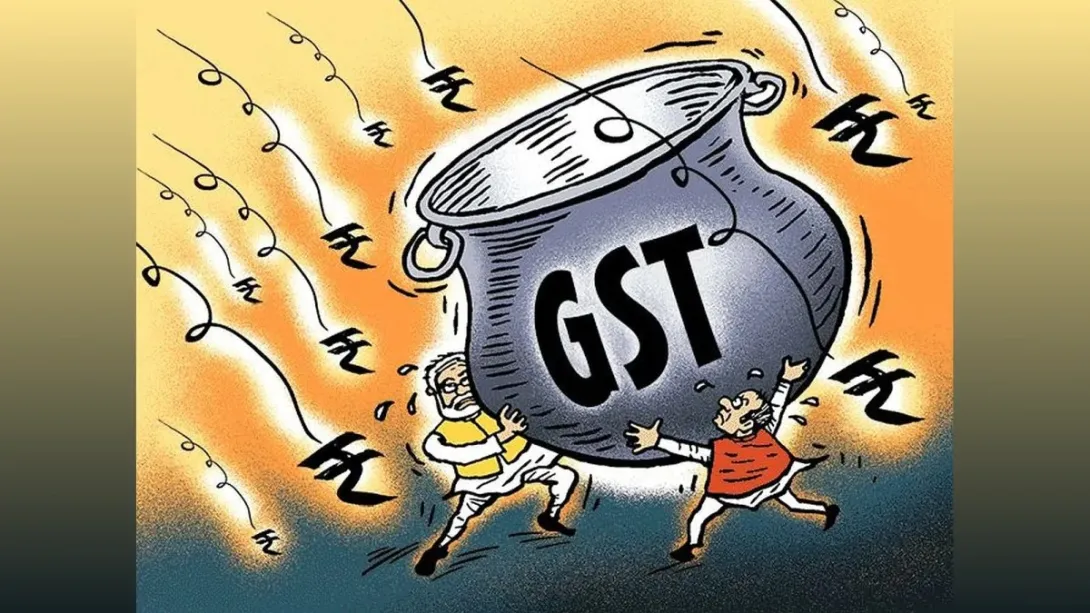
The state of Punjab has renewed its call for financial compensation from the Centre to offset revenue shortfalls arising from the Goods and Services Tax (GST) regime. Officials argue that the transition to GST has significantly eroded the state’s fiscal autonomy, particularly given its heavy reliance on revenue streams such as value-added tax (VAT) on alcohol and petroleum products, which remain outside the GST framework. With the compensation window promised at the time of GST rollout now expired, Punjab is pressing for renewed support, citing fiscal stress and the urgent need to finance welfare schemes and development programs.
Background: GST and Fiscal Federalism
Introduced in 2017, GST was billed as a landmark reform to unify India’s indirect taxation system. While it simplified compliance and created a common national market, states like Punjab—traditionally dependent on consumption-based taxes—experienced revenue volatility. To allay concerns, the Centre had assured states of compensation for a five-year period, covering any revenue losses during the transition. That guarantee lapsed in June 2022, leaving states to manage without central support despite uneven revenue buoyancy.
Punjab’s Fiscal Challenges
Punjab’s demand for compensation stems from its unique economic structure. The state’s revenue base is narrower compared with industrialized states, and its expenditure burden is higher due to agricultural subsidies, healthcare, and social welfare commitments. Post-GST, Punjab has struggled to maintain fiscal balance, as the share of its own tax revenue has fallen, while dependence on central transfers has increased. Officials warn that without additional support, the state’s capacity to invest in infrastructure and social programs could weaken further.
The Case for Extended Compensation
Punjab argues that the GST system, while beneficial nationally, has unevenly impacted states depending on their consumption and production patterns. Given this asymmetry, the state has urged the Centre to reinstate compensation or create a new mechanism that cushions states with limited revenue-generation capacity. Economists suggest that a longer transition period, or a targeted revenue-sharing formula, could help bridge fiscal disparities without undermining the GST framework.
Wider Policy Implications
The debate extends beyond Punjab. Several other states have quietly raised concerns about post-compensation fiscal strain, highlighting broader questions of fiscal federalism and the balance of power between states and the Centre. As India pushes for deeper tax reforms and enhanced compliance through technology, states are seeking greater clarity on how revenue autonomy can be preserved within a centralized system.
Conclusion
Punjab’s renewed demand for GST compensation underscores the unfinished business of India’s tax reform. While GST has streamlined indirect taxation, the uneven fiscal consequences for states remain unresolved. Addressing these concerns will require dialogue, innovation in revenue-sharing, and perhaps a reimagining of fiscal federalism to ensure that reform does not come at the expense of state-level financial stability.
Comments