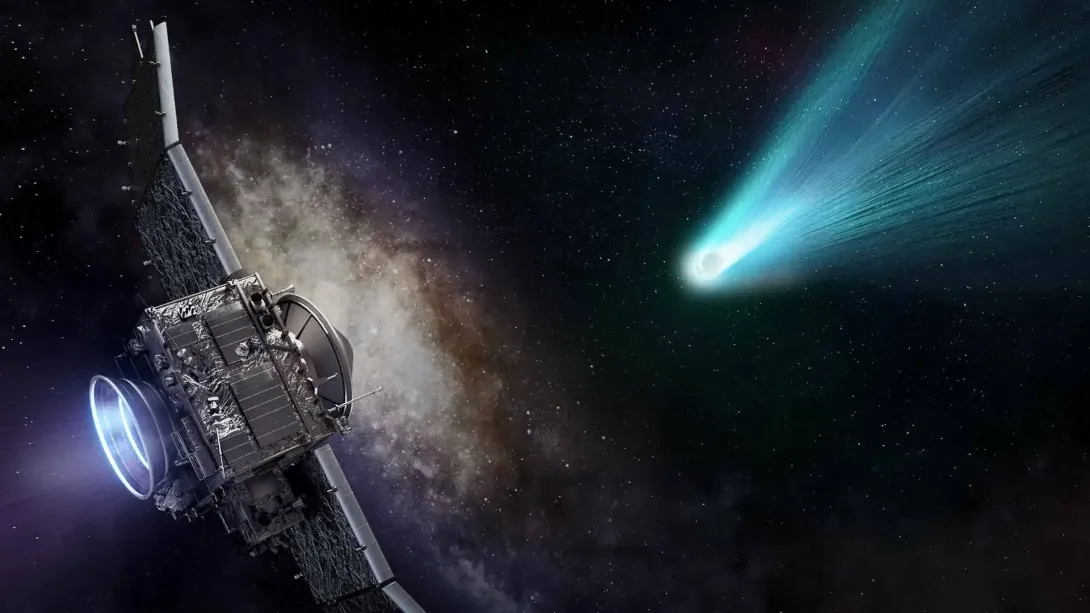
Astronomers worldwide are closely tracking comet 3I/ATLAS, a rare interstellar object moving through the solar system on a hyperbolic trajectory that confirms its origin beyond the Sun’s gravitational domain. Detected by advanced sky-survey technology, the comet offers scientists an uncommon opportunity to study primordial material formed around another star. While the object poses no threat to Earth, its approach has sparked intense academic interest due to its velocity, composition, and chemical signatures. The event underscores how modern observational infrastructure is reshaping humanity’s understanding of cosmic visitors and the broader architecture of the universe.
Discovery of a Cosmic Outlier
Comet 3I/ATLAS was identified through routine sky surveillance conducted by automated telescopes designed to detect near-Earth objects. Early trajectory analysis revealed an unmistakable hyperbolic path, a defining characteristic of interstellar bodies that are not gravitationally bound to the Sun.
Only a handful of such objects have been confirmed to date, making 3I/ATLAS a statistically rare phenomenon. Its discovery reflects the growing sophistication of astronomical monitoring systems and international data-sharing networks.
What Makes 3I/ATLAS Significant
Unlike typical comets that originate from the Kuiper Belt or Oort Cloud, 3I/ATLAS is believed to have formed in an entirely different stellar environment. Preliminary observations suggest it carries chemical and structural properties distinct from native solar system objects.
Researchers say these differences could provide clues about planetary formation processes beyond our cosmic neighborhood. In effect, the comet serves as a natural probe—delivering information that no spacecraft mission could easily replicate.
No Risk to Earth, High Value for Science
Space agencies and observatories have emphasized that 3I/ATLAS does not pose any collision risk. Its trajectory keeps it at a safe distance as it passes through the inner solar system before continuing its interstellar journey.
The lack of threat allows scientists to focus squarely on data collection, including spectroscopy, brightness variation, and gas emission analysis. These observations may help refine models of how organic compounds and volatile materials are distributed across the galaxy.
A Test Case for Planetary Defense Systems
Although harmless, the detection of 3I/ATLAS highlights the effectiveness of planetary defense and early-warning systems. Analysts note that the same tools used to identify potentially hazardous asteroids are now proving invaluable in expanding scientific discovery.
This dual-use capability strengthens the case for sustained investment in space surveillance infrastructure, which has both safety and research dividends.
Broader Implications for Astronomy
The passage of comet 3I/ATLAS reinforces a growing realization within the scientific community: interstellar objects may be more common than previously assumed. As detection capabilities improve, such visitors are expected to become a recurring feature of astronomical study rather than rare anomalies.
For now, 3I/ATLAS stands as a reminder of the dynamic, interconnected nature of the cosmos—and of how much remains to be learned from objects that briefly pass through our corner of space before returning to the stars.
Comments