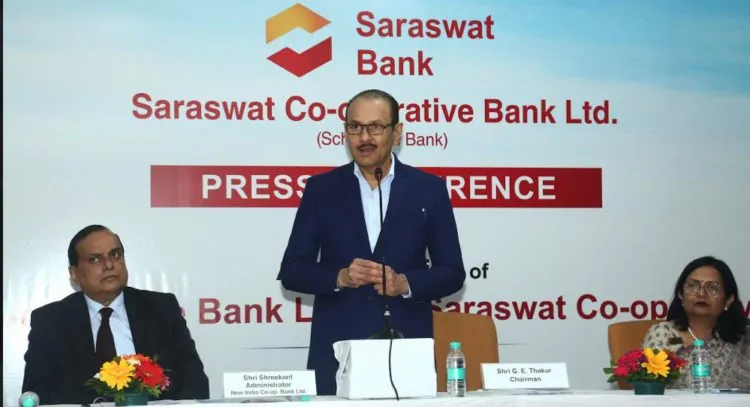
Saraswat Bank, India’s largest urban cooperative bank, has formally proposed a merger with the troubled New India Cooperative Bank (NICB), aiming to stabilize the latter’s operations and safeguard depositor funds. The move comes after NICB was rocked by a Rs. 122 crore fraud and placed under RBI administration earlier this year. Saraswat Bank Chairman Gautam Thakur assured that all 1.22 lakh depositors of NICB will receive full access to their savings with no loss or haircut. The merger, subject to shareholder and regulatory approvals, is expected to conclude by September 2025.
A Strategic Bailout of a Distressed Peer
In an initiative led by proactive intervention, Saraswat Bank has taken the mantle of rescuing New India Cooperative Bank, which has been reeling under financial distress since February 2025. The proposal, voluntarily submitted to the Reserve Bank of India (RBI), outlines a full-scale amalgamation that guarantees depositor protection and institutional continuity for NICB.
Saraswat Bank, with an asset base exceeding Rs. 36,000 crore, brings the financial strength needed to absorb NICB’s Rs. 1,100 crore portfolio, which includes both performing and stressed assets. NICB depositors, currently restricted by a withdrawal cap of Rs. 25,000 per account, will regain full access to their funds upon the merger’s formalization.
Merger Process and Shareholder Approval
According to Chairman Gautam Thakur, the merger will proceed through a structured scheme of amalgamation. Shareholders of both institutions are expected to approve the terms within the next three weeks. NICB shareholders will be allotted Saraswat Bank shares in a predetermined swap ratio, the details of which are yet to be disclosed.
Following shareholder consent, the merger proposal will be submitted to the RBI for regulatory approval. Thakur expressed confidence in receiving the necessary clearances and stated that a formal effective date would be announced by the RBI once the process is finalized.
No Impact on Depositors; Employees to Be Evaluated
A key assurance from Saraswat Bank is that NICB’s depositors will not suffer any financial loss. Despite the severe fraud incident that led to NICB’s downfall, Thakur emphasized that the bank will ensure that every depositor recovers their full savings.
The merger will also address the future of NICB’s employees. Of the 200 remaining staff members, Saraswat Bank plans to retain as many as possible after a thorough evaluation process. Individuals implicated in the mismanagement or fraud will not be considered for integration.
Synergies and Operational Footprint
Saraswat Bank already has extensive experience in mergers, having absorbed seven struggling cooperative banks in the past. NICB’s 27 branches, including 17 in Mumbai, are seen as complementary to Saraswat’s existing network of 120 branches in the city. This geographic and operational overlap is expected to facilitate a smoother transition and generate logistical synergies.
Thakur noted that many of Saraswat’s branches originated from past mergers, demonstrating the bank’s capability in integrating distressed institutions into its ecosystem.
Financial Stability and Risk Absorption
While acknowledging that NICB holds some stressed loans, Thakur clarified that not all assets are non-performing. Saraswat’s current gross non-performing assets (GNPA) ratio stands at 2.25%, and although it may rise slightly post-merger, he expects it to normalize within 18–24 months. The bank’s healthy balance sheet provides ample buffer to absorb the financial impact without jeopardizing overall stability.
Cooperative Identity and Future Outlook
Despite its growing scale, Saraswat Bank remains committed to its cooperative identity. Thakur firmly stated that the bank has no current intention of transitioning into a commercial bank. However, he acknowledged that should statutory changes permit, Saraswat may consider converting into a universal bank in the future.
For now, its focus remains on delivering cooperative banking services, promoting financial inclusion, and consolidating its position as a stable anchor in the urban cooperative banking sector.
Conclusion: A Responsible Step in Cooperative Sector Reform
The proposed merger of Saraswat Bank with New India Cooperative Bank stands as a responsible and strategic intervention aimed at protecting depositors, ensuring financial stability, and reinforcing public trust in the cooperative banking system. At a time when confidence in smaller banks can be fragile, such moves reflect the importance of strong governance, institutional leadership, and proactive crisis management in India’s evolving financial landscape.
Comments