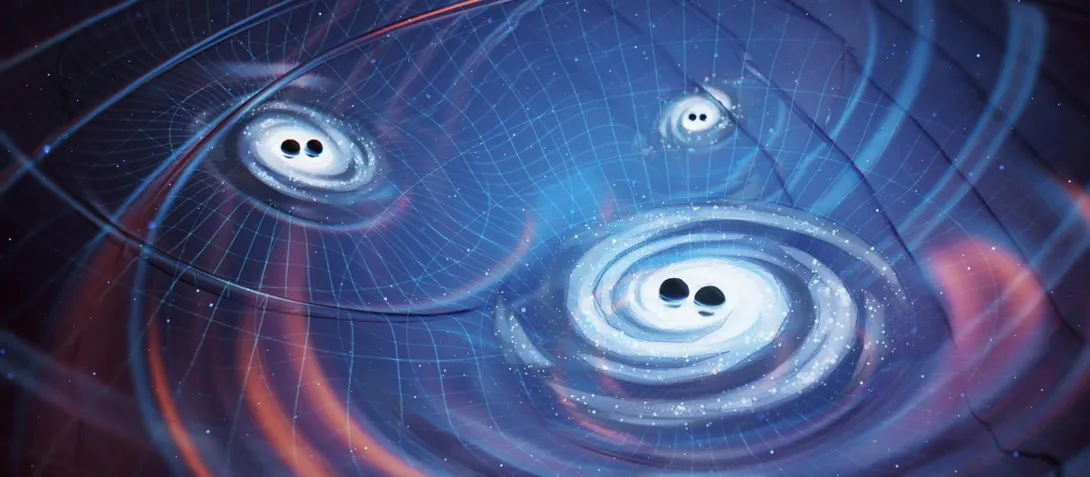
In a groundbreaking discovery, astronomers have used pulsars—ultra-dense, rapidly spinning remnants of dead stars—to detect the subtle ripples of low-frequency gravitational waves coursing through space-time. These waves, predicted by Albert Einstein more than a century ago, are believed to originate from colossal cosmic events, such as collisions between supermassive black holes. By analyzing decades of pulsar timing data from global observatories, researchers have identified a faint but consistent signal suggesting a “gravitational wave background” permeating the universe. The finding marks a new era in astrophysics, offering scientists an unprecedented window into the evolution of galaxies and the large-scale structure of the cosmos.
A Breakthrough in Astrophysics
For decades, scientists have sought to detect gravitational waves—minute distortions in the fabric of space-time—using a variety of techniques. While high-frequency gravitational waves from black hole mergers were first observed by LIGO in 2015, this latest discovery targets low-frequency waves that cannot be detected by ground-based instruments.
Researchers turned to pulsars—rotating neutron stars that emit beams of radio waves at incredibly regular intervals—to act as cosmic “clocks.” By monitoring how these pulses reach Earth, astronomers can detect minute variations caused by gravitational waves stretching or compressing the space between the pulsars and our planet.
This new detection was made possible through the collaborative efforts of the North American Nanohertz Observatory for Gravitational Waves (NANOGrav) and similar consortia in Europe, Australia, India, and China. Together, their findings point toward the existence of a gravitational wave background—essentially, a cosmic symphony created by the collective hum of countless supermassive black hole mergers across the universe.
The Role of Pulsars: Nature’s Precision Instruments
Pulsars are among the universe’s most reliable natural timekeepers. Formed from the collapsed cores of massive stars, they spin hundreds of times per second, emitting regular bursts of radio energy detectable by powerful telescopes. Because of their clock-like precision, even the slightest deviation in their pulse arrival time can reveal the influence of an external force—such as gravitational waves passing through space-time.
By studying over 60 millisecond pulsars spread across the sky, scientists noticed correlated timing fluctuations that couldn’t be attributed to noise or local interference. These synchronized irregularities are precisely what would be expected if gravitational waves were distorting space itself across galactic scales.
Implications: A New Window into the Universe
The detection of low-frequency gravitational waves has far-reaching implications for astrophysics and cosmology. Unlike the short, high-frequency waves produced by stellar-mass black holes, these slower ripples are thought to arise from supermassive black holes, each billions of times the mass of the Sun, merging in the centers of distant galaxies.
Such events are fundamental to understanding how galaxies grow and evolve. The new findings also provide indirect evidence supporting models of galaxy formation that predict frequent mergers throughout cosmic history. Moreover, mapping this gravitational wave background could help scientists test general relativity in extreme conditions, potentially revealing physics beyond Einstein’s equations.
According to astrophysicists, continuous monitoring of pulsars may one day allow them to pinpoint individual sources of gravitational waves, effectively enabling a new branch of gravitational wave astronomy.
Global Collaboration and Technological Achievement
This discovery represents one of the most significant global collaborations in modern astronomy. The combined efforts of international pulsar timing arrays—spanning data collected over 15 to 20 years—allowed researchers to refine their measurements with unprecedented precision.
The Indian Pulsar Timing Array (InPTA), for instance, contributed valuable data from the Giant Metrewave Radio Telescope near Pune, adding critical coverage from the southern hemisphere. Advances in computational modeling and signal processing were essential to filter out background noise and confirm the consistency of the observed signal.
The Road Ahead
While the evidence for a gravitational wave background is strong, scientists emphasize that further data are required to confirm its exact origin. Future studies will focus on expanding the pulsar network and improving sensitivity to capture even fainter signals.
The upcoming Square Kilometre Array (SKA)—a massive international radio telescope project—promises to revolutionize this field by detecting more pulsars and refining timing accuracy to within nanoseconds. With these tools, researchers hope to directly observe the cosmic mergers responsible for the low-frequency hum now detected across the universe.
Conclusion: A New Era of Cosmic Listening
The use of pulsars to detect gravitational waves marks a defining moment in humanity’s exploration of the cosmos. For the first time, scientists have begun to “listen” to the universe on the grandest possible scale—tuning in to the echoes of black holes colliding billions of years ago.
This discovery not only validates a crucial aspect of Einstein’s general relativity but also ushers in a transformative era of astrophysics—one in which space-time itself becomes an observable landscape. As researchers continue to decode these interstellar vibrations, our understanding of the universe’s origin, structure, and destiny stands on the brink of profound expansion.
Comments