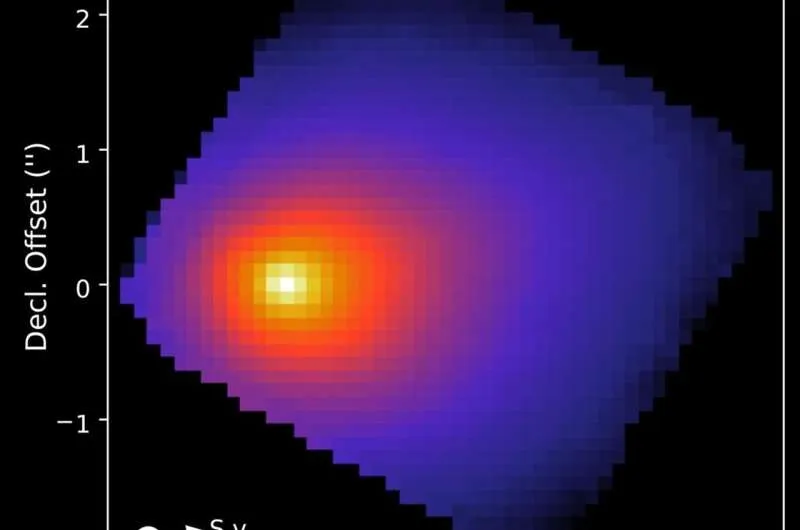
Astronomers have turned their telescopes toward interstellar comet 3I/ATLAS, a rare celestial visitor from beyond our solar system, offering unprecedented insight into the building blocks of other star systems. Traveling at extraordinary velocities, the comet provides a unique opportunity to study material formed around distant stars, potentially shedding light on the origins of planetary systems. Observations have revealed its composition, trajectory, and outgassing behavior, allowing researchers to compare it with native solar system comets. Scientists emphasize that such interstellar objects serve as natural probes, bridging the gap between observational astronomy, cosmochemistry, and models of planetary formation, expanding our understanding of the universe’s diversity.
Discovery and Trajectory
3I/ATLAS, first detected in late 2025, immediately captured the attention of astronomers worldwide due to its hyperbolic trajectory, confirming its interstellar origin. Traveling at over 100,000 km/h, it passed within observational range of Earth, allowing detailed study using both ground-based and space-borne telescopes.
Experts note that its hyperbolic path differentiates it from comets bound to the solar system, emphasizing the rarity of such opportunities to study material from other star systems.
Composition and Observational Insights
Spectroscopic analysis has revealed that 3I/ATLAS contains water ice, silicates, and complex organic molecules, mirroring some characteristics of comets in the Milky Way. However, subtle differences in isotopic ratios suggest formation under conditions unlike those found in our solar neighborhood.
Dr. Raghav Menon, an astrophysicist at the Indian Institute of Space Science, explains, “Studying interstellar comets allows us to directly sample the chemistry of distant planetary systems. This can inform our understanding of how planets and organic material form across the galaxy.”
Implications for Planetary Science
The comet’s behavior, including its tail formation and volatile release, provides data critical for modeling cometary dynamics in varied stellar environments. Researchers can use these observations to test existing theories of solar system formation and extend them to exoplanetary systems.
Interstellar objects like 3I/ATLAS also offer clues about how material is exchanged between star systems, influencing the distribution of water, organics, and dust across galaxies.
Global Scientific Collaboration
The study of 3I/ATLAS represents a coordinated effort among international space agencies, observatories, and academic institutions. Utilizing telescopes in multiple wavelengths, from visible light to radio and infrared, scientists have constructed a comprehensive profile of the comet’s composition and trajectory.
This collaboration underscores the importance of rapid-response astronomy in capturing transient interstellar phenomena, enabling detailed scientific analysis before such objects exit observational range.
Looking Ahead: Future Opportunities
The successful study of 3I/ATLAS sets the stage for future interstellar comet observations. Researchers are now developing strategies for rapid detection, tracking, and potential spacecraft missions to intercept similar objects in the coming decades.
By combining observational astronomy, laboratory spectroscopy, and computational modeling, scientists aim to deepen our understanding of the chemical diversity of the galaxy, offering a broader perspective on planetary system formation and the potential for life beyond Earth.
Comments