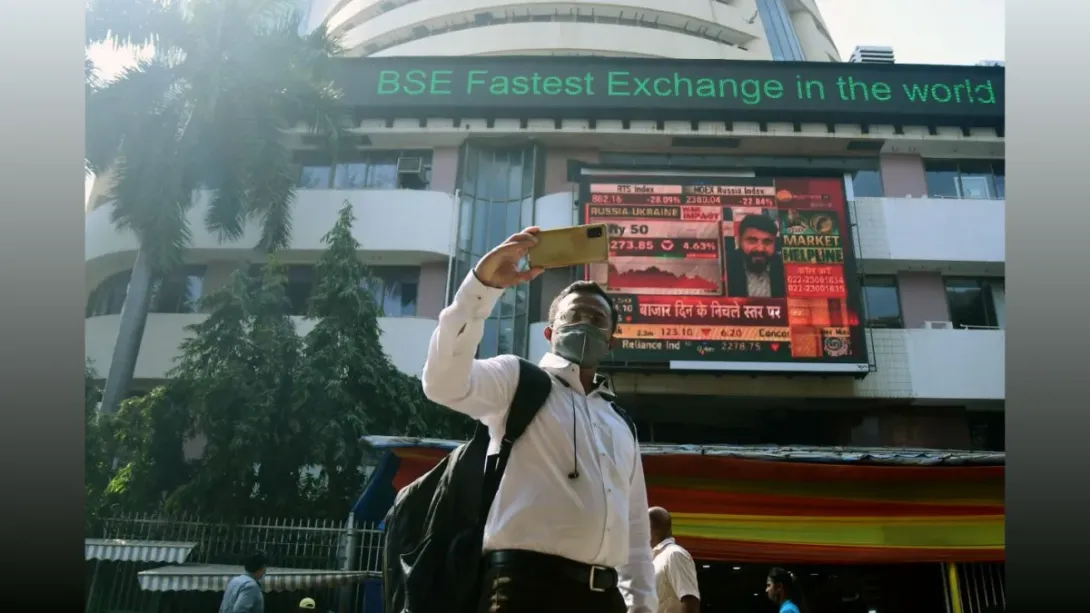
The Indian stock market witnessed a sharp sell-off on Thursday as persistent foreign outflows and renewed uncertainty over the U.S. Federal Reserve’s interest rate path rattled investor sentiment. The BSE Sensex fell over 600 points, while the Nifty 50 slipped below the 21,600 mark, marking one of the steepest declines in recent sessions. Concerns over prolonged global monetary tightening, a strengthening U.S. dollar, and elevated U.S. Treasury yields weighed heavily on risk appetite. Domestic investors remained cautious ahead of corporate earnings and key macroeconomic data, while foreign institutional investors (FIIs) continued their selling spree, further pressuring equities.
Foreign Selling Triggers Broad-Based Decline
Foreign institutional investors offloaded Indian equities worth over Rs. 2,000 crore, extending their selling streak amid global risk aversion. The exodus of foreign capital, driven by expectations that the Federal Reserve may delay rate cuts, pushed benchmark indices into negative territory for a third consecutive session.
Market analysts attributed the sell-off to global uncertainty, with rising yields on U.S. bonds prompting investors to shift capital toward safer assets. “The combination of firm U.S. yields and a resilient dollar is making emerging markets less attractive in the near term,” said a senior fund manager at a Mumbai-based investment firm.
Domestic institutional investors (DIIs), however, offered limited support by absorbing part of the FII outflow, though their buying was insufficient to prevent a broad-based market decline.
Sectoral Losses Led by IT, Banks, and Metals
Selling pressure was widespread across sectors, with information technology, banking, and metal stocks witnessing significant losses. The Nifty IT index dropped over 2% as global recession fears resurfaced, while banking heavyweights such as HDFC Bank, ICICI Bank, and Axis Bank slipped amid concerns over margin compression and sluggish credit growth.
Metal stocks also came under pressure following a decline in global commodity prices and weakness in Chinese demand. Meanwhile, auto and pharma sectors showed relative resilience, cushioning the broader market fall.
Mid- and small-cap stocks, which had outperformed in recent weeks, also succumbed to selling pressure, reflecting a general risk-off mood across the market.
Fed Policy Uncertainty Keeps Markets on Edge
Investors worldwide are grappling with mixed signals from the U.S. Federal Reserve. While inflation data has shown gradual moderation, Fed officials have maintained a cautious tone, suggesting that interest rates may remain elevated for an extended period to ensure price stability.
This uncertainty has caused significant volatility in global equity markets, with emerging markets like India bearing the brunt of shifting capital flows. The U.S. 10-year Treasury yield, hovering near 4.7%, has reinforced the dollar’s strength, exerting downward pressure on the Indian rupee, which weakened to around Rs. 88.70 per dollar in intraday trade.
Experts believe that sustained foreign selling could continue until there is clarity on the Fed’s policy outlook or a visible decline in global yields.
Domestic Factors Add to Market Nervousness
On the domestic front, caution ahead of key earnings announcements and macroeconomic data further dampened investor confidence. Market participants are closely monitoring upcoming GDP growth figures, manufacturing PMI, and fiscal deficit data, which will provide cues on the health of the Indian economy.
In addition, concerns over elevated valuations in several large-cap and mid-cap stocks have triggered profit-taking. The volatility index (VIX) rose sharply, signaling heightened short-term uncertainty among traders.
“Valuations are still rich, and any global shock—like a delayed rate cut or geopolitical tension—can lead to sharper corrections,” noted an equity strategist at a leading brokerage firm.
Analyst View: Correction or Opportunity?
Despite the downturn, analysts maintain a constructive long-term view on Indian equities, citing robust economic fundamentals, resilient corporate earnings, and strong domestic liquidity. However, they warn that short-term volatility could persist as global markets adjust to shifting interest rate expectations.
“Investors should brace for near-term turbulence but use market corrections as an opportunity to accumulate quality stocks, especially in sectors like capital goods, consumption, and infrastructure,” said an analyst at Kotak Securities.
Market experts also expect that once global yields stabilize and the Fed’s policy stance becomes clearer, foreign capital inflows could resume, providing renewed momentum to Indian markets.
Conclusion
The recent decline in the Sensex and Nifty underscores the growing tension between India’s domestic resilience and global macroeconomic headwinds. With foreign investors trimming exposure and the Fed maintaining a hawkish bias, volatility may persist in the coming weeks.
Comments