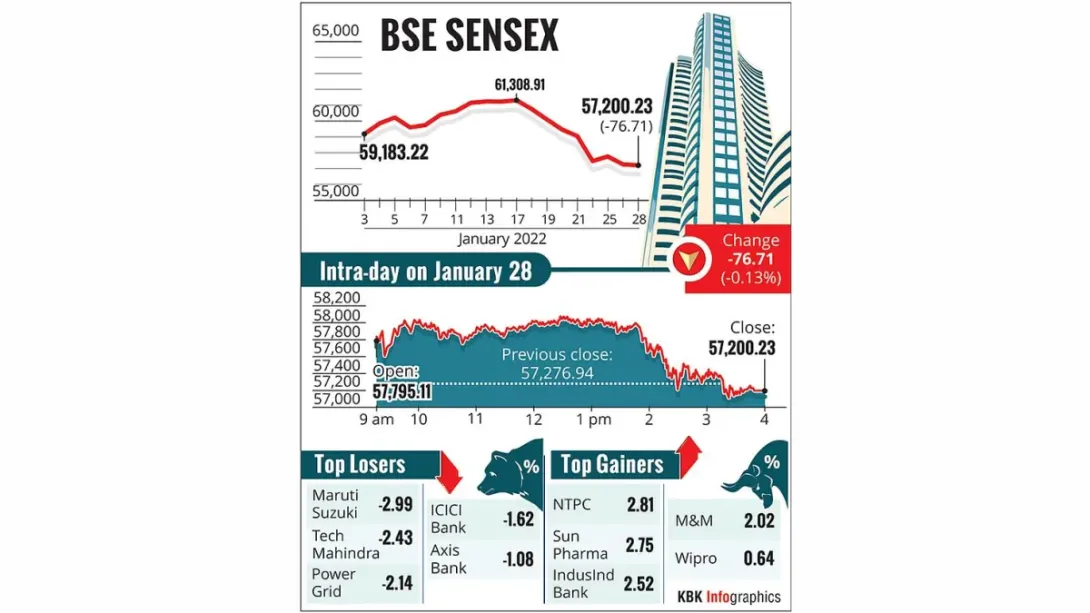
In a sharp retreat driven by heightened global risk aversion, the BSE Sensex plunged 586 points on Thursday, reflecting deep unease across global equity markets. Concerns over persistent inflation, rising bond yields, and cautious central bank signals from advanced economies spooked investors, triggering widespread selling across sectors. The NSE Nifty also declined sharply, slipping below critical technical levels. Heavy losses in financial, technology, and energy stocks amplified the market correction. With foreign institutional investors accelerating outflows, the volatility index surged, highlighting nervous sentiment. Analysts caution that near-term headwinds may persist unless global macroeconomic signals stabilize and domestic earnings revive.
Global Jitters Ripple Through Indian Markets
Global equities have entered a turbulent phase, and Indian markets are feeling the full impact. The Sensex nosedived 586.15 points, or 0.80%, to close at 73,128.77, while the Nifty50 slipped 167.90 points, or 0.76%, settling at 22,032.30. The decline marked one of the worst single-day performances in over a month.
Investor unease intensified after signs of sticky inflation in the U.S. and Europe reignited fears of delayed interest rate cuts. Coupled with weak manufacturing data from China and geopolitical uncertainties, the risk-off sentiment sent shockwaves through both developed and emerging markets.
Sectoral Impact: Broad-Based Declines Grip the Market
The market witnessed a broad-based sell-off, with banking, IT, FMCG, and energy stocks bearing the brunt. The Nifty Bank index fell by over 1.5%, weighed down by ICICI Bank, HDFC Bank, and Kotak Mahindra Bank, as rising global yields made borrowing more expensive and capital outflows more likely.
In the technology space, frontline stocks such as Infosys, TCS, and Tech Mahindra declined amid concerns that a slowdown in developed markets would hurt order pipelines and billing growth. The Nifty IT index closed down over 1.2%, reflecting reduced appetite for high-valuation sectors.
FII Selling Intensifies as Bond Yields Climb
Foreign institutional investors (FIIs) have been offloading Indian equities amid growing yield attractiveness in developed markets. Preliminary exchange data showed that FIIs were net sellers to the tune of over Rs. 2,800 crore in Thursday’s session alone.
The yield on the 10-year U.S. Treasury note climbed to multi-month highs, making it a more compelling alternative to risk assets. This shift in capital preference is further exacerbated by uncertainty around the timing of the U.S. Federal Reserve’s first interest rate cut, which now seems more likely to be delayed into late 2025.
India VIX Surges as Uncertainty Prevails
The India VIX, a key indicator of market volatility, jumped over 7%, signaling that traders are bracing for continued choppiness. The uptick reflects growing unease about macroeconomic developments, earnings uncertainty, and global liquidity conditions.
Technical analysts noted that the Nifty has breached key support at 22,100, opening the door to further declines. Unless the index reclaims the 22,300–22,400 range in the coming sessions, sentiment may continue to deteriorate.
Outlook: Uncertainty to Dominate in Near Term
With global macro headwinds mounting and domestic earnings yet to deliver meaningful upside surprises, market watchers expect volatility to remain elevated. Investors are advised to adopt a cautious stance, favoring high-quality, low-leverage stocks with resilient balance sheets.
While India’s long-term structural growth story remains intact, the immediate outlook is clouded by global financial tightening, tepid corporate earnings, and cautious FII behavior. Any signs of stabilization in global data or dovish policy commentary could offer respite to the current correction.
Conclusion:
The Sensex’s 586-point fall is more than a one-off correction—it is a signal of deeper anxieties gripping the markets. As global monetary tightening, yield dynamics, and economic uncertainties converge, Indian equities are likely to stay volatile. Investors and policymakers alike will be closely monitoring global cues, as the next few weeks could be pivotal in determining market direction. Patience, discipline, and selective exposure may prove to be the best strategies amid this storm.
Comments