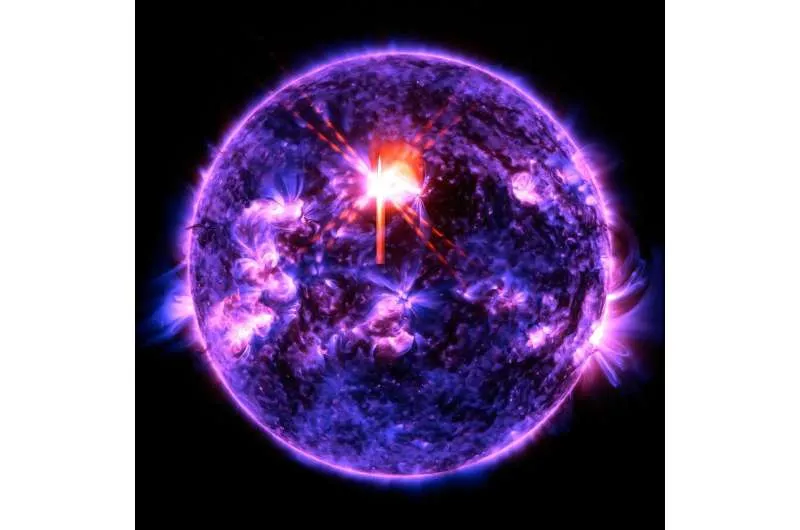
In early February, the Sun emitted a series of intense X-class solar flares, the most powerful category of solar eruptions, prompting heightened monitoring by space agencies and astrophysicists. These flares, capable of disrupting satellite communications, GPS navigation, and power grids on Earth, also produced spectacular auroral displays near polar regions. Scientists are studying the flares’ timing, intensity, and associated coronal mass ejections (CMEs) to predict potential geomagnetic storms. The events highlight the dynamic and sometimes volatile nature of solar activity, emphasizing the need for robust space weather forecasting, protective infrastructure, and international coordination to mitigate impacts on technology-dependent systems.
Understanding X-Class Solar Flares
X-class flares represent the strongest solar eruptions, releasing immense energy equivalent to millions of hydrogen bombs in minutes. These flares can accelerate charged particles toward Earth, potentially causing geomagnetic disturbances that interfere with electronic systems.
Astrophysicists emphasize that monitoring solar flares in real time is crucial to safeguarding satellites, spacecraft, and critical terrestrial infrastructure from potential disruptions.
Observations and Impacts
The early February X-class flares were accompanied by CMEs, massive clouds of charged particles ejected into space. Space weather agencies reported heightened geomagnetic activity, with auroras observed at unusually low latitudes.
Analysts note that while most Earth-based effects are manageable, vulnerable technologies such as high-frequency radio communications, GPS systems, and power transmission lines may experience temporary anomalies.
Scientific Significance
These flares provide a unique opportunity for solar scientists to study magnetic reconnection, particle acceleration, and the Sun’s coronal dynamics. Understanding flare behavior aids in refining predictive models of solar activity cycles, which is critical for both space exploration and Earth-based technological resilience.
Researchers are also examining how these energetic events influence the upper atmosphere, ionosphere, and radiation environment, enhancing knowledge of Earth-Sun interactions.
Preparedness and Forecasting
Space agencies, including NASA and NOAA, are issuing continuous space weather alerts, enabling satellite operators, airlines, and power grid managers to implement protective measures. Advanced modeling helps predict CME arrival times and geomagnetic storm intensity, reducing potential economic and operational disruptions.
Experts advise ongoing investment in satellite hardening, resilient communication systems, and global coordination to minimize vulnerabilities to solar storms.
Outlook: Ongoing Solar Activity
The Sun’s activity, which follows approximately an 11-year solar cycle, is expected to increase over the coming years, potentially producing more frequent and intense flares. Continuous monitoring, research, and international collaboration will be vital in understanding these phenomena, protecting technology, and advancing space weather preparedness.
This early February event underscores the need to respect the Sun’s power while harnessing scientific insight to mitigate risks and maximize observational opportunities for both research and public engagement.
Comments