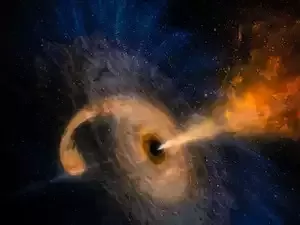
In a captivating astronomical event, a supermassive black hole shredded a star during a collision of two galaxies, offering scientists a rare look at the immense forces at play in the universe. The tidal disruption event (TDE), dubbed AT 2022wtn, unfolded roughly 700 million light-years away in the merging galaxy pair SDSSJ232323.79+104107.7. This is only the second time a TDE has been observed within interacting galaxies, making it a landmark discovery. The event provided an unprecedented opportunity for astronomers to investigate how these cosmic behemoths feed and influence their environments.
A Cosmic Catastrophe Unfolds
Astronomers have long theorized about the dramatic processes surrounding black holes, but direct observations of such events remain exceedingly rare. In the recent TDE, designated AT 2022wtn, a low-mass star was torn apart in a spectacular display of gravitational might. The event occurred in a smaller galaxy caught in the gravitational embrace of a much larger neighbor, marking an early stage of a galactic merger.
This merger, astronomers believe, stirred the pot—destabilizing the smaller galaxy and ultimately pushing the unfortunate star into the clutches of the black hole. As the star approached this cosmic predator, it was subjected to an extreme gravitational gradient, resulting in a process ominously known as “spaghettification.” The star was stretched and compressed into elongated streams of matter, which either fell into the black hole or were ejected into interstellar space as high-speed jets.
An Unprecedented Observation
The event was first detected by the Zwicky Transient Facility (ZTF), an automated observatory designed to catch fleeting cosmic phenomena. Once identified, the event triggered a flurry of observations across the globe. Scientists trained instruments to capture emissions spanning the electromagnetic spectrum—from radio waves to X-rays—painting a comprehensive picture of the unfolding cataclysm.
The central black hole responsible for this event is estimated to have a mass nearly a million times that of our Sun. Remarkably, the brilliance of the event outshone the galaxy itself for a brief period, signaling the release of an extraordinary amount of energy as the star met its demise.
A Unique Signature in the Void
What distinguishes AT 2022wtn from similar occurrences is its light curve, which remained at maximum luminosity for about 30 days—a comparatively extended duration for TDEs. Francesca Onori of Italy’s National Institute for Astrophysics highlighted the “peculiar” nature of this event. In addition to the prolonged brightness, astronomers noted the emergence of spectral lines associated with helium and nitrogen, hinting at complex chemical activity in the debris.
These observations suggest the rapid formation of an accretion disk around the black hole—a spinning disk of gas and dust formed from the star’s remains. Such disks serve as transient laboratories for studying the interplay of gravity, magnetism, and nuclear processes in the extreme environments of black holes.
The Anatomy of Stellar Destruction
Spaghettification is more than a vivid term—it represents the dramatic end of a star’s life when it ventures too close to a black hole’s event horizon. The immense tidal forces stretch the star into thin, elongated strands, ultimately transforming it into a swirling disk of plasma.
In this instance, the resulting disk didn’t just serve as a temporary halo of light; it also gave birth to fierce outflows of material. Observatories detected a fleeting surge of radio waves, a sign that some of the star’s material was ejected as jets traveling at astonishing speeds—further evidence of the violent aftermath of this cosmic meal.
Implications for Black Hole and Galaxy Evolution
The rarity of witnessing a TDE within merging galaxies adds profound significance to AT 2022wtn. While galactic mergers are not uncommon, observing such a dramatic event in their midst offers invaluable data for astronomers seeking to understand the role of black holes in galactic evolution.
This discovery reinforces the view that black holes are not passive inhabitants of their host galaxies; they can actively shape the fate of their cosmic neighborhoods. By unraveling the processes at play in AT 2022wtn, scientists hope to shed light on the complex dynamics of these powerful celestial engines.
Conclusion: A Glimpse into the Violent Ballet of the Cosmos
The cataclysmic end of a star in AT 2022wtn underscores the grandeur and violence inherent in the universe’s largest-scale events. Each observation deepens our grasp of the cosmic order—revealing how black holes grow, feed, and influence the galaxies that cradle them. As scientists continue to sift through the data from this extraordinary event, the insights gleaned will shape our understanding of the interplay between galaxies and their most enigmatic denizens: supermassive black holes.
Comments